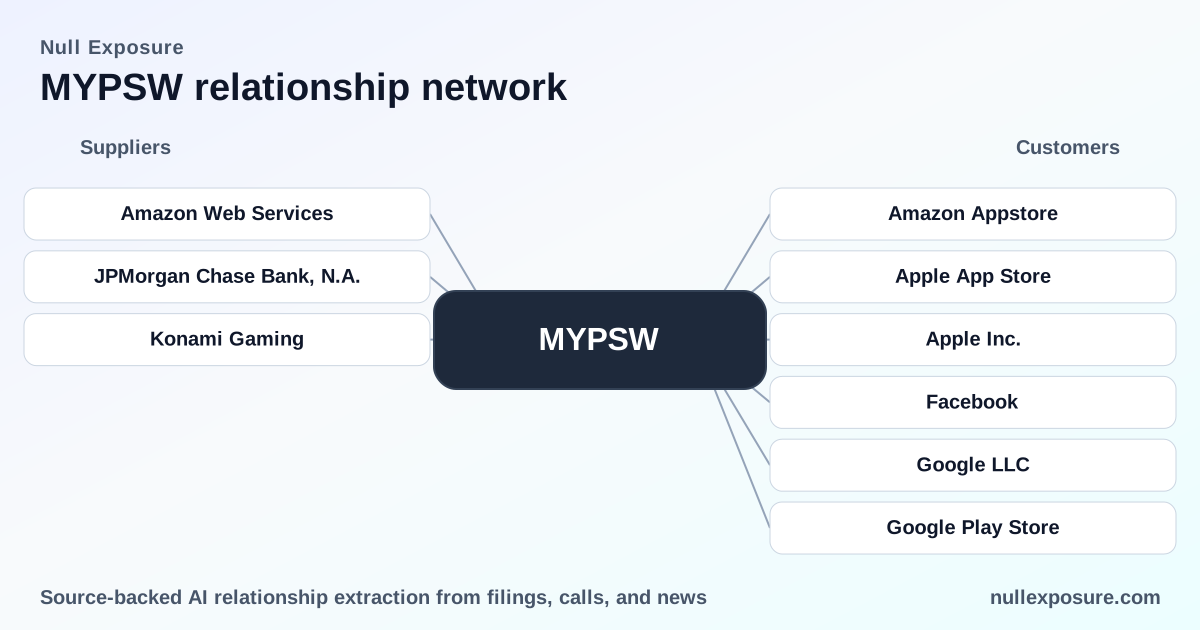
MYPSW supplier footprint: what investors need to know
MYPSW builds and monetizes mobile and social games by licensing well-known brands, distributing titles through major app and social platforms, and operating live services that generate in‑game revenue and platform revenue shares. The company relies on third‑party hosting and payment channels to deliver real‑time gameplay, uses licensed intellectual property to drive player acquisition and engagement, and funds operations with a revolving credit facility—each of which creates concentrated supplier and counterparty exposure that directly affects cash flow stability and operating leverage. For a quick view of the supplier map and implications, visit https://nullexposure.com/.
The short operating thesis for suppliers and monetization
MYPSW’s revenue model combines direct in‑game monetization with revenue shares to platform distributors and value capture from licensed IP. The company routinely pays usage‑based fees or shares a portion of in‑game sales with platform providers while outsourcing hosting, payment processing, and occasional game development to third parties. That structure produces two core dynamics for investors: (1) variable cost pressure tied to platform economics and payment fees, and (2) operational concentration risk tied to cloud and payment providers that support live gameplay.
How suppliers show up in the filings and what that implies
The FY2024 10‑K makes clear that MYPSW treats suppliers across several roles: licensing partners, platform distributors, and service providers that manage hosting, payments, and development capacity. The filing also signals two recurring contract types—licensing and usage‑based revenue sharing—that push costs into the variable line and complicate margin forecasting. Contracting posture is mixed: licenses create fixed intellectual property obligations and branding dependency, while usage‑based arrangements shift cost volatility to the revenue line. Concentration is material where a small number of platform or cloud providers underpin service delivery; maturity varies by relationship type, with long‑standing IP licenses coexisting alongside standard, renewable cloud and processing agreements.
- Contracting posture: combination of multi‑year IP licenses and ongoing usage‑based revenue shares.
- Concentration: hosting and platform distribution concentrate operational risk.
- Criticality: hosting and payment processors are mission‑critical to uptime and payment flows.
- Maturity: IP licenses can be long dated and strategic; service contracts are operational and renewable.
Supplier relationships disclosed in the FY2024 10‑K
MYPSW lists a short but strategically important supplier set. Each relationship below is summarized in plain English with the primary source.
Amazon Web Services
MYPSW hosts a significant portion of its game traffic on Amazon Web Services, so any disruption in AWS hosting or cloud services would directly affect game availability and operations. According to the company’s FY2024 Form 10‑K, a “significant portion” of game traffic is hosted by AWS, highlighting a concentrated hosting dependency (FY2024 10‑K).
JPMorgan Chase Bank, N.A.
MYPSW replaced its prior revolver with a five‑year revolving credit facility providing up to $75.0 million, with JPMorgan Chase Bank, N.A. serving as administrative agent and a lead arranger. The FY2024 10‑K documents the June 24, 2021 credit agreement tied to the Acies Merger and shows bank financing as a key element of liquidity and leverage management (FY2024 10‑K).
Konami Gaming
MYPSW uses licensed intellectual property from Konami Gaming in its games and marketing, making Konami a content licensor whose IP supports player acquisition and title differentiation. The FY2024 10‑K explicitly names Konami Gaming among third‑party licensors used for games and promotional activities (FY2024 10‑K).
What the constraints reveal about business model risk
The extracted constraints in the filing translate into practical business signals for investors rather than abstract labels. At the company level, filings emphasize licensing as a strategic growth lever (securing exclusive mobile rights for major brands), and they confirm usage‑based economics where MYPSW shares a portion of in‑game revenue with platform distributors. The firm also repeatedly identifies third parties as service providers for hosting, payments, and outsourced development.
- Licensing and licensee dynamics: IP deals drive growth and differentiation but create renewal and royalty risk that can meaningfully affect margins when major titles (for example, Tetris) are core drivers of engagement.
- Usage‑based economics: revenue shares with app stores and social platforms make gross margins sensitive to platform fee changes and player spending patterns.
- Service provider dependence: cloud hosting and payment processors are operationally critical and create concentration risk that can translate to episode‑level outages or higher unit costs.
Practical investor implications and near‑term watch list
Investors should treat supplier disclosures as forward‑looking operational levers. The combination of IP licensing, platform revenue shares, and concentrated hosting means margin volatility and downtime risk are the principal supplier‑related value levers.
- Monitor cloud provider performance and any multi‑cloud mitigation the company communicates; uptime and latency directly map to revenue.
- Track platform commission rates and product placements in app stores for evidence of shifting usage‑based economics.
- Watch credit facility covenants and maturity profile tied to the $75m revolver—liquidity events can compress optionality for renegotiating supplier terms.
For deeper supplier analytics in investment due diligence, see https://nullexposure.com/ for enterprise‑grade summaries and relationship impact mapping.
How operators should manage supplier exposure
Operators should prioritize negotiating flexibility into licensing agreements (termination triggers, exclusivity scope) and diversify hosting to reduce single‑provider outage risk. Manageable actions include:
- Securing multi‑region or multi‑provider hosting fallbacks to reduce AWS concentration risk.
- Rebalancing contractual terms with platform distributors when possible to lower variable cost pressure.
- Aligning bank covenant transparency with supplier risk mitigation plans to preserve borrowing capacity under stress.
Final takeaways and next steps
MYPSW runs a hybrid model: licensed IP plus platform distribution and hosted live services. That mix creates strong revenue upside when hits scale, but it also creates concentration and variable‑cost risk tied to cloud providers, payment processors, and platform fee structures. Review of the FY2024 10‑K shows AWS as a material hosting provider, JPMorgan as the agent on a $75m revolver, and Konami as a licensed IP partner—each relationship carries discrete operational and valuation implications (FY2024 10‑K).
If you are building a supplier risk view or performing counterparty diligence, start with the supplier map and run scenarios for hosting outages and platform fee increases; for tools and structured supplier intelligence, visit https://nullexposure.com/.
Interested in a tailored supplier risk brief for MYPSW? Explore the NullExposure homepage at https://nullexposure.com/ for engagement options and deeper analysis.