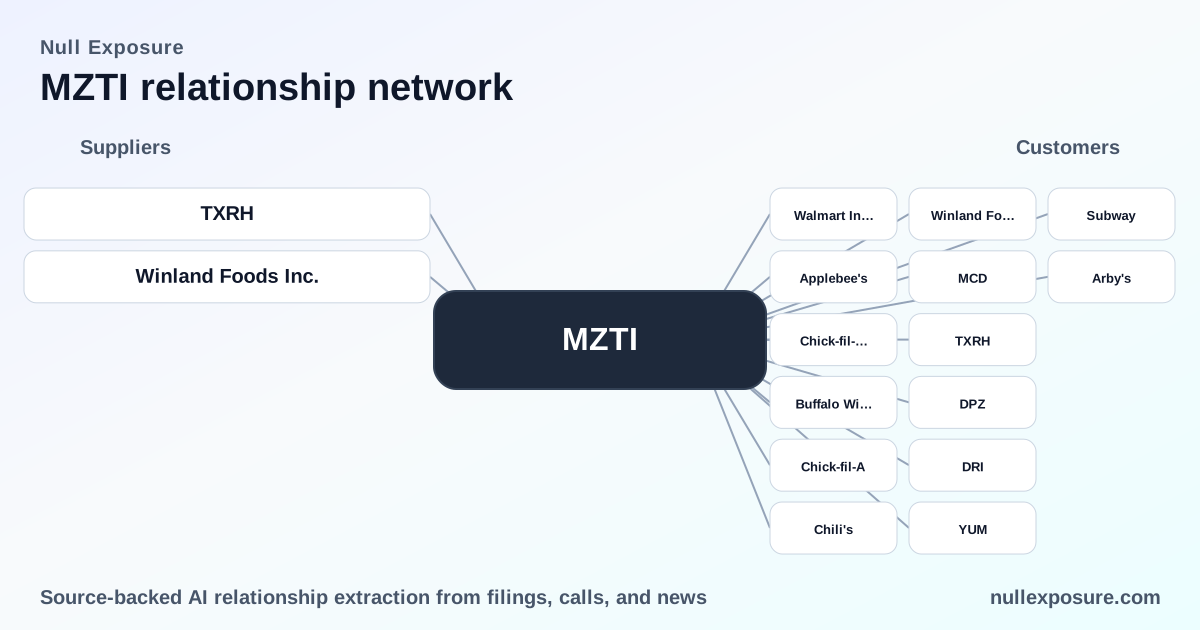
Marzetti (MZTI) — Supplier relationships and what they mean for investors
The Marzetti Company operates as a branded and private-label specialty food manufacturer, monetizing through the production and sale of sauces, dressings, frozen breads and foodservice items to retail and foodservice customers across the U.S. Marzetti’s model combines a broad manufacturing footprint with branded shelf presence and contract manufacturing for third parties; revenue comes from retail sales, foodservice contracts, and transitional contract work tied to acquisitions. Investors should view Marzetti as a cash-generative, margin-stable packaged foods operator with selective customer-led growth catalysts, rather than a high-variance, single-source supplier. For further supplier risk analytics and supplier-footprint mapping, visit https://nullexposure.com/ for in-depth supplier intelligence.
How Marzetti makes money and why supplier relationships matter
Marzetti manufactures at 14 U.S. plants and outsources certain items to third parties in the U.S., Canada and Europe, giving the company a geographically diversified production base while keeping commercial exposure primarily to North American retail and foodservice channels. The business produces revenue of roughly $1.94 billion (TTM) with an operating margin around 10.6% and EBITDA near $300 million, reflecting scale economics in packaged foods and predictable gross-profit mechanics driven by branded products and contract manufacturing. Short-term procurement contracts for raw materials—mostly purchased on the open market with some fixed-price arrangements typically one year or less—translate to a contracting posture that favors flexibility over long-term supplier lock-in, enabling the company to respond to commodity moves but increasing exposure to short-term input volatility.
Supplier relationships in the public record
The following relationships are documented in recent reporting and trade coverage. Each entry is a plain-English summary with a concise source reference.
Texas Roadhouse — foodservice partner driving frozen-bread growth
Texas Roadhouse dinner rolls, launched in fall 2024, generated more than $20 million in sales during the recently completed second quarter (FY2026), a clear demand success for Marzetti’s frozen-bread offering. A Baking Business article reported this contribution and framed it as a near-term lift to the company’s foodservice and frozen portfolio (Baking Business, March 10, 2026 — https://www.bakingbusiness.com/articles/65600-texas-roadhouse-rolls-boost-marzetti-sales).
Winland Foods Inc. — acquisition and transition-services interaction
Marzetti completed an acquisition that involved Winland Foods’ Atlanta sauce and dressing production plant; during FY2025, $10.7 million in non-core sales were recorded under a transition services agreement with Winland Foods, which the company excluded when reporting organic net sales growth. Food Business News covered the transaction and the transitional sales impact on Marzetti’s reported results (Food Business News, March 10, 2026 — https://www.foodbusinessnews.net/articles/29294-marzetti-gets-another-lift-from-frozen-bread).
Constraints and operational signals every investor should read
The public evidence delivers a compact set of operational signals that define Marzetti’s supplier posture and operational maturity:
- Contracting posture — short-term: Marzetti purchases most raw materials on the open market and maintains some fixed-price contracts generally one year or less, which provides procurement flexibility but increases exposure to commodity and price volatility.
- Geographic footprint — largely U.S. with global sourcing elements: Manufacturing is concentrated at 14 U.S. plants, with select packaging and manufacturing performed by third parties in the U.S., Canada and Europe, supporting scale and regional redundancy.
- Materiality of recent deals — immaterial at scale: The acquisition tied to Winland Foods was characterized in filings as not significant to overall financial position or operating results, signaling low balance-sheet disruption from smaller tuck-ins.
- Relationship posture — buyer and active: The company operates as an active buyer of raw materials and packaging with ongoing procurement relationships; operational language in filings indicates consistent supply adequacy during 2025.
- Maturity — established and operating at scale: Revenue near $1.95 billion with positive return metrics (ROE ~17.9%, ROA ~11.4%) indicates an established, mature operating company with stable margins.
These company-level signals show a mature packaged-food operator that prioritizes supply flexibility and operational scale over long-term supplier lock-ins. That strategy reduces capital tied to contracted inputs but concentrates risk in short-term commodity cycles and logistics.
What the relationships imply for risk, growth and valuation
The Texas Roadhouse success demonstrates Marzetti’s ability to convert branded product innovation and co-branded foodservice placements into meaningful revenue uplifts; a single successful foodservice program contributed over $20 million in one quarter, highlighting the upside from targeted product wins. Conversely, the Winland-related $10.7 million of transition services revenue in FY2025 is classified as non-core, reinforcing that smaller M&A-led revenue bumps are not core drivers of long-term top-line forecasts.
Operational implications for investors and operators:
- Revenue concentration risk: While Marzetti’s business is diversified across retail and foodservice, substantial incremental revenue from a single program (e.g., Texas Roadhouse rolls) elevates the need to monitor customer concentration and contract durability.
- Input-cost exposure: Short-term procurement contracts increase sensitivity to commodity price swings; the company’s margin resiliency depends on pass-through mechanisms, price realization, and operational cost control.
- Integration discipline: The Winland example shows Marzetti uses transition-service agreements to manage plant takeovers; such arrangements keep disruptions contained but generate temporary, non-recurring revenue that should be excluded from ongoing growth models.
- Geographic supply resilience: A U.S.-centric plant footprint with third-party production in North America and Europe reduces single-location criticality but requires robust logistics management and supplier oversight.
From a valuation standpoint, Marzetti trades at a forward EV/EBITDA near 12.9 and a trailing P/E of 22.4, consistent with a stable mid-cap packaged-food operator with low beta (0.42). The business generates dependable cash and pays a meaningful cash dividend, which supports investor return expectations while limiting aggressive reinvestment narratives.
For operator-level decisions, prioritize multi-supplier redundancy for critical inputs, harden pass-through pricing clauses in customer contracts, and treat transition-service revenues as temporary when modeling post-acquisition synergies.
If you want a tailored supplier-risk scorecard or to map Marzetti’s supplier ecosystem against peers, start with our platform at https://nullexposure.com/ — the homepage links contain the tools and service details.
Bottom line and recommended investor actions
Marzetti is a mature, cash-generative packaged-food manufacturer with a procurement stance that emphasizes flexibility and a manufacturing footprint that balances in-house scale with third-party capacity. The Texas Roadhouse relationship reveals tangible upside from targeted foodservice programs, while the Winland transition highlights conservative M&A integration practices that produce temporary revenue blips but do not materially alter the company’s financial profile.
Investors should:
- Monitor customer concentration as foodservice wins can quickly become material to quarterly results.
- Model commodity sensitivity given short-term contracting for raw materials.
- Treat transition-service revenues as non-recurring when assessing organic growth.
For deeper supplier-by-supplier analysis and to see how Marzetti’s relationships compare across the packaged-foods sector, visit our research center at https://nullexposure.com/.