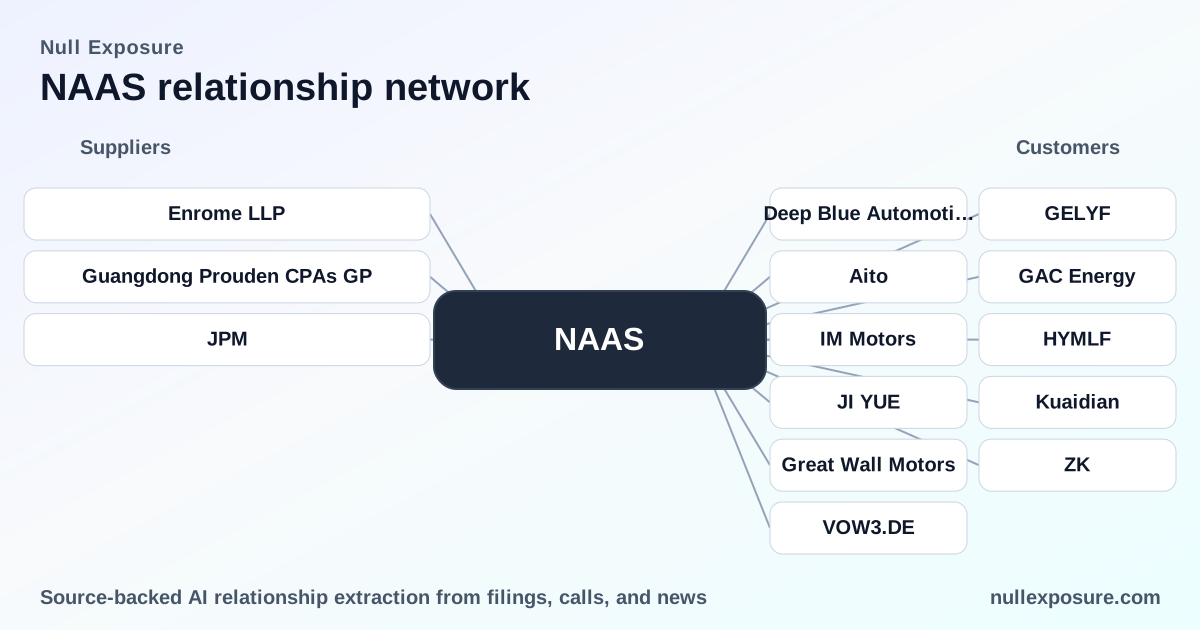
Naas Technology (NAAS) — supplier relationships and operational implications
Naas Technology builds and sells digital mobility solutions for urban transportation providers, monetizing through software platforms, data analytics, hardware integrations, and related services to cities and private mobility operators. The company runs a capital-intensive growth model — material revenue but negative EBITDA and stretched margins — that makes supplier and service-provider relationships (especially auditors and depositary banks) operationally and reputationally important for investors. Learn more about supplier exposure and governance signals at https://nullexposure.com/.
A compact read for investors: what this network says about risk and execution
Naas’s public filings and press releases show two discrete supplier categories that matter now: its independent auditors and the depositary bank for its ADS program. Auditor turnover is a governance event with potential accounting and execution implications; the depositary relationship is a routine but necessary conduit for ADS holders. Given Naas’s negative profitability and low institutional ownership, these relationships carry outsized signaling value for investors.
The full list of supplier relationships in the record (each summarized)
-
Enrome LLP
Enrome LLP resigned as Naas’s independent registered public accounting firm, and the board and audit committee accepted that resignation in early February 2026. This change was disclosed in a company press release and flagged publicly as part of the year-end audit transition. (The Globe and Mail press release, February 5, 2026.) -
Guangdong Prouden CPAs GP
Guangdong Prouden CPAs GP was appointed to audit Naas’s consolidated financial statements for the year ending December 31, 2025, effective February 4, 2026, replacing Enrome LLP. The appointment was disclosed contemporaneously with Enrome’s resignation. (The Globe and Mail press release, February 5, 2026.) -
JPMorgan Chase Bank, N.A.
JPMorgan Chase Bank, N.A. serves as the depositary for Naas’s American Depositary Share (ADS) program; ADS holders were instructed to effect voting through the depositary for a special general meeting with a record date of January 2, 2026. This is the operational mechanism for ADS voting and dividend mechanics. (Yahoo Finance notice and company meeting materials, January 2026.) -
JPMorgan Chase Bank (alternate reference)
Public notices and third‑party releases refer to JPMorgan Chase Bank (the depositary) when describing ADS mechanics and shareholder record dates for the January 23, 2026 special meeting, reinforcing that JPMorgan is the standard depositary counterparty for Naas’s ADSs. (RSWebSols and The Globe and Mail press materials, January 2026.)
Why these relationships matter for valuation and governance
-
Audit partner turnover is material for investors. The replacement of Enrome LLP with Guangdong Prouden CPAs GP is not a routine vendor swap; auditor changes are governance signals that can presage restatements, changes in audit scope, or simply a board push for greater audit quality. Investors should track the first consolidated audited statements under Guangdong Prouden for differences in disclosures or emphasis. (Globe and Mail, FY2026 disclosure.)
-
ADs depositary continuity matters for liquidity and vote execution. JPMorgan’s role is administrative but critical: it’s the mechanism by which ADS holders exercise voting rights and receive distributions. Disruption or contractual disputes with the depositary would have immediate operating consequences for holders of Naas ADSs. (Company notices via Yahoo Finance and RSWebSols, January 2026.)
-
Operational and financial context increases sensitivity. Naas reports negative EBITDA and large per‑share losses, with modest market capitalization and low institutional ownership, which increases the relative importance of non‑operational suppliers (auditors, depositary banks) as governance and liquidity signals. (Company financials, latest reported period.)
Operating model constraints and company-level signals
The supplier-relationship feed contains no explicit contractual constraints or supplier-level restrictions. Presenting that as a company-level signal:
-
Contracting posture: The data shows active board oversight on governance matters (auditor replacement), implying a contracting posture that is adaptive rather than static. That is a positive governance signal for investors who value oversight on financial controls.
-
Concentration and criticality: Auditor and depositary relationships are highly critical despite being limited in count; loss or deterioration of either would be operationally significant. There is low apparent supplier concentration across other categories in this feed, but that absence is a neutral signal rather than confirmation of supplier diversification.
-
Maturity and dependency: The relationships are typical of a public ADR issuer — an established depositary bank and an external auditor — and therefore operationally mature in form. However, the recent auditor change introduces transitional risk until the new auditor completes the annual audit.
Practical investor takeaways
-
Monitor the first audited FY2025 financial statements signed by Guangdong Prouden for changes in accounting judgments or audit scope. Auditor swaps can lead to additional disclosures or restatement risk, which is particularly important for companies with negative operating margins and complex international operations.
-
Treat JPMorgan’s depositary role as infrastructure risk management, not optionality. ADS mechanics influence shareholder voting and corporate actions; confirm continuity of depositary terms when evaluating liquidity and governance scenarios.
-
Assess governance and liquidity in light of financial strain. Naas’s reported negative EBITDA, deep per-share losses, and low institutional ownership elevate the impact of governance events, so auditor changes and ADS infrastructure deserve outsized attention relative to the size of these vendors.
Explore deeper supplier and governance signals on the Naas profile at https://nullexposure.com/ to support portfolio decisions.
Recommendations for analysts and operators
- Request the audit engagement letter and any auditor‑prepared communications to the audit committee when performing due diligence; those will show the new auditor’s scope and any existing disagreements.
- Confirm the terms and mechanics of the ADS depositary agreement to understand voting cutoffs, fees, and transfer mechanics for institutional trading desks.
- Factor auditor transition and ADS operational continuity into downside scenarios given Naas’s leverage in cash flow generation and the concentrated nature of disclosed supplier relationships.
For a consolidated dashboard of supplier exposure and governance events across equities, visit https://nullexposure.com/.
Final assessment
Naas’s visible supplier footprint is small but strategically important: auditor turnover creates a near-term governance focal point, and JPMorgan’s depositary role is essential for ADS holder rights. Given the company’s financial profile, these relationships deserve active monitoring as part of valuation and event-driven risk frameworks. If you want a tailored supplier-risk briefing or a deeper audit‑quality readout for NAAS, start here: https://nullexposure.com/.