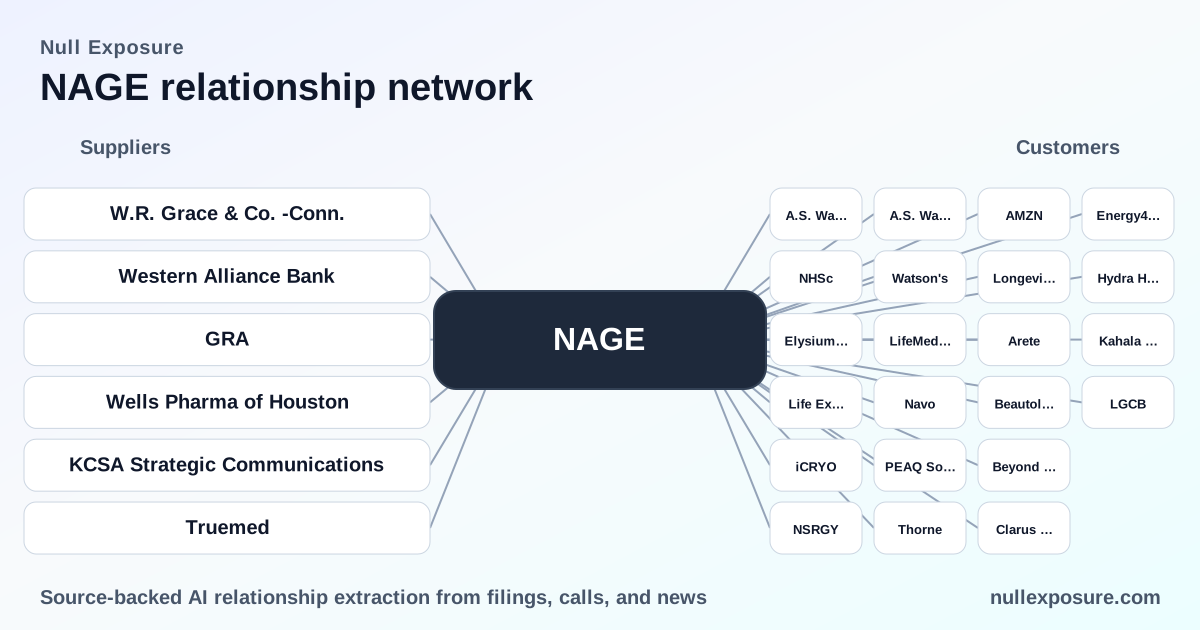
Niagen Bioscience (NAGE) — supplier relationships, concentration risk, and operational levers
Niagen Bioscience manufactures and sells Tru Niagen and related healthy-aging products by outsourcing critical manufacturing and distribution functions while retaining direct-to-consumer and B2B sales channels; the company monetizes through product sales and strategic channel partnerships, with margins dependent on a small set of manufacturing and compounding vendors and a revolving credit facility for working capital. For investors, the story is straightforward: revenue growth and margin stability hinge on a limited supplier base that is both contractually committed and operationally critical. Learn more at https://nullexposure.com/.
Executive snapshot: how the supplier map drives the investment case
Niagen is a branded nutraceutical/biopharma hybrid: product formulation, marketing, and distribution are in-house, but manufacturing and certain pharmaceutical compounding functions are outsourced to a small number of specialized partners. The balance sheet reflects that posture — modest leverage supported by a formula-based revolver — while operating metrics show high gross margins that depend on supplier continuity. Key investment lever: preserve continued access to food-grade and pharmaceutical-grade Niagen at predictable cost and volume.
The supplier roster investors must understand
W.R. Grace & Co. -Conn. (Grace)
Niagen identifies W.R. Grace as its exclusive manufacturer of food-grade NRC (the active ingredient in Tru Niagen) and relies on Grace under a long-running Manufacturing and Supply Agreement that has been amended multiple times; the 10‑K notes a Tenth Amendment effective January 1, 2025 and purchase obligations into 2025. According to the 2024 Form 10‑K, Grace is the single supplier for NRC and therefore a material counterparty whose contract renewals are strategically critical. A March 2026 BioSpace press release also confirms that Tru Niagen is manufactured in the U.S. by Grace and packaged domestically. (Niagen 2024 10‑K; BioSpace, March 2026)
Western Alliance Bank
Niagen uses a formula-based revolving credit facility provided by Western Alliance Bank to manage working capital and inventory financing; the original credit agreement was entered into on November 12, 2019 and remains the company’s primary bank financing arrangement. This lender relationship underpins short-term liquidity and the ability to fund purchase commitments to suppliers. (Niagen 2024 10‑K)
Wells Pharma of Houston
For pharmaceutical-grade Niagen destined for healthcare and compounding channels, Niagen contracts with 503B outsourcing facilities including Wells Pharma of Houston, which compounds, tests, and distributes product under USP and FDA-referenced controls. This relationship supports the company’s ability to address regulated pharmaceutical use cases beyond retail supplements. (Yahoo Finance press release, March 2026)
KCSA Strategic Communications
KCSA is listed as Niagen’s investor relations contact, with Valter Pinto named Managing Director; the relationship is a communications and IR engagement that supports shareholder relations and market-facing disclosure. This affects market perception and liquidity rather than manufacturing operations. (Yahoo Finance press release, March 2026)
Truemed
Niagen partnered with Truemed to enable eligible customers to purchase Tru Niagen via Health Savings Account (HSA) and Flexible Spending Account (FSA) funds on Niagen’s direct website, widening payment channels for consumers and potentially improving conversion on direct sales. This is a distribution/commerce partnership that directly supports DTC revenue. (Sahm Capital report, January 2026)
What the formal constraints reveal about the operating model
The company’s public documents and constraint signals paint a clear operating profile:
- Contracting posture: mixed but weighted to long-term commitments. The Tenth Amendment to the Grace Manufacturing Agreement (effective 1/1/2025) signals a long-term manufacturing relationship with formal purchase commitment windows, while the company also carries near-term purchase obligations ( ~$4.8 million between January and March 2025). Where the amendment explicitly names Grace, that contract is both amended and renewed rather than ad hoc.
- Concentration and criticality: high. The 10‑K explicitly states Niagen relies on a single supplier for NRC, a signal of supplier concentration that the company itself classifies as material to financial results. This elevates operational risk and makes contract terms and contingency planning investment-grade considerations.
- Maturity and spend profile: committed, mid-size spend bands. Public evidence shows near-term committed purchases of several million dollars and forecast obligations pushing into the $10–12 million range for the first half of 2025, placing supplier spend in the $1M–$100M band with concentrated exposure.
- Relationship stage and activity: active and contractually enforced. Purchase forecasts and the Tenth Amendment create an active, contract-backed supplier engagement, not a purely spot-market sourcing relationship.
- Financing posture: working-capital support via revolving credit. The Western Alliance Bank facility is the explicit financing tool Niagen uses to manage these supplier commitments and inventory timing.
These are company-level signals drawn from the filing language and supporting press coverage, and they collectively shape the firm's operational risk-reward profile.
Investment implications: risk concentration, optionality, and margin sensitivity
Niagen’s value proposition is sensitive to supplier continuity. If Grace were to renegotiate pricing or fail to extend terms on commercially acceptable conditions, Niagen’s cost of goods sold and the availability of product could change meaningfully; the 10‑K frames that as a material risk. On the positive side, the presence of 503B compounding partners such as Wells Pharma and distribution innovations like the Truemed HSA/FSA channel create adjacent optionality for segment growth and reimbursement-driven demand.
- Upside levers: scale DTC and HSA/FSA channels, diversify manufacturing if feasible, and negotiate longer-term cost certainty with Grace.
- Downside levers: supplier concentration, contract renewal risk, and single-supplier operational outages.
For a deeper supplier-risk assessment and partner scoring, professionals can use the firm’s filing references and market coverage at https://nullexposure.com/.
Final read: actionable takeaways for investors
- Primary risk is supplier concentration — W.R. Grace is the single source for food-grade NRC under a contract structure that is both long-term and carries near-term purchase obligations. (Niagen 2024 10‑K; BioSpace March 2026)
- Liquidity and procurement are synchronized through a Western Alliance revolver, reducing short-term refinancing risk but not eliminating operational supplier exposure. (Niagen 2024 10‑K)
- Commercial diversification is incremental but meaningful — pharma-grade compounding partners and payment-channel partnerships broaden addressable demand and reduce pure-retail dependence. (Yahoo Finance, March 2026; Sahm Capital, January 2026)
If you evaluate supplier risk as part of investment due diligence, Niagen is a clear case where contract terms, renewal timing, and contingency manufacturing plans should be central to valuation and scenario modeling. Explore more supplier intelligence and the underlying filings at https://nullexposure.com/.
For direct access to the source filings and press coverage used in this review, visit https://nullexposure.com/.