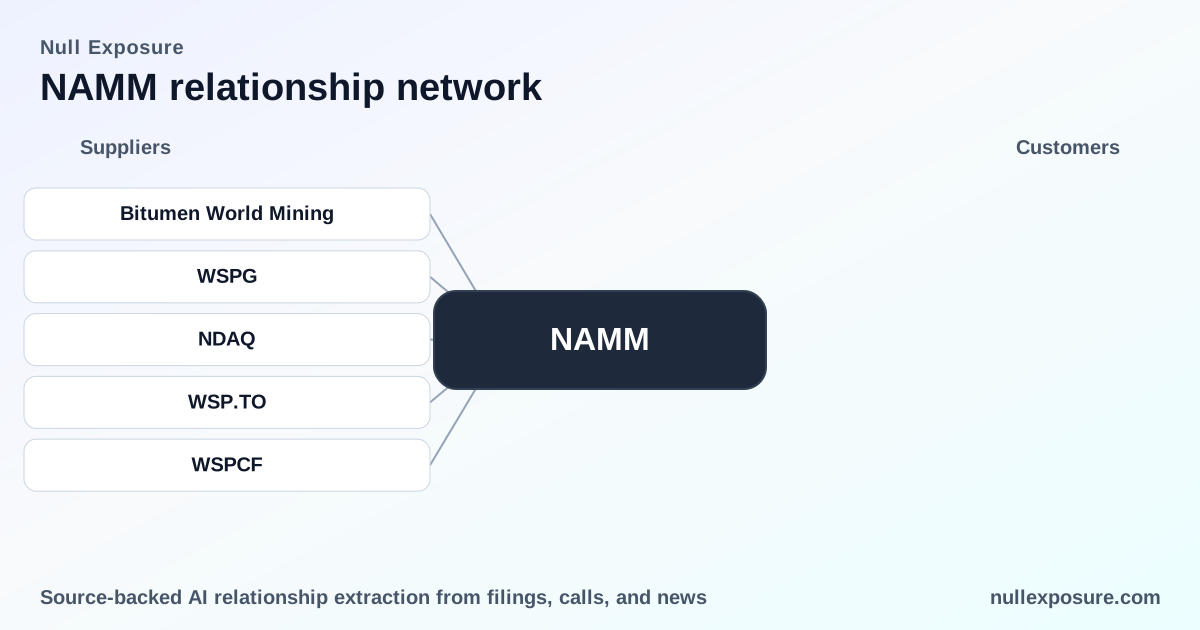
Namib Minerals (NAMM): Supplier relationships that shape near-term development value
Namib Minerals operates as an exploration and development miner focused on gold and critical green metals, monetizing through the progression of its Zimbabwe and Namibia assets toward production and by selling ore or concentrate when operational. The company funds development through market capital and third‑party contracts for technical services and mineral processing; its supplier relationships directly influence project timelines, capital intensity, and route-to-market execution. Investors should view supplier counterparty quality and contractual posture as immediate drivers of project deliverables and valuation optionality. For a concise view of supplier exposures and partner signals, visit https://nullexposure.com/.
Executive snapshot — what matters to investors
Namib Minerals is small-cap with a market capitalization around $133.7 million, trailing revenue of $80.3 million and EBITDA of $11.1 million (latest TTM). The firm reports negative EPS and thin operating margins, but has meaningful insider ownership (92% of shares) and a very small public float, which concentrates control and amplifies execution risk for outside investors. Key metrics:
- Market capitalization: $133,657,000
- Revenue TTM: $80,348,000; EBITDA: $11,106,000
- Shares outstanding: 53,677,000; shares float: 6,811,100; insiders ~92%
These figures underline concentration of governance and thin public liquidity, which are material for counterparty negotiating leverage and for assessing supplier payment risk. Learn more about supplier exposures at https://nullexposure.com/.
Supplier relationships that matter — one by one
Bitumen World Mining — processing partner for How Mine sands
Namib announced a commercial agreement with Bitumen World Mining to treat sands at its How Mine operation, reflecting a tactical route to monetization and processing capacity without immediate large capital expenditure. According to Namib’s operational update published on GlobeNewswire (November 14, 2025), the company concluded an agreement with Bitumen World Mining for the treatment of sands at How Mine.
WSP — engineering and feasibility services on Redwing and Mazowe
Namib has re-engaged WSP, the global professional services firm, to perform comprehensive feasibility studies on the Redwing and Mazowe gold assets in Zimbabwe, signaling reliance on an external technical partner to de‑risk project economics and support permitting and bankability. Multiple notices and analyst summaries in FY2025 reference the renewed collaboration with WSP for feasibility work, including Namib’s business update on GlobeNewswire (November 24, 2025) and coverage on SimplyWall.St (October/November 2025).
Nasdaq Stock Market LLC — listing compliance correspondence
The company received formal correspondence from Nasdaq confirming that Namib regained compliance with the minimum market value of publicly held shares (MVPHS) requirement under Nasdaq Listing Rule 5450(b)(2)(C), removing a regulatory overhang on the ticker. A news release reported via Bitget referenced the Nasdaq letter confirming regained compliance in FY2026.
How these relationships reveal the operating model
Namib’s supplier mix shows a contracting posture that leans on third‑party specialists rather than captive execution: feasibility and engineering are outsourced to WSP, and processing is contracted to an external miner (Bitumen World Mining) for at least one asset stream. That posture signals lower fixed capex risk up front, but greater dependency on supplier performance and contract terms to drive timelines to cash flow.
Company‑level characteristics that investors must factor into counterparty assessment:
- Concentration and control: Very high insider ownership constrains market liquidity and increases single‑party influence on supplier selection and payment priorities.
- Criticality of suppliers: WSP’s feasibility work is critical for project bankability and permitting; Bitumen World Mining’s processing role is critical for near‑term ore monetization.
- Maturity of arrangements: The relationships are in early/transactional stages (feasibility engagements and processing agreements) rather than long‑term tolling or offtake contracts, implying meaningful execution risk as studies conclude and operational handovers are tested.
- Flexibility vs. lock‑in: Outsourcing feasibility and processing creates flexibility and conserves capital but transfers schedule and technical execution risk to suppliers, making contractual terms and performance guarantees central to value capture.
No explicit supplier‑level constraints were extracted in the source material; this absence is a company‑level signal indicating there are no disclosed enduring contractual constraints recorded against supplier relationships in the available reporting.
Financial and governance implications for supplier risk
- Capital intensity and timing: Outsourced feasibility reduces immediate capital demands but pushes capital deployment decisions to later stages—when bankability outputs from WSP will determine financing terms.
- Counterparty credit and reputational risk: Supplier performance is now a leading indicator for delivery. WSP’s global standing lowers technical execution risk; Bitumen World Mining’s operational capability determines near‑term throughput.
- Liquidity and negotiation leverage: Extremely high insider ownership and a small public float reduce external investor governance influence; suppliers negotiate with an owner‑dominated counterparty that can prioritize different risk tolerances than institutional shareholders.
Practical investor implications and risk checklist
- Monitor WSP feasibility deliverables and timelines closely; completion and positive outputs materially increase financing options and valuation optionality.
- Track operational milestones tied to the Bitumen World Mining agreement for How Mine sands—processing start dates and throughput reports will support near‑term revenue recognition.
- Keep an eye on ongoing Nasdaq compliance and public float dynamics; market liquidity and regulatory status shape investor access and sentiment.
If you want a consolidated supplier risk brief or tailored counterparty map, start here: https://nullexposure.com/.
Bottom line and recommended actions
Namib’s supplier strategy emphasizes external technical validation and outsourced processing to convert resource potential into cash flow while deferring large capital expenditure. That approach reduces near‑term capex but increases dependence on supplier execution and contract terms. Investors should prioritize monitoring WSP feasibility outputs and the operationalization of the Bitumen World Mining arrangement, and factor governance concentration into any valuation model.
For a deeper supplier diligence package and tracking alerts, visit https://nullexposure.com/ and request the Namib Minerals supplier dossier.