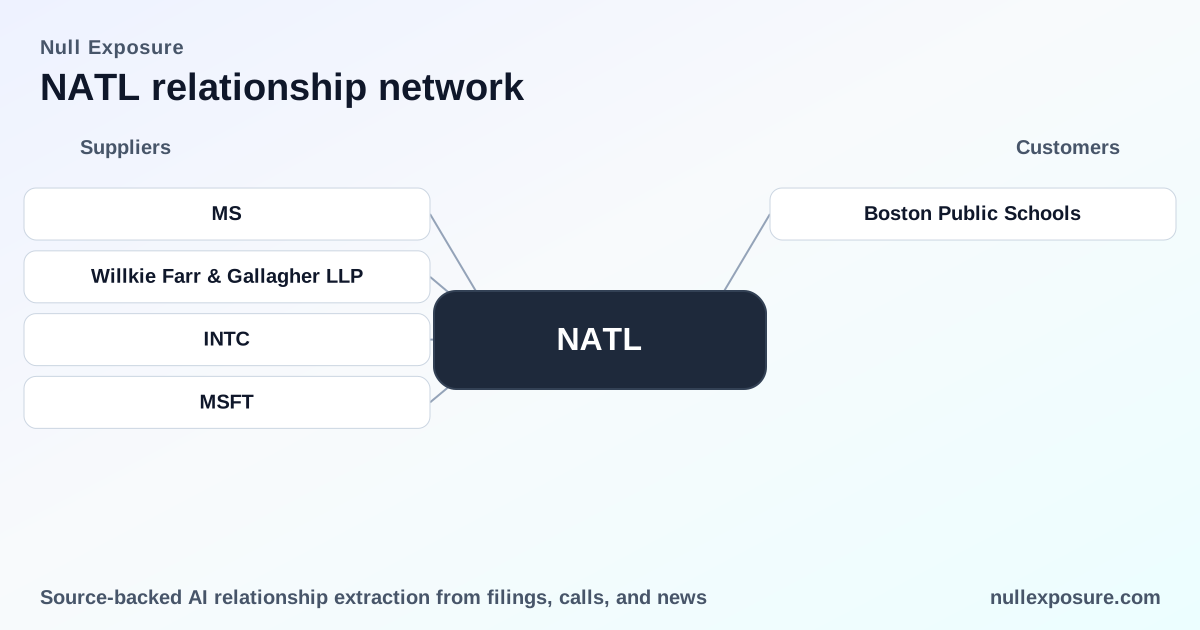
NATL (NCR Atleos Corporation): supplier map and what it means for investors
NCR Atleos Corporation (NATL) is a fintech-oriented software and hardware supplier to financial institutions and retail chains that monetizes through recurring software licenses, hardware sales and extended services, and multi-year financing and leasing arrangements. The company's cash generation is driven by installed hardware fleets plus subscription-style software and maintenance contracts, while financial risk management uses long-dated hedges and counterparty relationships with large global banks. For investors evaluating NATL as a supplier or counterparty, the combination of durable installed-base economics and concentrated third-party dependencies creates a profile of predictable revenue with discrete operational dependency risks.
Explore provider-level relationship intelligence at https://nullexposure.com/ for transaction-ready insight.
How NATL makes money and why supplier relationships matter
NATL sells ATM and financial-technology hardware and software, then extracts service and software revenue over the lifecycle of devices. The business model blends capital-intensive hardware sales with recurring service and software revenue streams, which elevates the operational importance of component, software and legal advisors that keep networks compliant and live. According to public filings and company metrics, revenues run in the billions (Revenue TTM ≈ $4.35B) and operating margins are material, which reinforces the strategic value of reliable suppliers and large financial counterparties to hedging and leasing programs.
What the disclosed supplier relationships are and why each matters
The dataset contains four relationship entries. Each is summarized below with the source.
-
Morgan Stanley — Morgan Stanley acted as the financial adviser to the special committee of National Interstate shareholders during a transaction review, indicating engagement for advisory services in corporate transactions. Source: Insurance Journal coverage of the 2016 transaction advisory engagement (reported FY2016).
-
Willkie Farr & Gallagher LLP — NATL (or the related group) relied on Willkie Farr & Gallagher LLP for legal advice around the same transaction, indicating use of large law firm counsel for corporate and transactional legal work. Source: Insurance Journal reporting on the transaction legal advisers (FY2016).
-
Intel — NATL’s 2024 Form 10‑K explicitly lists dependence on Intel for computer chips and microprocessors, identifying Intel as a critical hardware component supplier in the company’s technology stack. Source: NATL 2024 Form 10‑K (filed FY2024).
-
Microsoft — NATL’s 2024 Form 10‑K states dependence on Microsoft for operating systems, marking Microsoft as a core software platform provider for NATL’s deployed systems. Source: NATL 2024 Form 10‑K (filed FY2024).
Contracting posture, concentration and maturity — company-level signals
NATL’s public disclosures deliver several operating constraints that shape supplier risk and contracting posture. Presenting these as company-level signals:
-
Contract duration skewed toward long-term commitments. The company reports operating leases with a weighted average lease term of 6.2 years and interest rate swaps sized at $2.0 billion terminating in 2027, indicating multi-year financial and real-estate commitments that require stable counterparty access.
-
Short-term hedging overlay for FX exposures. NATL hedges certain non-functional currency cash flows for up to 15 months, reflecting a mixed maturity approach: long-term structural contracts for core assets and short-term tactical hedges for currency volatility.
-
Counterparty selection favors very large financial institutions. Credit exposure language confirms that NATL selects major international financial institutions as counterparties to hedging transactions, which signals a contracting posture that prefers counterparty credit quality over diversification of smaller providers.
-
Cybersecurity engagements characterized as service-provider relationships and immaterial to date. The company engages external cybersecurity firms and internal experts for incident response; expenditures have been reported as not material historically, but formalized relationships exist and are active.
-
Relationship maturity: active and operational. Multiple excerpts indicate the company maintains active relationships—both for cyber response and for its interest-rate derivative programs—so these supplier links are not purely occasional.
These constraints together describe a supplier posture of strategic, long-duration commitments with selective short-term hedging, emphasizing counterparty quality and operational readiness.
What investors should watch — risks and operational criticality
-
Component concentration risk: Dependence on Intel for chips and Microsoft for operating systems makes these suppliers critical to NATL’s ability to deliver and service devices; any supply shock or licensing disruption would have immediate operational impact. (10‑K disclosures, FY2024)
-
Counterparty concentration in financial markets: NATL’s use of major international banks for hedging and long-term swap positions concentrates financial-counterparty exposure; this limits replacement flexibility but mitigates credit risk through high-quality counterparties.
-
Legal and advisory continuity: Historical use of marquee advisers like Morgan Stanley and Willkie Farr & Gallagher reflects a pattern of engaging large, reputable professional services firms for capital transactions and legal work; such relationships support execution on M&A and corporate finance activities.
-
Cyber resilience is outsourced but non-material historically: NATL uses external cybersecurity vendors for incident response; these are active service-provider relationships but historically immaterial in cost. Continued external reliance requires monitoring as incident complexity grows.
Practical implications for counterparties and operators
-
For suppliers and vendors: expect long-term contracting negotiations and strong credit checks; NATL’s preferred posture is with established institutions and multi-year arrangements.
-
For investors: stress-test scenarios that involve component-supply interruption from Intel or licensing shifts from Microsoft, and assess the company’s inventory, alternate sourcing strategy, and software portability.
-
For risk managers: NATL’s mix of long-term leases and concentrated hedging relationships implies liquidity and counterparty management are first-order governance items; monitor the notional swap roll schedules and hedging counterparties.
Explore deeper supplier exposure and transaction histories at https://nullexposure.com/ to align diligence with portfolio risk appetite.
Actionable takeaways
-
Primary dependencies are clear and concentrated: Intel for chips and Microsoft for operating systems. These are operationally critical and should be covered in any vendor-continuity plan. (NATL 2024 Form 10‑K)
-
Financial hedging and leasing commitments are multi-year and anchored to large counterparties. This reduces counterparty credit risk but raises replacement costs if counterparties shift terms. (Company disclosures, FY2024)
-
Professional services engagements are handled by large, reputable advisers, which supports corporate-finance execution capacity but also signals higher fixed-cost legal/advisory spend in transaction periods. (Insurance Journal, 2016 reporting)
If you need a tailored supplier-risk brief or counterparty stress matrix for NATL, start here: https://nullexposure.com/.
Bottom line
NATL combines hardware distribution with recurring software and service economics, supported by long-term leasing structures and hedging relationships with large financial institutions. The supplier map highlights two operationally critical partners — Intel and Microsoft — and several high-quality advisory/financial counterparties. For investors and operators, the priority is to monitor component sourcing resilience and to validate counterparty continuity for interest-rate and FX hedges. Further diligence on swap maturity schedules, inventory buffers, and multi-vendor software strategies will determine how resilient NATL is to supplier-side shocks.
For transaction-ready supplier intelligence, visit https://nullexposure.com/ and align your exposure analysis with corporate finance realities.