Nautilus (NAUT): Supplier Map, Strategic Risks, and What Investors Should Price In
Nautilus Biotechnology builds a proprietary proteomics platform to quantify proteome complexity and intends to monetize that platform through commercial sale and deployment of instruments, reagents and analytical services, plus strategic partnerships and licensing. The company is development-stage with no reported revenue in the trailing twelve months, and its supplier posture—particularly dependency on third-party reagents and single-source components—drives both near-term execution risk and long-term operating leverage. For diligence on supplier exposure and counterparty risk, go to https://nullexposure.com/.
Executive snapshot: commercial model, balance-sheet posture, and supplier impact
Nautilus is a development-stage life sciences company headquartered in Seattle focused on a platform approach to proteomics rather than one-off products. The platform strategy concentrates value in a few core components (instruments, affinity reagents, software/analytics), which concentrates supplier importance. Public filings show zero reported revenue TTM and negative EBITDA, which places a premium on execution against supplier milestones: reagent libraries, manufacturing-readiness, and partner commercialization. Insider ownership (about 33%) and institutional ownership (about 45%) create concentrated stakeholder incentives to de-risk supply chains quickly.
Key takeaways:
- Supplier concentration is a structural risk given the platform model and current development-stage economics.
- No current revenue increases the binary nature of supplier execution: delays in reagent supply or manufacturing qualification directly postpone any path to commercialization.
- Advisor relationships for the IPO and legal counsel establish baseline capital markets access but do not substitute for manufacturing resilience.
What the company lists as supplier and advisor relationships
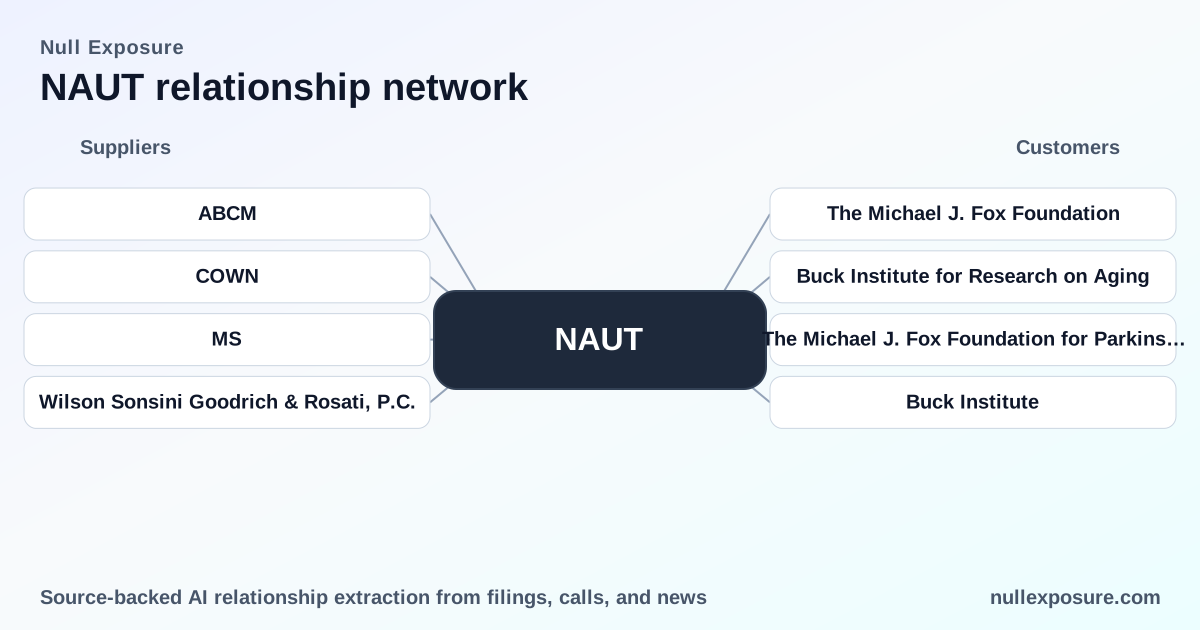
Below I cover every relationship surfaced in the available results and the disclosure or press source that documents it.
Abcam — strategic reagent partner to augment affinity libraries
Abcam agreed to provide Nautilus with antibodies intended to add to and enhance Nautilus’ library of affinity binding reagents, reflecting a supplier partnership that integrates third-party reagents into Nautilus’ platform strategy. This relationship was announced in a press release on Newswire in 2021 and positions Abcam as a tactical reagent supplier for platform development (Newswire press release, 2021).
Cowen — financial advisor at public debut
Cowen acted as a financial advisor to Nautilus in connection with its public market debut, supporting capital formation and go-to-market planning that enabled platform investment (GlobeNewswire release, June 2021).
Morgan Stanley — lead financial advisor for listing
Morgan Stanley served as lead financial advisor to Nautilus during the company’s public entrance, providing underwriting and strategic advisory services that shaped initial institutional distribution and capital structure (GlobeNewswire release, June 2021).
Wilson Sonsini Goodrich & Rosati, P.C. — legal counsel
Wilson Sonsini served as legal counsel to Nautilus for the transaction that took the company public, supporting corporate, securities and transactional work required for listing (GlobeNewswire release, June 2021).
Operating-model constraints and what they tell investors
Company disclosures explicitly state reliance on third-party manufacturers and, in many cases, single third‑party manufacturers for the production of certain reagents and antibodies. The company also discloses that it does not currently have contracts for third parties to provide manufacturing for every platform component, and that it expects continued reliance on third parties. These are company-level signals with direct operational implications:
- Contracting posture: Nautilus currently relies on supplier relationships that are partially informal or not fully contracted for all components; this weakens negotiating leverage and creates execution uncertainty when moving from R&D to manufacturing scale.
- Concentration: Single-source suppliers for specific reagents or components create high-consequence single points of failure; any disruption to an individual supplier can delay commercialization timelines.
- Criticality: Supplier inputs (antibodies, affinity reagents, manufacturing capability) are mission-critical to the platform; they are not interchangeable commodities in the short run.
- Maturity: As a development-stage company with no reported revenue, Nautilus lacks operating cashflows to absorb protracted supplier failures and must rely on capital markets or partner-funded programs to bridge gaps.
These constraints should be treated as fundamental risk factors when modeling time-to-revenue and capital needs. The company’s own filings document the supplier exposure that underpins these signals (company disclosures, filings).
Commercial and governance implications for investors and operators
From an investor or operator perspective, supplier exposures translate directly into valuation and execution priorities:
- Underwrite scenarios where single-supplier failure adds 6–18 months to commercialization timelines; stress-test cash burn under those timelines.
- Prioritize diligence on supply agreements, exclusivity clauses, qualification standards, and lead times—not just the identity of suppliers.
- Insist on contractual remedies: supply continuity guarantees, multi-sourcing obligations, inventory pre-funding, or rollback rights should be part of commercial negotiations.
- Monitor the Abcam relationship as a practical test case: Abcam’s role supplying antibodies demonstrates third-party reagent reliance; track whether formal supply contracts and qualification milestones follow the announcement (Newswire press release, 2021).
If you need a structured supplier-risk briefing, see https://nullexposure.com/ for tailored supplier intelligence.
Practical next steps for trading desks, strategic partners, and procurement teams
Operators and acquirors should treat Nautilus’ supplier picture as an active variable in valuation, not a static footnote. Recommended actions:
- Request copies of supplier agreements, qualification criteria, and any termination or exclusivity provisions.
- Model dilution or follow-on funding needs assuming delayed revenue from reagent or manufacturing setbacks.
- Encourage dual-sourcing strategies for the most critical reagent families and build contingency inventory where feasible.
For investors building a thesis around platform commercialization or potential M&A, the path to de-risking supplier concentration is a key value unlock. For bespoke supplier intelligence and counterparty analysis, visit https://nullexposure.com/.
Bottom line: supplier relationships are strategic assets and principal risk drivers
Nautilus’ platform ambition confers high upside if reagent libraries, manufacturing readiness and commercial partnerships execute as planned. Supplier concentration and the lack of fully contracted manufacturing partners are the principal near-term risk that investors and operators must price and mitigate. The advisory and legal relationships established at IPO provide capital markets access and transactional scaffolding, but they do not remove the operational dependency on third‑party manufacturers and reagent suppliers documented in the company’s disclosures and partner announcements.
For a deeper supplier map and risk score tailored to institutional decision-making, go to https://nullexposure.com/.