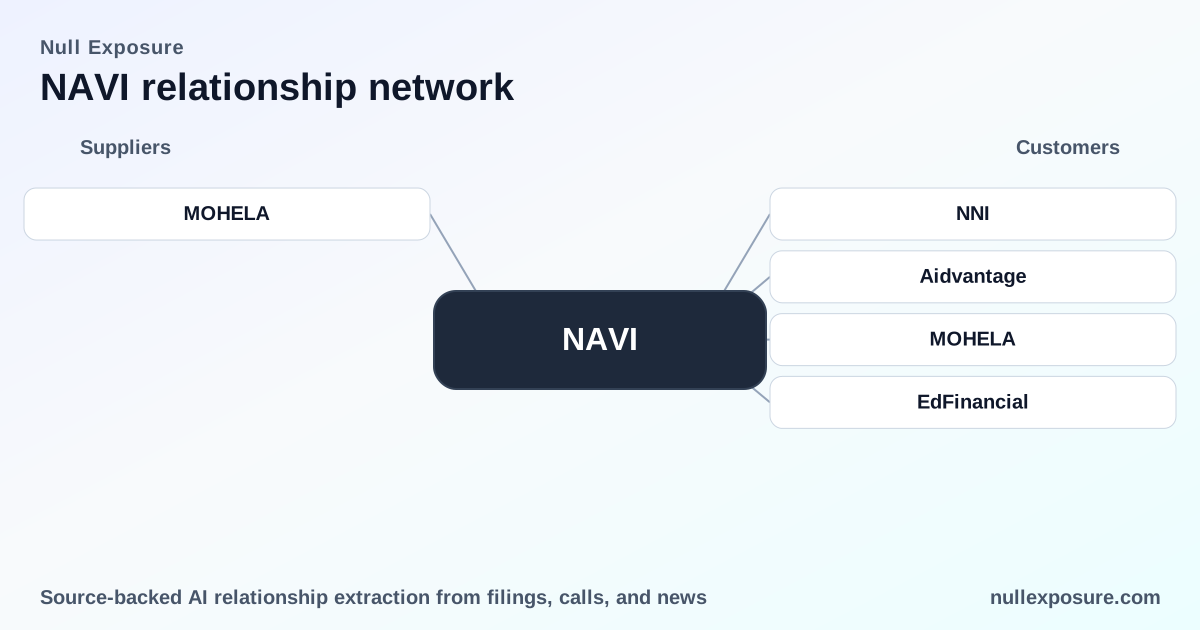
NAVI supplier relationships: how the MOHELA outsourcing reshapes Navient’s operating model
Navient is an education-loan servicer and credit-services provider that monetizes through servicing fees, interest spreads on portfolios it owns, and business processing contracts for government and institutional clients. The company is converting fixed labor and operational expense into variable servicing costs by outsourcing core servicing to third parties while continuing to originate and buy private education loan portfolios; this drives predictable unit economics but concentrates operational and counterparty risk. For full supplier-mapping and relational intelligence, visit https://nullexposure.com/.
The headline: Navient outsourced servicing to MOHELA, changing the cost base
Navient executed an outsourcing agreement in May 2024 that transferred servicing of its student-loan portfolio to MOHELA and moved nearly 900 employees as part of the transition, with borrower transitions largely completed by October 2024. This deal converts portions of Navient’s fixed operating base into a variable cost structure and creates attractive unit economics across servicing-volume scenarios, while concentrating servicing dependency on a single external provider. According to a ProtectBorrowers article published March 10, 2026, the outsourcing covered roughly 2.7 million student loans (https://protectborrowers.org/what-we-do/federal-student-loans/federal-loan-servicing-abuse/navient/). Navient’s own disclosures in 2024 documented the May 2024 outsourcing agreement and the July–October 2024 employee and borrower transition milestones.
Visit https://nullexposure.com/ for more supplier intelligence and relationship risk profiling.
How this single relationship fits into Navient’s supplier map
The MOHELA arrangement is the principal supplier relationship surfaced in the available results. The company explicitly designated MOHELA as the servicing provider and described the transition as active and largely complete during 2024, making this a contemporary and material operational relationship for Navient’s servicing function.
Relationship-by-relationship review (complete)
MOHELA — Navient outsourced student-loan servicing to MOHELA in May 2024 and transferred nearly 900 employees as part of the operational handoff; borrower transition activity was largely completed by October 2024. A March 2026 report highlighted that the outsourcing covered roughly 2.7 million student loans, reflecting a substantial shift in Navient’s servicing posture (ProtectBorrowers, March 10, 2026; Navient disclosures, May–Oct 2024).
Constraints and what they imply for Navient’s operating and business model
Navient’s disclosures and constraint excerpts provide direct signals about company-level risk posture and the consequences of the MOHELA outsource:
-
Contracting posture — outsourcing over insourcing. The May 2024 outsourcing disclosure demonstrates a deliberate move from internal servicing to external service provision, converting fixed headcount into vendor payments and altering capital allocation priorities. Because this constraint explicitly names MOHELA, it is attributed to that relationship.
-
Concentration and criticality — large-volume dependency. The outsourced portfolio encompasses millions of loans and therefore creates counterparty concentration risk: a single supplier executing core customer-facing activity becomes operationally critical. That concentration is an explicit operational consequence of the MOHELA transfer.
-
Maturity and stage — active, largely completed transition. Disclosures show the servicing transition began July 1, 2024, included employee transfers, and was largely complete by October 2024, indicating a mature, active outsourcing arrangement rather than a nascent pilot. This constraint names MOHELA directly and therefore is relationship-level.
-
Company-level financial constraints — funding and valuation sensitivity. Navient’s filings note that adjustments to secured and unsecured borrowings are material to valuation and rely on inputs from inactive markets, signaling balance-sheet sensitivity to market liquidity and lender perceptions. This is a company-level constraint and is not attributed to MOHELA specifically.
-
Buyer activity — strategic portfolio purchases. Navient discloses it has purchased, and may continue to purchase, private education loan portfolios from third parties. That purchaser role is a company-level strategic signal that impacts supplier needs and the mix of servicing requirements across vendors.
-
Spend scale — large secured facilities. Navient reported approximately $1.7 billion outstanding under certain facilities (with about $1.8 billion of assets securing them), a company-level indicator of sizeable secured funding arrangements and potential counterparty exposures.
Investment implications: where upside and risk concentrate
-
Upside: Outsourcing to MOHELA creates clear operational leverage — reduced fixed costs and more flexible unit economics should support better cash flow stability under volume swings. The active, mature transition reduces execution risk for the operating model change.
-
Risks: The move concentrates operational risk with MOHELA and preserves regulatory and reputational exposure for Navient as the portfolio owner and buyer/seller in secondary markets. Additionally, company-level funding sensitivity (material borrowings adjustments based on inactive-market inputs) introduces valuation volatility that can offset operational margin gains.
-
Earnings sensitivity: With servicing reclassified as variable expense, near-term GAAP volatility could decline while underlying cash economics improve; however, credit and funding market inputs remain a material valuation lever for NAVI.
Midway action item: if you are evaluating Navient counterparties or exposure, review supplier performance metrics and recent transition KPIs at https://nullexposure.com/ to validate service continuity and borrower outcomes.
Monitoring checklist for operators and counterparties
- Counterparty performance metrics from MOHELA (service-level performance, call-center metrics, complaint volumes).
- Borrower transition indicators (delinquencies, re-default rates, payment accuracy) tied to post-transition servicing quality.
- Quarterly disclosures on servicing economics and any changes to the outsourcing agreement or fee schedule.
- Funding-market inputs and valuation adjustments tied to secured/unsecured borrowings reported in company filings.
Final takeaways and action
Navient’s outsourcing of loan servicing to MOHELA is a strategic shift that converts fixed costs into scalable, vendor-driven economics while concentrating operational risk in a single external provider. Company-level constraints — particularly material valuation sensitivity around borrowings and ongoing portfolio purchases — remain central to NAVI’s risk profile and should be monitored independently of the MOHELA relationship.
For a deeper supplier risk assessment and up-to-date relationship mapping, visit https://nullexposure.com/ and check our supplier intelligence tools. If you are underwriting NAVI exposure or negotiating counterparties, prioritize vendor performance data, contractual protections around service levels, and transparency on valuation inputs tied to borrowings. For structured supplier analysis and ongoing monitoring, see https://nullexposure.com/ for tailored coverage and reports.