Northeast Bancorp (NBN): Supplier relationships that shape credit capacity and regulatory cost
Northeast Bancorp operates as a regional commercial bank headquartered in Portland, Maine, monetizing primarily through lending, deposit gathering and related fee income. The bank’s growth vector is a mix of organic deposit-led originations in New England and an expanding national lending footprint—particularly SBA and small-balance commercial loans—funded by a combination of deposits and wholesale liquidity. For investors and operators evaluating supplier exposure, the signal set here is narrow but meaningful: counterparties that provide funding, regulatory insurance, and distribution for public disclosures directly influence capital efficiency and expense dynamics. Learn more at https://nullexposure.com/.
What matters for investors: funding, guarantees, and disclosure channels
Northeast Bank’s operating model trades off regional deposit strength for occasional reliance on wholesale advances and government-guaranteed lending programs. That creates three practical supplier categories that drive performance and risk:
- Wholesale funding partners (working capital and purchase-funding) determine short-run liquidity and the pace of loan growth.
- Regulatory and insurance authorities determine operating expense volatility through assessment rates and insurance assessments.
- Distribution channels for corporate communications shape market reception of earnings and strategic shifts.
These dimensions are not theoretical—each is visible in recent public disclosures and press activity.
Supplier relationships in the public record
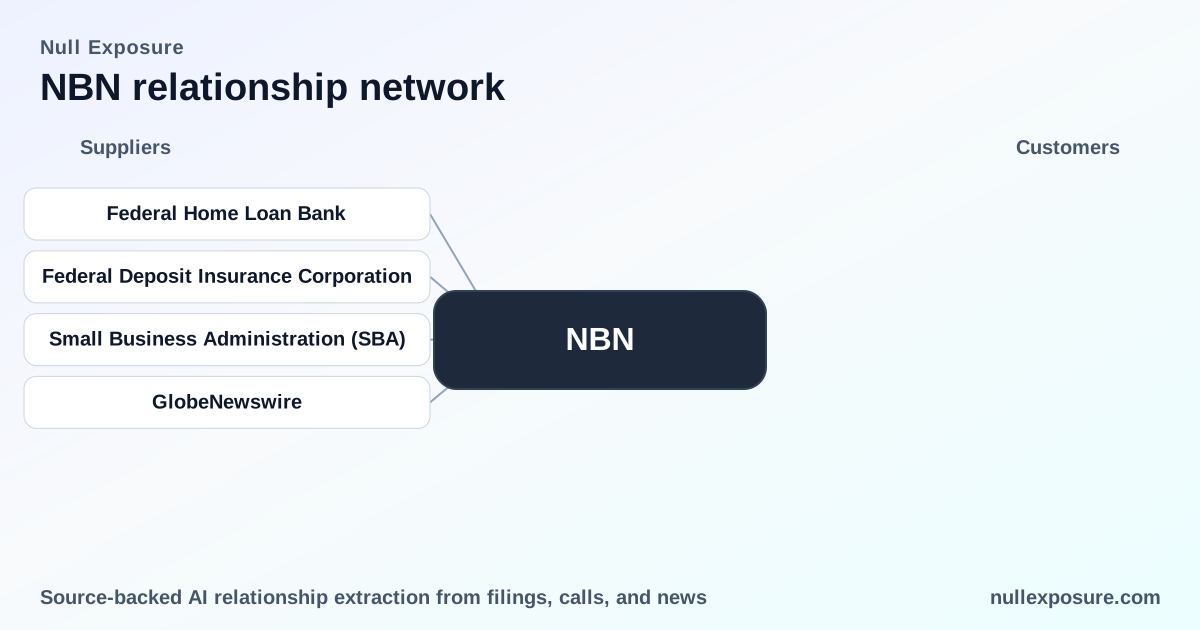
Below I cover every supplier relationship surfaced in the results set and why each matters to an investor evaluating Northeast Bancorp.
Federal Home Loan Bank — incremental advances to finance loan purchases
Northeast Bank used Federal Home Loan Bank (FHLB) advances, which increased by $180.9 million (56.5%) from June 30, 2025, to fund a portion of loan purchases for the quarter ended December 31, 2025, indicating tactical use of wholesale liquidity to support loan growth. According to a QuiverQuant summary of the company’s FY2026 results, these advances funded loan purchase activity in Q2 FY2026. (Source: QuiverQuant coverage of Northeast Bank FY2026 results, March 2026.)
Federal Deposit Insurance Corporation — insurance expense affects operating cost
The bank recorded a decrease in FDIC insurance expense of $484 thousand driven by changes in the assessment rate, which directly lowered expense in the reported quarter and thus improved reported net income. This detail is disclosed in the same FY2026 results summary and highlights how regulatory fee shifts can move near-term profitability. (Source: QuiverQuant coverage of Northeast Bank FY2026 results, March 2026.)
Small Business Administration — national origination of government-guaranteed loans
Northeast Bank’s Small Business division originates government-guaranteed SBA loans, while its National Lending Division both purchases and originates commercial loans on a nationwide basis—confirming that a portion of the bank’s growth and credit mix is anchored by government-guaranteed programs and nationwide lending activity. This structural choice broadens yield and credit diversification but also ties performance to SBA program execution and servicing capability. (Source: QuiverQuant coverage of Northeast Bank FY2026 results, March 2026.)
GlobeNewswire — press distribution partner for investor communications
GlobeNewswire is the distribution channel used for the company’s earnings and investor notices, as indicated in the press release summaries; the press release itself was distributed via GlobeNewswire and summarized in the public report. Public dissemination through GlobeNewswire ensures standardized investor access and timely disclosure. (Source: QuiverQuant reporting noting a GlobeNewswire-distributed press release, January 2026.)
Constraints and operating-model implications (company-level signals)
There are no explicit supplier constraint clauses delivered with this relationship extract. As a company-level signal, the absence of constraints in the supplied data means investors must infer operating posture from the relationships themselves:
- Contracting posture: Northeast Bank shows a pragmatic contracting posture—leveraging FHLB advances opportunistically rather than relying solely on long-term wholesale facilities. This implies a preference for flexible, short-to-medium-term liquidity arrangements that support growth without long-term leverage commitments.
- Counterparty concentration: Public data signals moderate concentration risk where FHLB advances represent a meaningful, episodic source of funding; deposit funding remains the core but is supplemented by a single wholesale channel when loan purchases accelerate.
- Criticality: Relationships with regulatory insurers (FDIC) and the SBA are critical to expense stability and product ability (SBA-guaranteed origination), respectively—both affect net interest margin and credit mix.
- Maturity: The bank’s use of advances and SBA origination suggests a mixed maturity profile: stable deposit funding on the liability side with adjustable wholesale funding for tactical balance-sheet moves and long-duration loans originated or purchased on the asset side.
These signals create a profile where liquidity counterparties and regulatory expense drivers have outsized influence on return-on-equity sensitivity and near-term earnings variability.
Investment implications and risk considerations
- Liquidity risk is operational: the sizable quarter-over-quarter jump in FHLB advances shows management’s willingness to use wholesale funding to accelerate loan growth; this is efficient in expansionary cycles but increases funding sensitivity if deposit attrition or tighter wholesale markets coincide with stress.
- Regulatory fee volatility is non-trivial: a $484k change in FDIC expense meaningfully moved quarterly earnings; for a bank of this size, regulatory assessment shifts are an earnings lever.
- SBA channel is a growth lever and credit mitigant: originating government-guaranteed loans expands national reach and reduces loss incidence but increases operational complexity and reliance on SBA program rules.
Investors should watch: FHLB advance balances, FDIC assessment trends, SBA origination volumes and servicing metrics, plus the timing and tone of GlobeNewswire disclosures for management guidance.
If you want a deeper mapping of supplier exposures across Northeast Bank’s financing and regulatory relationships, start here: https://nullexposure.com/.
Bottom line: focused exposures, meaningful levers
Northeast Bancorp’s supplier footprint is compact but influential. Wholesale funding via the FHLB, regulatory insurance costs through the FDIC, SBA program participation, and standardized investor communications via GlobeNewswire collectively shape the bank’s liquidity flexibility, expense structure, credit mix, and market narrative. For investors and operators, the practical takeaway is simple: monitor advances, assessment rates, and SBA activity as primary drivers of near-term earnings variability and medium-term growth capacity.
For continuing coverage and structured supplier-risk profiles on regional financials, visit https://nullexposure.com/.