NBT Bancorp (NBTB) — supplier relationships, operating posture, and what investors should price
NBT Bancorp operates as a regional bank centered on commercial and retail banking with a growing wealth-management and insurance push. The company monetizes through net interest margin on loan and securities portfolios, fee income from wealth and insurance services, and transactional banking revenue; incremental growth is coming from third-party partnerships that expand consumer lending and fee-based revenue streams. For investors evaluating counterparty risk and supplier concentration, the next sections map the bank’s external counterparties and the operational constraints that shape credit and operational risk. For a deeper supplier-level view, visit https://nullexposure.com/.
How NBTB’s business model converts balance sheet into earnings
NBTB’s core economics are classical regional banking: collect low-cost deposits, deploy assets into loans and held-to-maturity (HTM) securities, and capture spread plus fee income. Key drivers are loan portfolio composition, the mix of HTM government securities, and the rate of growth in fee-based wealth and insurance revenues. The company’s reported metrics (FY ending Dec 2025) — a trailing P/E around 12.5, Price/Book ~1.14, and return on equity near 9.9% — reflect a mature regional franchise with steady profitability and modest growth expectations.
Supplier relationships that move the P&L and the balance sheet
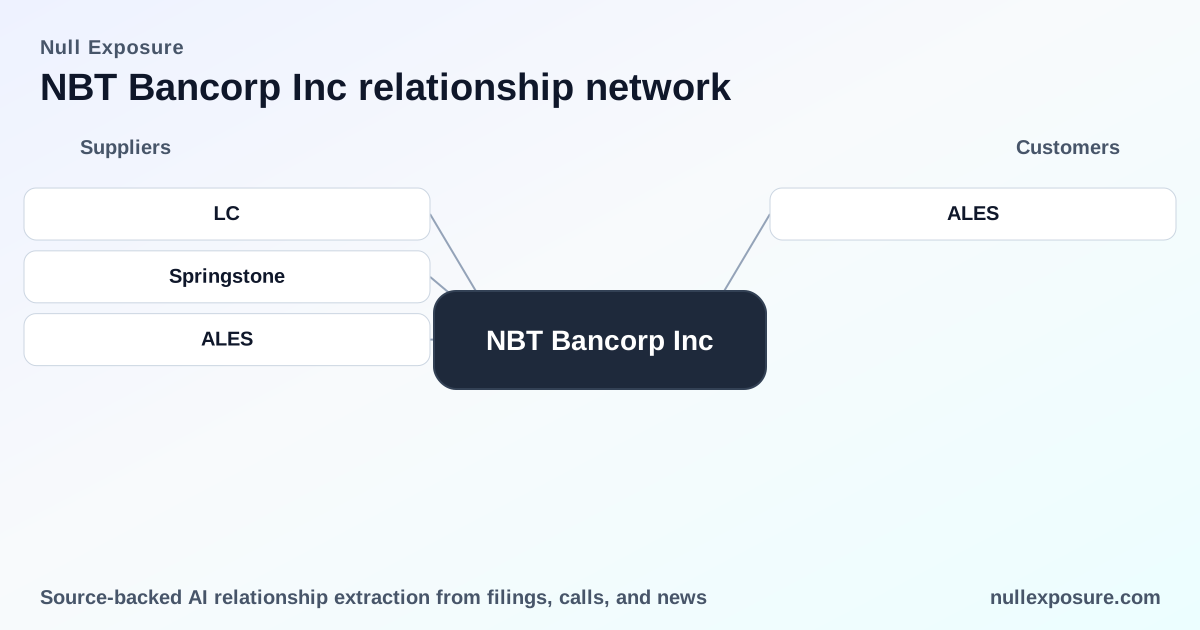
Below are every supplier/partner relationship surfaced in available public reporting and media coverage, with a concise investor-focused description and source references.
LendingClub — a material unsecured consumer exposure
NBTB disclosed a "fairly large unsecured consumer book with our LendingClub" as part of its Q4 2025 earnings commentary, indicating NBTB sources or acquires unsecured consumer credit through LendingClub-originated or related portfolios. This relationship increases exposure to unsecured consumer credit performance and links NBTB to the fintech-originated credit cycle. According to the Q4 2025 earnings call transcript published by InsiderMonkey on March 10, 2026, management specifically called out LendingClub as part of its unsecured consumer book (InsiderMonkey, earnings call transcript, Mar 10, 2026 — https://www.insidermonkey.com/blog/nbt-bancorp-inc-nasdaqnbtb-q4-2025-earnings-call-transcript-1683038/).
Springstone — another unsecured consumer partner in the same book
Management also named Springstone alongside LendingClub as a component of its unsecured consumer portfolio, suggesting multiple external originators feed NBTB’s consumer exposure and that underwriting and credit performance are partially reliant on those partners’ sourcing and risk-selection. This was noted in the same Q4 2025 earnings call transcript (InsiderMonkey, earnings call transcript, Mar 10, 2026 — https://www.insidermonkey.com/blog/nbt-bancorp-inc-nasdaqnbtb-q4-2025-earnings-call-transcript-1683038/).
Evans — strategic extension into wealth and insurance channels
NBTB is pursuing expanded wealth management and insurance distribution via access to Evans’ customer base, which management and analysts highlight as a driver of non-interest, fee-based revenue growth. That positioning indicates a deliberate shift to diversify away from pure lending spreads toward higher-margin, fee-generating services. SahmCapital’s January 9, 2026 valuation commentary referenced NBTB’s enhanced focus on wealth and insurance expansion tied to Evans’ customers (SahmCapital, Jan 9, 2026 — https://www.sahmcapital.com/news/content/assessing-nbt-bancorp-nbtb-valuation-after-mixed-shareholder-returns-and-earnings-expectations-2026-01-09).
Operational constraints and what they tell investors
The company’s public disclosures deliver several company-level operational signals that impact counterparty and operational risk.
- Government-heavy HTM posture reduces credit volatility but creates duration and rate sensitivity. Company filings indicate that as of December 31, 2024 and 2023, 66% of HTM debt securities were issued by U.S. government agencies or government-sponsored enterprises with A–AAA ratings. This is a conservative securities allocation that limits credit loss exposure while amplifying interest-rate and duration risk in a rising-rate environment.
- Municipal securities credit loss assessed as immaterial under CECL, signaling limited credit exposure in that slice of the portfolio; the company recorded no allowance for credit loss on its HTM municipal bond portfolio as of Dec 31, 2024 and 2023.
- Dependency on third-party service providers is material to operations. NBTB explicitly relies on external vendors for data processing, online banking interfaces, network access, and core transaction processing, and the company’s external auditor (KPMG LLP) has reported on internal control effectiveness. This contracting posture makes vendor management and cyber resilience a core operational risk for investors to monitor.
These constraints present a mixed signal: low credit-risk tilt in securities, limited municipal credit exposure, and concentrated operational reliance on vendors. Investors should price in operational concentration risk even as credit fundamentals in the securities book look conservative.
What this means for risk, concentration and growth
NBTB’s supplier relationships and operating posture imply a bank that is balancing traditional interest-income generation with fee-based expansion. LendingClub and Springstone increase unsecured consumer credit flow and short-term credit risk exposure; Evans supports higher-margin fee growth that improves earnings stability over time. The heavy allocation to government-backed HTM securities reduces default risk but increases sensitivity to market rates. The company's dependence on vendors for critical infrastructure suggests operational resilience is as important as credit quality for valuation.
For actionable diligence, investors should track:
- Performance and delinquencies in the LendingClub/Springstone-originated consumer book.
- Growth and margin trajectory of wealth and insurance revenues tied to Evans.
- Changes in HTM composition and duration metrics given the government-heavy posture.
- Vendor concentration and third-party risk controls — particularly around data processing and core banking interfaces.
If you want a detailed mapping of counterparties and supplier concentration for portfolio stress testing, start here: https://nullexposure.com/.
Valuation and strategic takeaways
NBTB trades at modest multiples (trailing P/E ~12.5, P/B ~1.14) that reflect a stable regional bank with incremental growth via fees. Key upside is fee-income acceleration and steady credit performance in consumer portfolios; key downside is operational or vendor disruption and adverse consumer credit cycles tied to fintech-originated loans. Investors should weight the stock for steady earnings and asset-quality sensitivity rather than rapid multiple expansion.
For investors and operators building counterparty-aware models, the practical next step is to integrate these supplier signals into scenario analysis. Explore supplier-level analytics and tracking at https://nullexposure.com/ to convert these qualitative signals into actionable exposure assessments.
Final recommendation
NBTB is a classical regional bank executing a cautious securities strategy while actively diversifying into fee businesses through external partnerships. Price NBTB for reliable core earnings with idiosyncratic operational and consumer-credit exposures born of third-party relationships; reward depends on successful fee-income execution and robust vendor governance. For further supplier-level due diligence and continuous monitoring, visit https://nullexposure.com/.