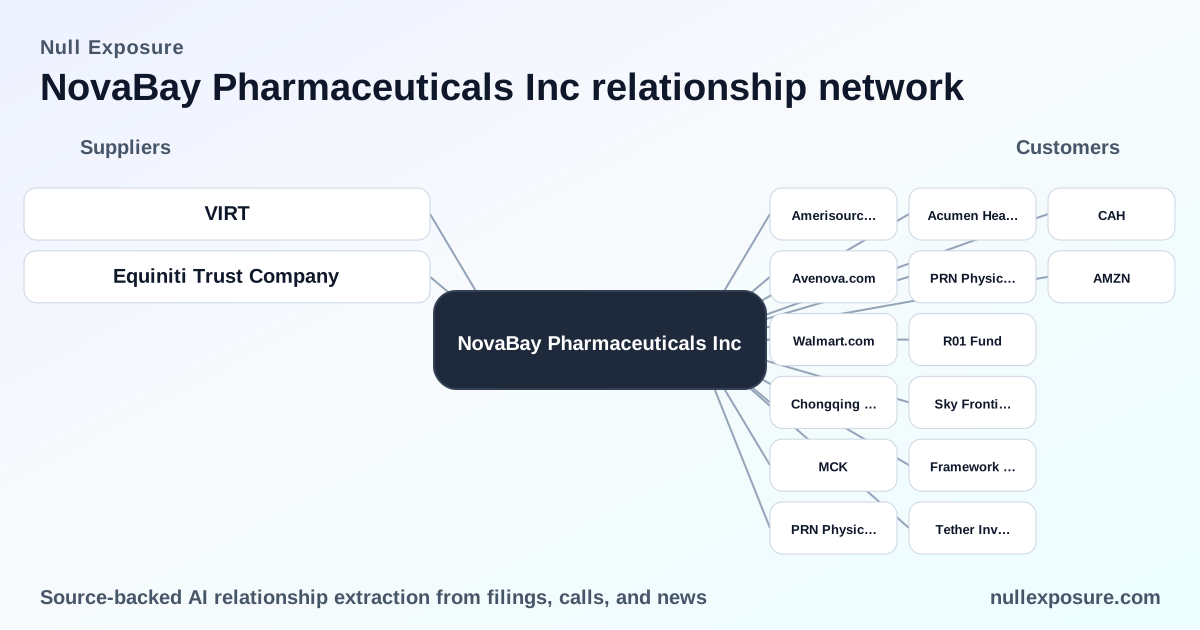
NovaBay Pharmaceuticals (NBY): Supplier Relationships, Financing Moves, and What Operators Should Know
NovaBay Pharmaceuticals sells ophthalmic and wound-care products and monetizes through finished-goods sales while outsourcing manufacturing; recent capital-marketing actions (an at‑the‑market equity program and a reverse split) drive the company’s near-term funding profile and directly affect supplier and counterparty dynamics. The company relies on third‑party contract manufacturers for production, uses market-based equity facilities to raise cash, and executes corporate actions to reshape its capital structure — a combination that creates operational concentration risk and liquidity-driven counterparties that investors and operators must evaluate. Learn how these supplier and financing relationships interact with NovaBay’s operating constraints and governance at https://nullexposure.com/.
How NovaBay runs its business and where suppliers fit in
NovaBay is a small medical‑device company focused on eye‑care products (Avenova among them). The firm’s most relevant commercial facts: revenue TTM of $10.3M, gross profit of $6.5M, and a market capitalization near $37.9M. NovaBay does not own manufacturing plants; it outsources finished‑goods production and sells through direct channels and distributors. That operating model means supply chain partners are critical — the company’s ability to ship finished products and recover gross margin depends on the stability and contracting posture of contract manufacturers and distribution agents.
Operational and governance signals that matter to business users:
- High insider ownership (≈91.9%) and low institutional ownership (~5.4%), implying a tightly held equity base and potential liquidity constraints for large counterparties.
- Small public float and shares outstanding dynamics can increase the impact of equity financings on share price and on the behavior of sales agents or market makers.
- Outsourced manufacturing creates single‑source concentration risk for finished goods, particularly for Avenova Spray production in U.S. facilities.
If you are modeling supplier exposure or counterparty credit, consolidate this operating posture with on‑the‑ground supplier diligence; for a broader supplier‑relationship view visit https://nullexposure.com/ for supplier mapping and evidence aggregation.
Recent relationships that changed the operating picture
Virtu Americas — ATM sales agent and $100M stock sale agreement
NovaBay executed an at‑the‑market (ATM) arrangement with Virtu Americas, under which Virtu will act as sales agent or principal and use commercially reasonable efforts to execute sales according to NovaBay’s instructions. A TradingView report documented the sales‑agent role and the general terms of the ATM (first seen March 10, 2026).
A separate news item reported a concurrent announcement of a $100 million stock sale agreement with Virtu Americas, triggering a roughly 54% intraday stock price decline as the market priced the financing into the share value (reported March 10, 2026 by Intellectia). Both items together signal that NovaBay is using equity markets and third‑party execution agents to raise capital rather than relying on internal cash flow or secured credit.
Sources: TradingView coverage of the ATM arrangement (March 10, 2026) and Intellectia news reporting on the $100M sale agreement and market reaction (March 10, 2026).
Equiniti Trust Company — exchange agent for reverse split
Equiniti Trust Company is acting as the exchange agent in NovaBay’s announced 1‑for‑5 reverse stock split, a corporate action designed to consolidate the share base. TradingView noted that Equiniti will perform exchange agent duties for the reverse split (reported March 10, 2026). This is a conventional corporate‑action role but important operationally because reverse splits change share counts, affect the public float, and influence how equity financings and market makers manage orders post‑transaction.
Source: TradingView report on NovaBay’s reverse stock split and Equiniti’s role (March 10, 2026).
What the formal constraints say about supply risk and contracting posture
Company filings and disclosures provide direct operating constraints that define supplier exposure:
- Manufacturing concentration: The company relies on a single contract manufacturer for production of finished goods and intends to continue outsourcing manufacturing rather than building internal facilities. This is a company‑level operating fact that increases supplier criticality and reduces internal flexibility.
- Geographic manufacturing footprint: For Avenova Spray specifically, manufacturing was outsourced to a contract manufacturer with facilities located in the United States, which concentrates production geographically and can simplify regulatory oversight but concentrates operational risk in a single region.
- Contract termination history: Filings state that the existing supplier/distributor relationship with a counterparty named Phase One was terminated upon closing of a Wound Care Divestiture, showing the company will restructure supplier relationships as part of divestitures and strategic repositioning.
These constraints together produce an operating model where third‑party manufacturers are mission‑critical, relationships are strategically restructured when business lines change, and corporate financing decisions directly influence counterparty behavior. Treat these as company‑level signals to be layered into commercial diligence rather than as attributes of any single external supplier unless the filing names that supplier.
Investment and operational implications — what operators and investors should track
NovaBay’s recent activity and constraints create a concentrated set of risks and decisions for both counterparties and investors:
- Dilution and market execution risk: The Virtu ATM and reported $100M sales agreement indicate the company will use equity issuance for liquidity; equity sales executed by market agents will depress share price and increase volatility, which in turn affects the willingness of suppliers or partners to extend credit or accept stock compensation.
- Supplier concentration: Relying on a single U.S.-based contract manufacturer is efficient but creates single‑point‑of‑failure risk; operators should demand contingency plans and multi‑source options in supplier contracts.
- Corporate actions change operational mechanics: The 1‑for‑5 reverse split (Equiniti as exchange agent) reduces float and can alter market behavior — service providers and distributors should re‑price credit and commercial terms after such actions.
- Governance and liquidity signals: High insider ownership and low institutional ownership reduce market liquidity and can make negotiations asymmetric; counterparties should factor this into contract terms and credit limits.
Mid‑analysis suggestion: if you need consolidated supplier evidence and relationship mapping tailored to NovaBay, review our supplier profiles and counterparty dashboards at https://nullexposure.com/ for detailed, sourced relationship views.
Final takeaways and next steps
NovaBay operates a lean manufacturing model dependent on outsourced U.S. production, while aggressive equity‑market financing and corporate actions are reshaping its capital structure. For investors and operators, the three practical lines of work are: verify production redundancy for critical SKUs, stress‑test counterparty credit to equity financings, and re‑negotiate commercial terms to reflect reduced public liquidity.
For a consolidated view of NovaBay’s external relationships and to convert these observations into operational checklists, visit https://nullexposure.com/ to explore supplier evidence and transaction histories.