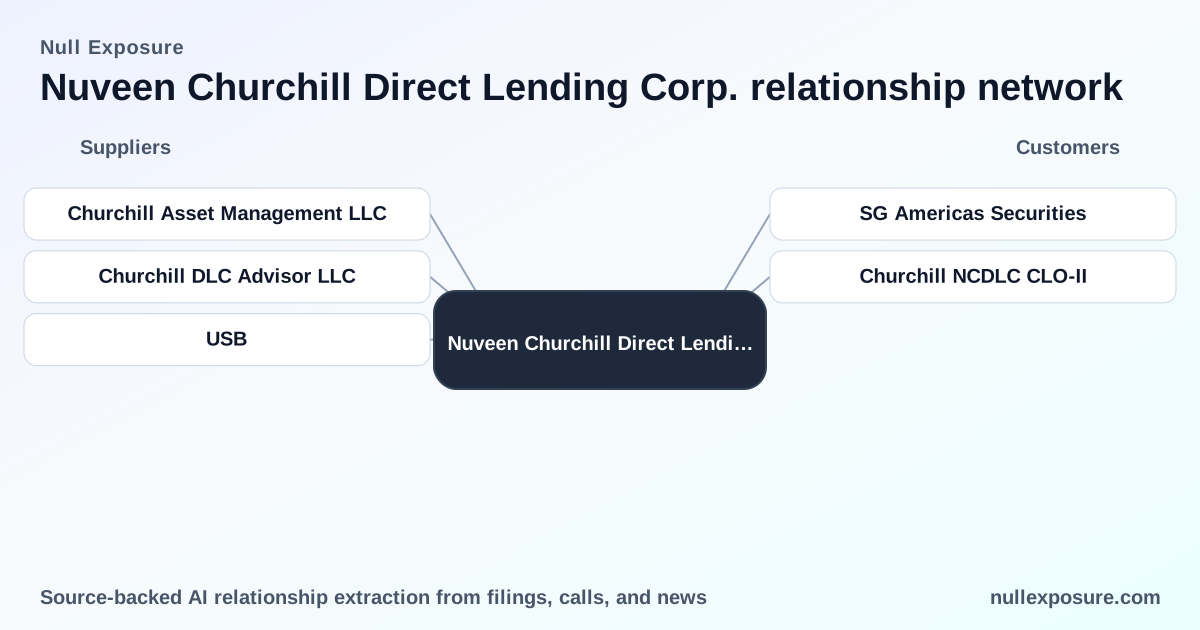
Nuveen Churchill Direct Lending (NCDL): the supplier map investors need
Nuveen Churchill Direct Lending Corp. (NCDL) is a closed-end business development company that earns income by originating and holding senior-secured loans to U.S. middle-market companies while outsourcing portfolio management and back‑office functions to affiliated managers. The company monetizes through interest income on loans, leverage provided by long‑dated debt and securitizations, and management arrangements that funnel portfolio execution to external advisers; equity holders receive returns from current income and capital appreciation under that externally-managed operating model. Learn more about the firm’s supplier footprint at https://nullexposure.com/.
How the business is structured and why suppliers matter
NCDL does not operate as a traditional self‑managed lender. The company is externally managed and relies on a triad of contractual and financing relationships to deliver yields: sub-advisory arrangements that source and service loans, an administration agreement that delivers corporate and compliance functions, and long‑term financing (notes, securitizations and credit facilities) that provides leverage. This structure concentrates operational execution and reputational risk in a small set of service providers, while shifting capital structure risk onto long‑term creditors and securitization counterparties.
Key structural points investors should note:
- External management and delegation: portfolio sourcing, underwriting and servicing are delegated to external advisers and sub‑advisers, making those relationships operationally critical.
- Leverage and long maturities: NCDL uses term securitizations, facilities and notes with multi‑year maturities to fund lending activity, creating cash‑flow and refinancing dynamics investors must monitor.
- Middle‑market focus and geography: the investment mandate centers on U.S. private equity–owned middle‑market companies, concentrating credit risk in a defined borrower segment.
If you want a consolidated view of supplier links and filings, visit https://nullexposure.com/.
Supplier relationships you need to track now
Below are the supplier relationships surfaced in recent filings and press coverage. Each is summarized in plain English with a concise source reference.
Churchill Asset Management LLC
Churchill is the company’s named sub‑adviser responsible for day‑to‑day portfolio management, including sourcing, structuring and monitoring middle‑market loans on NCDL’s behalf. According to the company’s Q3 2025 press release, Churchill performs the bulk of the active credit work under the CAM Sub‑Advisory Agreement. (Source: press release reported on The Globe and Mail, Q3 2025).
Churchill DLC Advisor LLC
Churchill DLC Advisor LLC is NCDL’s investment adviser and the contractual counterparty that oversees the adviser‑sub‑adviser relationship and receives management fees under the Advisory Agreement. The Adviser relationship is explicitly referenced in multiple distribution and earnings announcements through early 2026. (Source: company announcements on AIJourn and MarketScreener, March 2026).
U.S. Bank Trust Company
U.S. Bank Trust Company is named in recent filings as the trustee/indenture party for supplemental indentures tied to NCDL’s debt instruments, indicating its role in the company’s structured debt arrangements. The supplemental indenture filing was referenced in a March 2026 trading notice. (Source: TradingView news item referencing the supplemental indenture, March 2026).
What the relationship map implies for investors
The supplier set and the constraints embedded in NCDL’s documentation tell a coherent operational story. NCDL runs a lean corporate layer and outsources the entire investment stack—that is efficient for scaling but increases single‑point failure risk where advisers or administrators fail to perform. The constraint evidence supports several company‑level and relationship‑specific signals:
- Contracting posture: long‑term financed. NCDL uses notes and multiple term securitizations with maturities extending into the 2030s and multi‑year credit facilities, which create predictable funding but require attention to interest cost and refinancing risk. (Company‑level signal based on debt and securitization references in filings.)
- Contract variety and maturity: alongside long‑dated notes, the company had a subscription facility that expired in 2023 and a mix of revolving and special purpose vehicle facilities, demonstrating an active approach to diversified financing sources. (Company‑level signal.)
- Counterparty profile and focus: NCDL’s lending mandate targets U.S. middle‑market borrowers (core $10m–$100m EBITDA), concentrating credit exposure geographically and by borrower size class—this shapes portfolio sensitivity to the middle‑market economy. (Company‑level signal from investment objective language.)
- Service provider centrality: the Adviser (Churchill DLC Advisor LLC), sub‑adviser (Churchill Asset Management LLC) and the Administrator (Churchill BDC Administration LLC) are explicit, legally recognized service providers who execute essential functions, and the company has no internal investment staff—this elevates operational reliance on those contracts. (Relationship‑specific signal; excerpted from administration and advisory agreement language.)
- Governance and renewal posture: the board has actively reviewed and renewed advisory and sub‑advisory agreements following IPO, signaling continuity but also a reliance on formal renewals to preserve these critical relationships. (Company‑level signal based on Board approvals referenced in governance excerpts.)
Risks and monitoring priorities
Investors evaluating supplier relationships should focus on a short list of actionable monitoring items:
- Adviser continuity and compensation: confirm fee schedules, renewal terms and whether key personnel executing the strategy remain aligned with NCDL’s mandate. The investment engine is outsourced—if advisers change, execution changes.
- Debt maturity and covenants: track the timetable for long‑dated notes and the performance of securitizations; covenant stress or rising funding costs compress distributable income.
- Operational concentration: NCDL’s lack of employees heightens dependency on the Administrator and sub‑adviser; investors should read administration agreements and test service‑level continuity.
- Borrower mix within mid‑market: monitor sector and EBITDA concentration within the portfolio for correlated credit shocks.
For a full supplier‑relationship audit and ongoing monitoring tools, visit https://nullexposure.com/.
Practical checklist for investors and operators
- Review the Advisory and CAM Sub‑Advisory Agreements for termination rights and fee breakpoints.
- Map debt amortization and securitization roll windows against expected cash flows and loan prepayment behavior.
- Confirm trustee arrangements and whether any supplemental indentures alter priority or waterfall mechanics.
- Track board minutes and proxy disclosures for any future renewals or contested approvals that could change the adviser mix.
Bottom line and next steps
NCDL’s model is a partnership between capital and external expertise: it monetizes loans through interest and leverage while outsourcing execution to Churchill entities and relying on trust/indenture counterparties for financing. That design produces attractive scalability and clear sources of revenue, but it concentrates operational and governance risk in a small set of contractual relationships. Active investors should monitor adviser continuity, debt maturity profiles, and trustee arrangements as the primary axes of counterparty risk.
If you need a consolidated supplier risk brief or ongoing alerts tied to these counterparties, start here: https://nullexposure.com/.
This article synthesizes public disclosures and press reports through March 2026 to highlight the supplier footprint and the governance constraints that shape NCDL’s operating profile. For ongoing supplier intelligence and deeper document-level analysis, visit https://nullexposure.com/.