New Century Logistics (NCEW) — supplier relationships, operational posture, and what investors should know
New Century Logistics is a Hong Kong–based freight forwarder that monetizes through cross-border transportation services, booking and managing air and ocean cargo capacity, and value-added logistics for South China exporters. The company generates revenue by brokering and operating end-to-end shipments, leveraging third‑party carriers and strategic commercial partnerships to scale routes without heavy owned-asset investment; its profitability today is weak, so partnerships that increase yield or reduce operating cost are strategically critical. For more background on supplier exposures and monitoring tools, visit https://nullexposure.com/.
How New Century runs the business and where the economics come from
New Century operates as a classic integrator in the freight-forwarding sector: it sells door-to-door logistics and arbitrages carrier capacity while collecting fees, surcharges and service margins. Revenue is volume-driven and sensitive to carrier access, routing flexibility, and regional trade flows. The company’s public financials show meaningful scale in sales but persistent operating losses — Revenue TTM roughly $44.1 million with negative EBITDA and a large negative EPS — which makes successful supplier and carrier relationships essential to improving unit economics quickly.
Operational characteristics that define the commercial exposure:
- Contracting posture: Predominantly B2B contracting with carriers and shippers; relationships with airlines and freight partners act as the operational backbone rather than proprietary asset ownership.
- Concentration and liquidity: High insider ownership (about 67%) and extremely low institutional ownership indicate limited public float and meaningful shareholder concentration, which reduces market liquidity and increases execution risk on capital markets actions.
- Criticality of partners: Carriers and capacity providers are mission-critical; inability to secure air cargo capacity directly impacts revenue realization and customer retention.
- Maturity and financial resilience: Small market capitalization and negative margins position the firm in a high operational risk category until margins stabilize or capital is strengthened.
If you want continuous monitoring of supplier exposures and how they affect NCEW, explore practical tools at https://nullexposure.com/.
What the disclosed supplier relationships are and why each matters
The public relationship records for NCEW list two counterparty mentions that matter for operational reach and corporate history. Each is summarized below with source references.
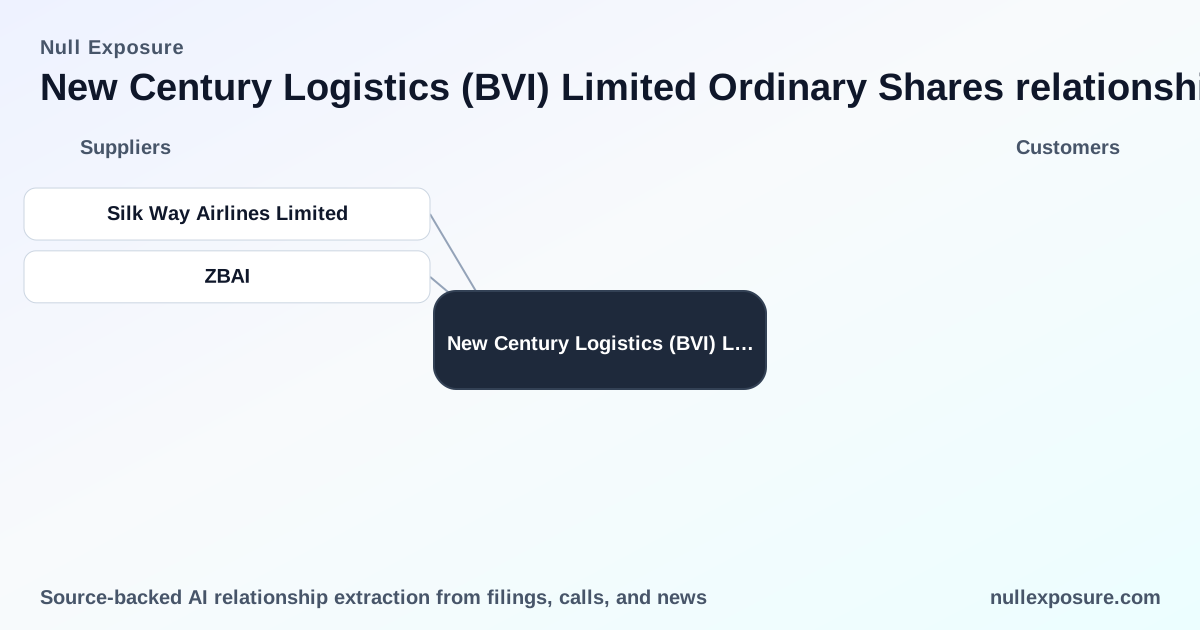
Silk Way Airlines Limited — expanding air capacity for South China routes
New Century announced a joint development effort with Silk Way Airlines to integrate Silk Way’s air cargo resources with New Century’s global logistics network to deliver end-to-end cross-border services for exporters in South China. This partnership is directly relevant to New Century’s ability to offer reliable air freight capacity and faster transit options, which should increase service attractiveness to cross-border trading enterprises. A Macau Business report covering New Century’s 2025 milestones described the joint development initiative (March 2026) — see https://macaubusiness.com/new-century-logistics-unveils-major-milestones-for-2025/.
ATIF (inferred symbol ZBAI) — role in the company’s Nasdaq listing narrative
Public references indicate ATIF was consulted in connection with New Century’s Nasdaq listing, positioning ATIF as an advisory or transactional contact during the listing process. This relationship speaks to capital markets and advisory links that enabled NCEW’s public listing, which is a foundational event for future fundraising or investor relations work. A company quote referenced on a Finviz company page points to PR Newswire coverage of the listing and the consulting role (FY2024) — see https://finviz.com/quote.ashx?t=NCEW.
What these relationships imply for investors and operators
Both disclosed relationships are strategically complementary: Silk Way expands operational capacity and route coverage, while ATIF’s involvement relates to capital-market access and corporate formation. For portfolio and operations managers, the takeaway is straightforward: supplier and advisory ties materially influence New Century’s ability to convert revenue into sustainable profits.
Key operational and investment implications:
- Revenue upside from carrier partnerships: The Silk Way relationship is a direct lever to increase air-freight throughput and service levels, which can improve yields per shipment if managed with disciplined pricing and cost pass-throughs.
- Execution risk due to weak margins: With negative operating margins and EBITDA, New Century’s current financial posture limits its ability to absorb shocks (rate volatility, fuel surcharges, seasonal drops). Supplier agreements that require prepayments or minimums increase liquidity strain.
- Governance and market-risk signals: High insider ownership and negligible institutional stake point to low free float and potential information asymmetry, so public trading dynamics can be volatile and sensitive to corporate announcements.
- Concentration and partner dependence: The business model relies on third-party carrier capacity rather than owned aircraft or terminals, so counterparty performance and contract terms are critical operational constraints.
Practical watch-list for the next 6–12 months:
- Execution milestones from the Silk Way initiative (volume ramp, service lanes launched).
- Any incremental carrier agreements that diversify capacity or improve margin capture.
- Balance-sheet actions or capital raises that shore up liquidity and reduce operating leverage.
- Changes in insider selling or any increase in institutional ownership as a sign of investor confidence.
How to act on this read
For investors evaluating NCEW equity or counterparties evaluating supplier risk, the focus should be on partner execution and measurable margin improvement. If supplier partnerships translate into consistent air cargo volumes and better routing economics, the equity case improves; if not, downside is driven by liquidity stress and market illiquidity. For real-time supplier monitoring and deeper due-diligence, visit https://nullexposure.com/ to map these exposures across counterparties and events.
Bottom line
New Century’s disclosed supplier relationships provide two clear strategic benefits: operational capacity through Silk Way and capital-markets traction via ATIF-related advisory. Those benefits are necessary but not sufficient to offset a fragile financial profile characterized by negative margins, small float, and concentrated insider control. Investors and operators should prioritize verification of partnership execution and balance-sheet strengthening before re-rating the company’s risk profile. For continued coverage and supplier relationship mapping, go to https://nullexposure.com/.