Neo-Concept International (NCI) — what the placement advisors tell investors about supplier posture and financing risk
Neo-Concept International Group Holdings (NCI) designs and manufactures apparel and monetizes through wholesale and branded garment sales, with the business financed episodically through capital markets activity rather than stable institutional ownership. The company operates as a small-cap, Hong Kong–based apparel manufacturer with USD 216.6M trailing revenue and a reliance on capital raises to manage liquidity and growth; recent placement transactions and the fee structure for those transactions are the most relevant supplier relationships for investors assessing counterparty and execution risk. For a concise vendor and placement-intelligence brief, visit https://nullexposure.com/.
Why the placement agents matter to a supplier-risk investor
Neo-Concept’s commercial model is capital-sensitive: manufacturing and order cycles require working capital and periodic equity or placement raisings. The company’s market capitalization of roughly USD 117.8M against TTM revenue of USD 216.6M signals a thin market valuation relative to sales, and the firm’s low institutional ownership (0.064%) and higher insider stake (14.81%) indicate a shareholder base that is concentrated and oriented to control rather than broad-market support. Placement agents therefore play a dual role for NCI: they enable access to immediate funding and they influence market reception of equity actions. Learn more supplier intelligence at https://nullexposure.com/.
- Operational implication: When NCI turns to external placement agents, those vendors are executing transactions that directly affect liquidity, share float, and short-term valuation volatility.
- Contracting posture: The observed placement terms show NCI is willing to pay premium placement fees for speed and coverage — a sign that capital access is prioritized over fee minimization in certain financings.
Placement counterparties observed in recent media
Below I cover every placement or placement-adjacent relationship recorded in the source set and provide a plain-English summary for each.
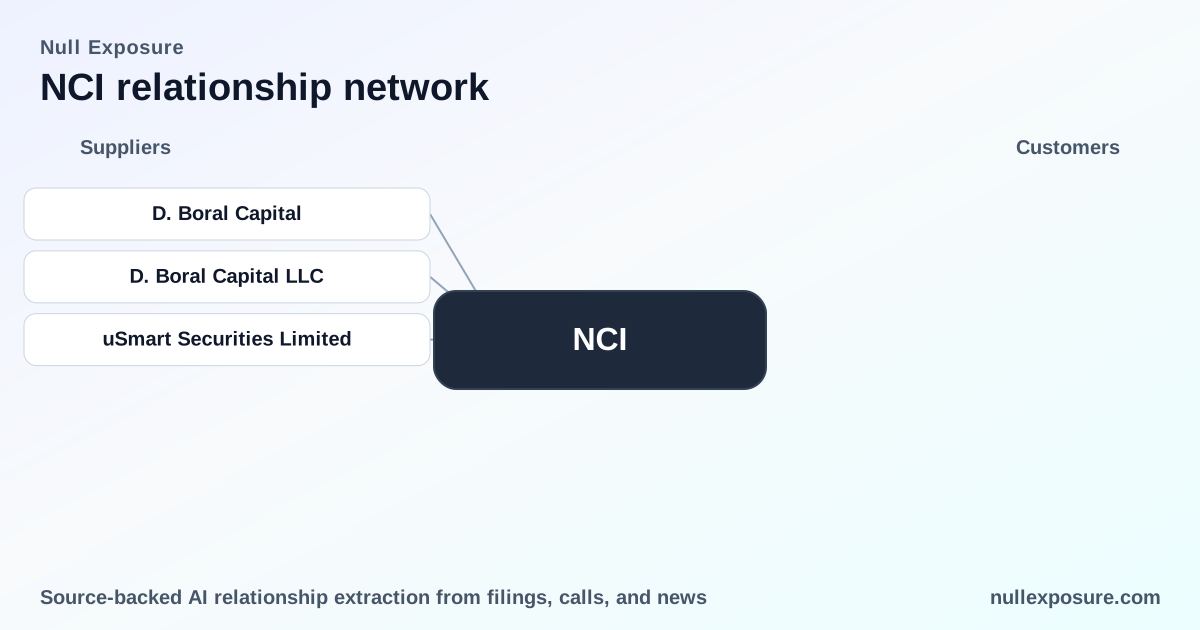
D. Boral Capital
Neo-Concept engaged D. Boral Capital as a placement participant, with reporting that the firm was entitled to a 5% cash fee as lead placement agent as well as expense reimbursement capped at up to $100,000, and that a final prospectus was filed on February 11, 2026. According to a March 10, 2026 news piece on bez-kabli, those explicit fee terms were the focal point of investor attention during the after-hours volatility that followed the share sale announcement (https://www.bez-kabli.pl/nci-stock-price-whipsaws-neo-concept-shares-triple-then-sink-after-hours-on-share-sale-fallout/).
D. Boral Capital LLC
Multiple press outlets reported that D. Boral Capital LLC acted as lead placement agent on the FY2026 offering, with the firm named consistently across syndicated coverage of the transaction. A March 10, 2026 Bitget news post cites D. Boral Capital LLC in the role of lead placement agent alongside joint agents and confirms the timing and market messaging around the placement (https://www.bitget.com/amp/news/detail/12560605199172).
uSmart Securities Limited
uSmart Securities Limited served as a joint placement agent on the same FY2026 transaction, working with D. Boral Capital LLC to distribute the offering. Bitget coverage on March 10, 2026 explicitly lists uSmart Securities Limited as the joint placement agent, placing the firm in the operational chain that widened the float and contributed to short-term share-price impacts (https://www.bitget.com/amp/news/detail/12560605199172).
What these relationships reveal about NCI’s operating and financing model
The placement-agent relationships and fee disclosures are not vendor trivia — they are signals about how NCI sources capital and manages execution risk.
- Contracting posture: NCI is willing to pay meaningful placement fees (reported 5% cash fee) and expense reimbursement to secure distribution and speed of execution. That posture signals a pragmatic, execution-first approach to capital raises rather than selective bargaining for lower fees.
- Concentration and control: With insiders holding a material share of equity and institutional ownership at negligible levels, equity placements are a primary mechanism for liquidity and float adjustments rather than long-term institutional streams. External agents therefore carry outsized influence when capital events occur.
- Criticality of relationships: Placement agents are critical for NCI in the short term because market-based capital infusions are used to manage cash flow and potentially scale production; disruptions in placement capacity or reputational friction could materially affect NCI’s access to capital.
- Maturity and market positioning: Neo-Concept sits in a mid-revenue, small-cap bracket (USD 216.6M revenue, market cap ~USD 117.8M) where costs of capital are elevated and perceived financing friction leads to reliance on specialized placement houses rather than broad underwriter syndicates.
Risk implications for investors and counterparties
- Execution risk: The combination of premium placement fees and low institutional support increases the probability of dilutive financings and post-offering volatility. That dynamic elevates short-term execution risk for creditors and suppliers who rely on timely payment cycles.
- Counterparty concentration: Repeated use of the same placement advisors concentrates execution risk with those counterparties; any reputational or performance issue at those firms would have outsized impact on NCI’s ability to raise follow-on capital.
- Governance signal: A meaningful insider ownership share coupled with thin institutional participation suggests governance dynamics that favor control, which can influence strategic choices about when and how to access third-party capital.
If you are tracking supplier credit exposure or evaluating counterparty risk for procurement teams, these are actionable signals to incorporate into aging and payment forecasts. For an expanded supplier risk brief and monitoring setup, see https://nullexposure.com/.
Tactical takeaways for investors and operators
- Monitor placement filings and fee disclosures as near-real-time indicators of liquidity stress or strategic capital deployment; the February 2026 prospectus and March 2026 coverage illustrate how quickly market sentiment can move.
- Stress-test supplier payment windows against potential dilutive financings: a company willing to pay 5% placement fees is prioritizing speed of capital over fee efficiency — that behavior correlates with episodic liquidity needs.
- Treat placement-agent continuity as a risk factor: repeated use of a small set of placement agents implies single-point execution risk; diversify your counterparty exposure if you are a supplier or lender.
Conclusion — actionable next steps
Neo-Concept’s recent placement activity is an operational lens into its capital strategy: the company leverages external placement agents with meaningful fees to secure funding quickly, reflecting a capital-sensitive operating model. Investors and suppliers should prioritize monitoring prospectus filings and placement-agent disclosures as forward indicators of liquidity events and counterparty pressure.
For bespoke supplier intelligence and live monitoring of placement activity and counterparty exposure, visit https://nullexposure.com/ and request a vendor-risk briefing.