Northann Corp. (NCL) — supplier map, near-term dilution mechanics, and what operators need to know
Northann Corp. runs an integrated maritime and logistics business that combines physical shipping, supply-chain services and a growing push into software-enabled logistics platforms; it monetizes through freight and logistics fees, supply-chain management contracts and newly acquired software assets that the company intends to fold into its operating stack. Recent supplier arrangements are notable because NCL is paying for strategic technology and advisory services largely with equity—creating near-term dilution and governance conditions tied to NYSE American approvals that directly affect investor returns.
If you want a single-click view of supplier exposures and contractual signals for diligence, visit https://nullexposure.com/ for more supplier intelligence and sourcing context.
What the supplier footprint reveals about operating posture and constraints
NCL’s supplier disclosures and recent transaction headlines present a company with spot-oriented sourcing, regional concentration in APAC input markets, and a material concentration among a small number of vendors. These characteristics shape procurement flexibility, cost volatility and supplier negotiation leverage.
- Contracting posture — spot purchases: NCL states that it orders raw materials based on immediate needs rather than long-term supply agreements, which gives operational flexibility but increases exposure to input-price volatility and supply shocks (company filing, FY2024 10‑K).
- Geographic concentration — APAC sourcing: Raw material inputs — powders, coatings and inks — are primarily sourced from suppliers in China and Japan, concentrating upstream geopolitical and logistics risk in the Asia‑Pacific region (FY2024 10‑K).
- Supplier concentration — material suppliers matter: NCL discloses that three suppliers accounted for ~38.6% of total cost of revenues in FY2024 and five suppliers accounted for ~48% of cost of revenues, indicating material supplier concentration that elevates single‑counterparty risk for production continuity (FY2024 10‑K).
- Third‑party service reliance and cybersecurity exposure: The company explicitly uses third‑party service providers for critical functions and incident response support, which introduces vendor‑risk vectors beyond physical suppliers (FY2024 10‑K).
- Outsourced distribution and manufacturing partners named in filings: NCL routes wholesale/distribution operations through Benchwick and performs much of its manufacturing via NCP, indicating reliance on named channel and manufacturing partners for execution (FY2024 10‑K).
These are company-level signals drawn from NCL’s disclosures; they define the procurement and operational constraints that investors should bake into scenario models for margin stress, capex prioritization and counterparty disruption.
If you’re running supplier diligence projects or stress-testing counterparties, start your checklist at https://nullexposure.com/ — the platform centralizes the exact relationship signals that matter to underwriters and operators.
Relationship roll call — every supplier/result cited in filings and coverage
Below I list each relationship item surfaced in the review with a concise plain‑English summary and the attributable source.
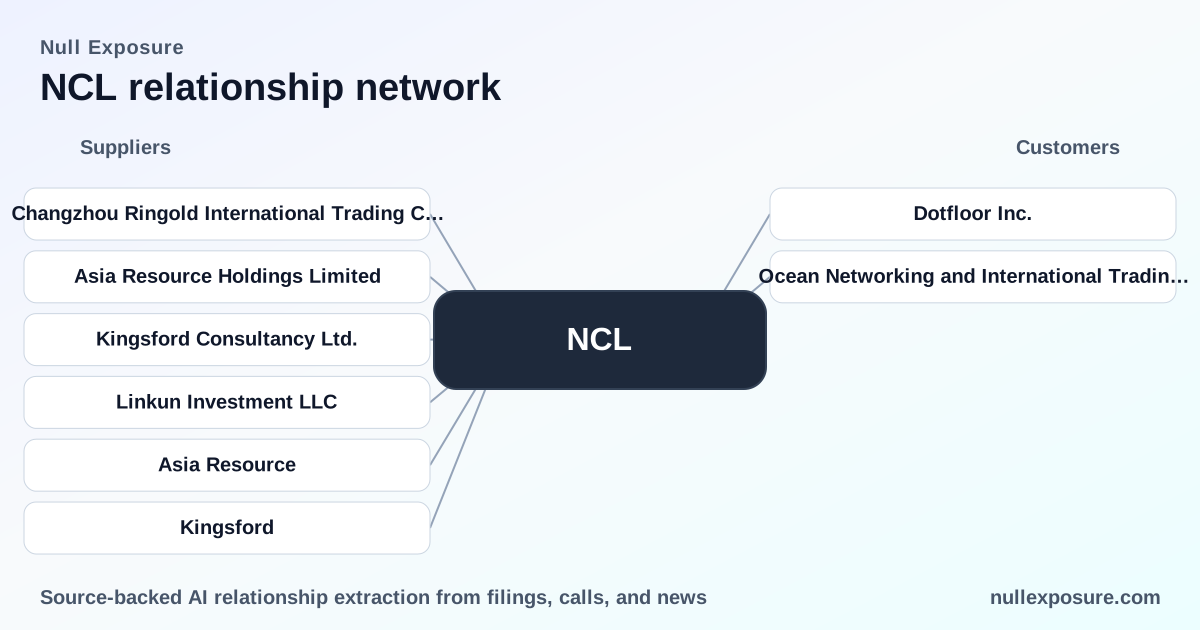
- Changzhou Ringold International Trading Co., Ltd.: NCL states that raw materials are procured through Ringold, indicating Ringold operates as a sourcing conduit for inputs used in production (NCL FY2024 10‑K, ncl‑2024‑12‑31).
- Asia Resource Holdings Limited (development agreement): NCL disclosed a $6.0 million development agreement with Asia Resource to deliver a customized software platform, with payment structured as 15,000,000 shares at $0.40 per share payable in tranches subject to stockholder and NYSE American approval (reported by ts2.tech, March 10, 2026).
- Kingsford Consultancy Ltd. (asset purchase agreement): NCL entered an asset purchase agreement to acquire supply‑chain‑management software from Kingsford for $5.0 million, to be settled with 12,500,000 shares at $0.40 per share, with closing conditioned on stockholder and NYSE approval (reported by ts2.tech, March 10, 2026).
- Linkun Investment LLC (financing and advisory): NCL agreed a six‑month financing and strategic planning advisory engagement with Linkun, compensated with 1,800,000 common shares to individuals designated by Linkun, issuable only after NYSE American approval (reported by ts2.tech, March 10, 2026).
- Linkun Investment LLC (proxy disclosure): The company’s proxy materials reiterate Linkun’s advisory engagement and the 1,800,000‑share compensation contingent on NYSE American approval (ts2.tech coverage of the Dec. 26, 2025 trading halt and proxy, December 26, 2025).
- Asia Resource (proxy proposal): NCL’s proxy lists a proposal to issue 15,000,000 shares tied to the development agreement with Asia Resource for the customized software platform (proxy disclosure summarized by ts2.tech, December 26, 2025).
- Kingsford (proxy proposal): NCL’s proxy also lists a proposal to issue 12,500,000 shares to a designee of Kingsford under the asset purchase agreement dated Nov. 23, 2025 (proxy disclosure summarized by ts2.tech, December 26, 2025).
Each of these items is directly documented in NCL’s FY2024 filing or covered in news reports and proxy summaries; the repeated appearance of equity‑for‑services deals is the consistent theme across the March 2026 and December 2025 reports.
What these supplier arrangements mean for investors and operators
The recent deals are strategically coherent—NCL is acquiring software and advisory capabilities to accelerate its logistics platform—but they carry concrete investor implications:
- Dilution and governance risk are front and center. Payment in common stock (totaling tens of millions of shares across agreements) requires shareholder and exchange approvals and compresses existing equity value until approved. News coverage emphasizes pending NYSE American approval windows and related compliance deadlines (ts2.tech reporting, Dec 2025–Mar 2026).
- Execution dependency on counterparty integrations. Acquiring third‑party software assets creates integration and product‑market fit risk; success depends on rapid integration with NCL’s core freight and distribution operations that are already concentrated among a few suppliers.
- Supply shock vulnerability from APAC concentration and spot contracting. NCL’s spot‑purchasing model and concentration in Chinese and Japanese suppliers create both flexibility and acute exposure to shipping disruptions, raw‑material shortages, or tariff shocks (FY2024 10‑K).
- Regulatory and listing risk. Several issuances are explicitly conditioned on NYSE American approval and Section 4(a)(2) exemptions, so listing‑related gating is a near‑term operational constraint that can delay or prevent the contemplated payments (proxy disclosures summarized in media coverage).
Bottom line and recommended actions
Northann is executing a clear strategy to build software‑enabled logistics capabilities by swapping equity for technology and advisory services. That strategy accelerates capability at low cash cost but concentrates near‑term dilution, introduces integration execution risk, and leaves the company exposed to APAC supply volatility. For investors, the priority is monitoring NYSE American approval processes, the timing of share issuances, and any proxy outcomes that could change dilution assumptions.
For teams underwriting supplier risk, procurement continuity planning and cyber‑vendor oversight should be prioritized given NCL’s reliance on third‑party service providers and material supplier concentration.
For comprehensive tracking of these supplier signals and to align diligence with market events, visit https://nullexposure.com/ — the homepage aggregates filing‑level relationship signals and timelines.
Concluding: NCL’s supplier moves are strategically aggressive and readable; they are high‑impact for equity holders and operationally meaningful for partners and customers. Monitor approval milestones and the integration cadence closely—those events will determine whether these equity‑financed deals are value‑accretive or value‑dilutive for existing stakeholders.
For a consolidated supplier risk profile and ongoing event alerts tied to NCL and peers, go to https://nullexposure.com/.