Norwegian Cruise Line Holdings (NCLH): Supplier Relationships and Strategic Implications
Norwegian Cruise Line Holdings operates a global cruise platform that monetizes through three interlocking revenue streams: passenger ticket sales, onboard and ancillaries (F&B, premium experiences, and casino), and fleet capacity growth enabled by long‑term shipbuilding contracts. The company is capital‑intensive and growth is driven by the pace of new ship deliveries and onboard revenue per passenger; recent financials show TTM revenue of $9.83 billion and EBITDA of $2.55 billion, with a market capitalization near $9.04 billion—figures that frame how supplier relationships scale both cost and growth. For a structured view of counterparties and supplier risk, see the full NCLH supplier profiles at https://nullexposure.com/.
Why suppliers matter more for a cruise operator than a typical leisure company
Cruise operators are uniquely dependent on a small set of high‑value, long‑duration supplier contracts. Shipbuilders determine capacity, timing and balance‑sheet funding cadence; hospitality vendors influence onboard margins and guest experience; and finance and insurance counterparties underwrite working capital and vessel risk. The combination produces three critical characteristics:
- Capital concentration: Large, multi‑year ship orders drive multi‑billion dollar contracted spend and set the company’s fleet growth profile.
- Operational criticality: A handful of suppliers—shipyards, hotel services vendors, and certain technology and payment providers—directly affect revenue per passenger and delivery schedules.
- Currency and contract complexity: Many ship contracts are denominated in euros and other currencies, creating direct FX and procurement scheduling exposure.
These are not abstract risks; they are core to NCLH’s operating model and how investors should evaluate supplier counterparty health. Learn more about supplier counterparty signals at https://nullexposure.com/.
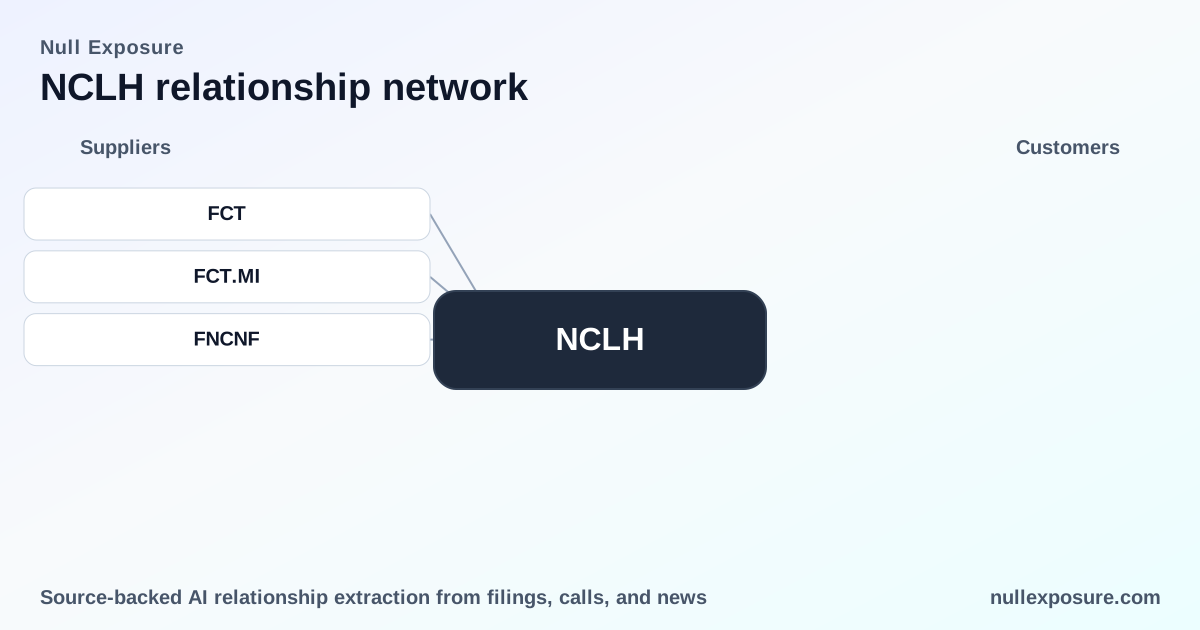
Recent supplier activity: multiple reports all point to Fincantieri
The supplier news in the provided results is concentrated on a single counterparty: Fincantieri, the Italian shipbuilder. The sources document both a large new order and a recent vessel delivery. Below are the individual items from the record, each handled distinctly.
-
Simply Wall St reported that in February 2026 NCLH replaced its CEO and signed a more than €4 billion three‑ship order with Fincantieri for deliveries through 2037 across its three brands (Simply Wall St, March 10, 2026).
Source: https://simplywall.st/stocks/us/consumer-services/nyse-nclh/norwegian-cruise-line-holdings/news/what-norwegian-cruise-line-holdings-nclhs-ceo-shake-up-and-e -
An alternate Simply Wall St amp link carries the same item noting the €4 billion three‑ship order and leadership change, reiterating that the agreement extends fleet planning into the late 2030s (Simply Wall St, March 10, 2026).
Source: https://simplywall.st/stocks/us/consumer-services/nyse-nclh/norwegian-cruise-line-holdings/news/what-norwegian-cruise-line-holdings-nclhs-ceo-shake-up-and-e/amp -
Marinelink documented that Fincantieri delivered the Norwegian Luna at its Marghera shipyard, a second vessel in the expanded Prima Plus class, signaling ongoing fulfillment of prior construction programs (Marinelink, March 10, 2026).
Source: https://www.marinelink.com/news/fincantieri-delivers-norwegian-luna-536571 -
Cyprus Shipping News noted the Norwegian Luna delivery and emphasized the human and partner resources involved, and that the delivery came shortly after the announcement of the major Fincantieri three‑ship agreement (Cyprus Shipping News, March 10, 2026).
Source: https://cyprusshippingnews.com/2026/03/10/fincantieri-delivers-norwegian-luna-in-marghera/ -
Ships Monthly reported that Fincantieri secured the three‑ship order from NCLH, reinforcing a long‑standing collaboration between the two companies and the shipbuilder’s role in NCLH’s next‑generation fleet strategy (Ships Monthly, March 10, 2026).
Source: https://shipsmonthly.com/news/fincantieri-secures-order-from-norwegian-cruise-line-for-three-new-cruise-ships/
Collectively these items show both execution (vessel delivery) and a material new build order, underlining Fincantieri’s role as a strategic shipbuilder for NCLH.
What the constraints tell investors about NCLH’s supplier posture
The company‑level constraints extracted from filings and disclosures create a clear profile of supplier risk and contracting behavior:
- Counterparties are primarily large enterprises: NCLH states it conducts business with large, well‑established financial institutions and insurers, limiting credit concentration in financial services but not eliminating operational supplier concentration.
- Global footprint: Leases and offices span NA, EMEA, APAC and LATAM, reflecting a geographically diversified operations base that requires multinational supplier arrangements and regional vendor management.
- Manufacturer role and currency exposure: The company explicitly references ship construction contracts often denominated in euros or other foreign currencies, signaling meaningful FX risk on capital projects.
- Service provider dependency: Filings note reliance on external hotel management, technology, and payment processing suppliers, and in at least one area NCLH contracts a single vendor for a broad range of hotel and restaurant services—a clear operational concentration that affects margins and resilience.
- Spend scale: The disclosed pipeline—13 ships on order with combined contract prices of ~€17.5 billion as of December 31, 2024—demonstrates multi‑year, >$100m spend bands that anchor NCLH’s capital plan.
These constraints are company‑level signals and should shape both counterparty due diligence and scenario planning for investors. For provider‑level intelligence and deeper supplier maps, visit https://nullexposure.com/.
Investment implications: what to watch next
- Capacity and delivery cadence: The new three‑ship order with Fincantieri locks in future capacity and capital commitments; investors must monitor delivery timing and any schedule slippage.
- Margin sensitivity to supplier costs and FX: Shipbuilding and vendor contracts priced in euros translate to direct FX exposure; rising euro costs would pressure cashflow unless hedged or passed to pricing.
- Concentration risk in hotel services: The single‑vendor arrangement for many onboard services is an operational lever—service quality or cost changes at this vendor will show up quickly in onboard revenue and guest satisfaction.
- Counterparty health of major shipbuilders: Fincantieri’s ability to deliver on schedule and control costs is a direct driver of NCLH’s capacity growth; the recent delivery of Norwegian Luna is a positive signal on execution.
Bottom line and recommended actions
Fincantieri is a strategically critical supplier for NCLH, demonstrated by a recent vessel delivery and a material multi‑billion euro new‑build agreement that extends deliveries into 2037. Company filings and disclosures portray NCLH as operating with large enterprise counterparties and significant capital commitments, producing high supplier concentration and meaningful currency exposure that investors should factor into valuation and downside scenarios.
For portfolio managers and operators focused on supplier risk, track delivery schedules, vendor contract terms (especially single‑vendor service agreements), and FX hedging for euro‑denominated builds. For a consolidated view of NCLH counterparties and risk signals, visit https://nullexposure.com/.
Explore detailed supplier profiles and ongoing updates at https://nullexposure.com/ — a practical next step for investors evaluating counterparty exposure and operational resilience.