nCino (NCNO): supplier posture, partner signaling, and what it means for investors
nCino delivers cloud-native banking software to financial institutions and monetizes primarily through subscription and hosting fees, supplemented by implementation and professional services. The company packages its applications on top of the Salesforce Platform and remits platform subscriptions as part of customer deals, while also entering into multi-year hosting and license purchase commitments. For investors, the critical questions are how embedded third-party hosting (notably Salesforce) shapes operating leverage and vendor concentration, and how new partnerships (for example, distribution tie-ups in mortgage and insurance) drive incremental usage and cross-sell.
Explore supplier intelligence on Null Exposure
Why supplier relationships matter for a SaaS banktech vendor
nCino’s economics depend on predictable recurring revenue and controllable hosting costs. The company’s supplier posture shows long-term contractual commitments for platform and hosting services and a pattern of non-cancellable purchase obligations for licenses and hosting. Those features translate into a more predictable cost base but also to vendor concentration risk where a single platform partner can influence margins and product delivery timelines.
- Contracting posture: nCino extended its agreement with Salesforce through January 31, 2031, with automatic one-year renewals thereafter; termination rights are limited to material breach, bankruptcy, change in control to a direct competitor, or IP infringement, per the company’s December 20, 2023 filing. This is a deeply embedded relationship that creates operational coupling to Salesforce’s platform and pricing behavior.
- Buyer profile and cost structure: The company reports non-cancellable purchase commitments for licenses and hosting services, reflecting a committed, recurring cash outflow that supports its SaaS delivery model but reduces short-term flexibility.
- Service dependency: When nCino sells client onboarding, loan origination, and deposit account opening solutions, it includes a Salesforce Platform subscription and remits a subscription fee while Salesforce provides hosting infrastructure and configuration capabilities—making that supplier role functionally critical to nCino’s delivery.
- Segment signal: Purchase commitments are concentrated in services—licenses and hosting—so supplier risk maps directly to product delivery and gross margin resilience.
How this supplier posture reshapes risk and upside
Operationally, long-term platform agreements reduce variability in infrastructure availability and support go-to-market scale; strategically, they create a single-provider dependency that limits nCino’s ability to diversify hosting and platform economics quickly. Financially, this shows up as predictable gross profit (Revenue TTM: $586.5M, Gross Profit TTM: $353.8M) but also exposes margins to changes in third-party fees and contract renewals.
nCino’s operating margin (TTM ~8.2%) and reported EBITDA ($53.7M) indicate the company has room to scale if revenue growth accelerates, but the company also carries non-cancellable purchase commitments that anchor a fixed-cost base. Investors should treat platform supplier terms as a lever on gross margin expansion and a possible bottleneck on margin improvement if third-party fees escalate or availability shifts.
Explore supplier insights on Null Exposure
Relationship inventory: what the records show (complete list from results)
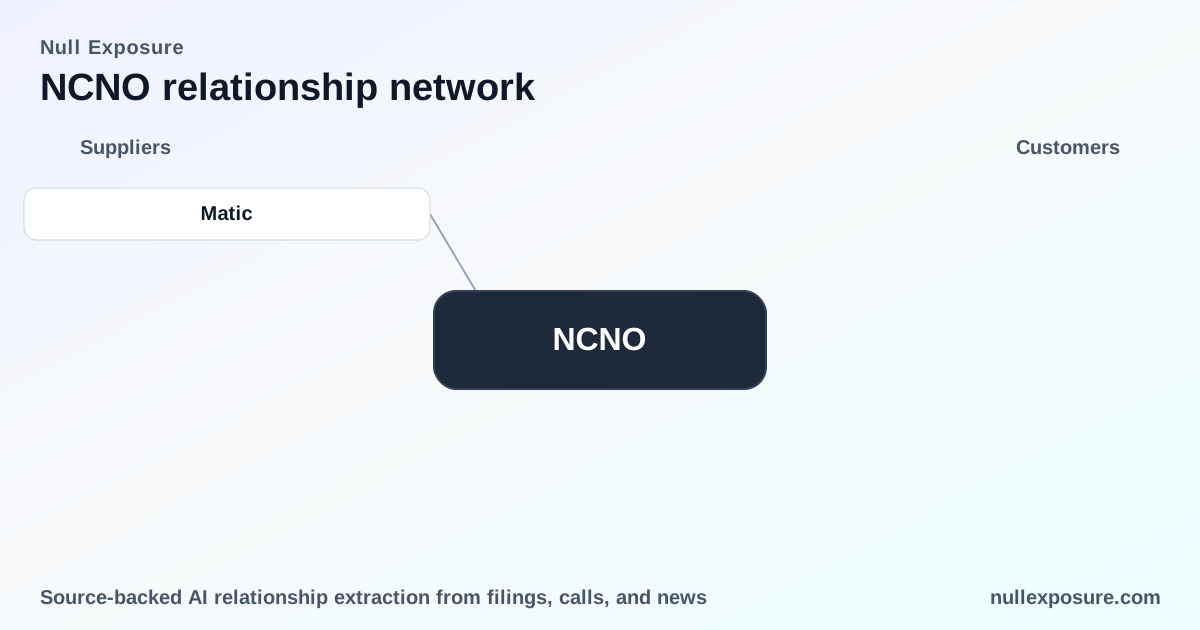
Matic — A Simply Wall St news item dated March 10, 2026 describes a new partnership where Matic integrates a home insurance marketplace into nCino’s mortgage point-of-sale product, a strategic push into ancillary mortgage services that can deepen customer workflows and generate referral or marketplace revenue inside lending use cases. (Source: Simply Wall St news, March 10, 2026; reporting on FY2026 partnership announcement.)
(That listing is the complete set of supplier/partner relationships surfaced in the supplied results.)
Salesforce: the platform anchor (constraints-driven signal)
The company’s own disclosures show an amended agreement with Salesforce extended to January 31, 2031, with automatic one-year renewals and defined termination triggers, and that nCino resells or bundles Salesforce Platform subscriptions while Salesforce provides the hosting infrastructure and configuration features for nCino applications (per company filings). That makes Salesforce both a critical service provider and an embedded component of nCino’s go-to-market. Investors should evaluate contract renewal economics, the potential for pricing pass-through, and the operational risk of platform changes.
What investors should watch next
- Monitor contract renewal language and any changes to the Salesforce relationship: the 2031 term and automatic renewals create stability but also concentration risk; any renegotiation could be a material margin event.
- Track adoption and monetization from partner integrations like Matic: marketplace or referral models inside mortgage workflows can expand ARPU without high incremental hosting cost, but their actual revenue contribution requires careful disclosure.
- Watch purchase commitments and hosting spend in disclosures: non-cancellable commitments raise the floor on operating costs, so revenue growth must outpace fixed obligations for margin improvement.
- Consider valuation in light of supplier risk: the market values nCino at roughly $1.76B with a Price/Sales around 3.0 and EV/EBITDA near 42x; supplier concentration influences how to discount future free cash flow scenarios.
Practical investor actions
- Revisit filings for any near-term amendments to the Salesforce agreement and quantify the portion of platform spend that is resold versus directly incurred by customers.
- Evaluate partner announcements (like the Matic integration) for contractual economics: referral fees, marketplace margins, and whether the partnerships require additional hosting or development investment.
- Use supplier intelligence to stress-test margin scenarios under different renewal/pricing outcomes and model sensitivity to hosting cost inflation.
Explore more supplier-driven research on Null Exposure
Conclusion — nCino’s model delivers recurring, subscription-based revenue and benefits from the scalability of a cloud delivery stack, but that same architecture creates vendor concentration and committed cost structures that are first-order risks for profitability. Partnerships such as the Matic integration present clear upside for product-led revenue expansion inside mortgage workflows; the net outcome for investors depends on how nCino manages platform economics, contract renewals, and the conversion of partner integrations into measurable revenue.