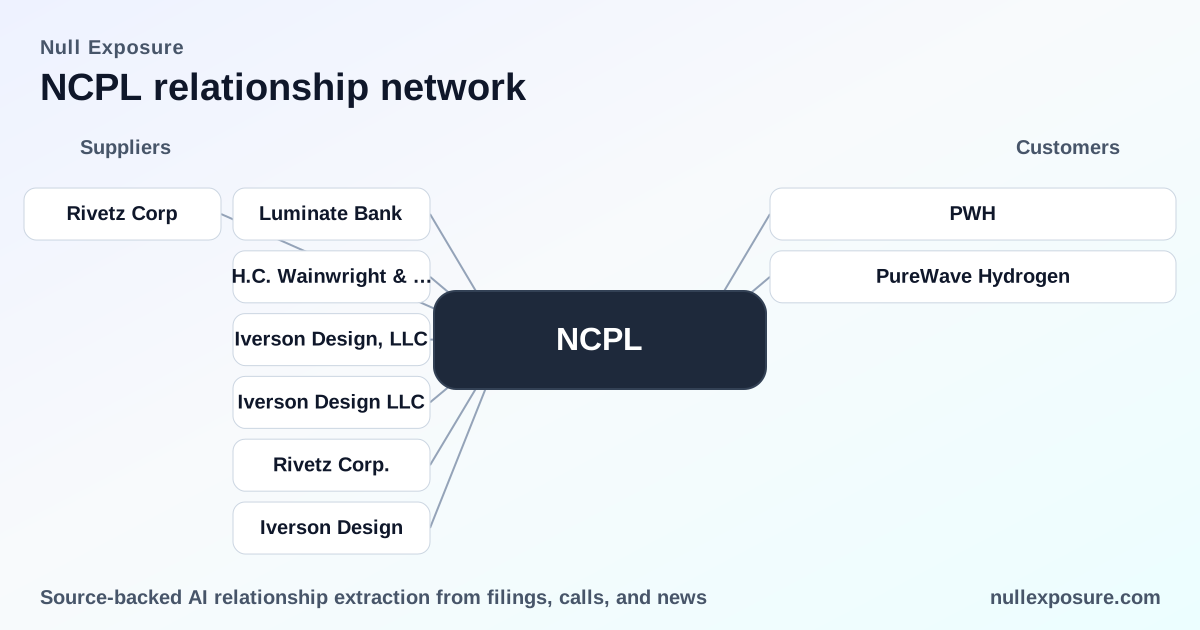
Netcapital (NCPL) — supplier map and what it means for investors
Netcapital operates a capital-raising and secondary trading platform that connects issuers and investors while monetizing through transaction fees, placement and sales arrangements, and selectively monetized technology/licensing. The company combines a regulated funding portal with an expanding stack of digital asset and design technologies acquired to support tokenization services; revenue is small relative to operating losses, so supplier relationships and licensed technology are central to execution and cost structure. For a concise supplier-risk assessment and ongoing monitoring, visit https://nullexposure.com/.
How Netcapital runs the plumbing for capital formation
Netcapital’s operating model is built on three interdependent components: the escrow and payment rails that clear investor funds, the sales and distribution partners that place capital, and the software and IP that run the portal and enable new products (tokenization, design and security features). That architecture explains why Netcapital both pays for third‑party services and acquires capability when services require deeper integration. Escrow services are single‑point critical, sales agents are transactional and commission‑driven, and the company is actively converting vendor capabilities into owned IP through asset purchases.
Explore deeper supplier relationships and risk signals at https://nullexposure.com/.
Relationship snapshots investors need to know
Below are each supplier relationship identified in public filings and coverage, written in plain English with source context.
Luminate Bank — escrow services (FY2025)
Netcapital states that it relies on Luminate Bank for all escrow services related to offerings on its platform, making Luminate the operational gatekeeper for investor funds and closing. This dependency is disclosed in the FY2025 10‑K filing. (NCPL FY2025 10‑K)
H.C. Wainwright & Co. — placement and ATM sales agent (FY2025–FY2026)
H.C. Wainwright acted as the exclusive placement agent for a registered direct offering and has served as sales agent under an at‑the‑market (ATM) program, with the company paying a commission (reported at a 3.0% commission rate in filings). Press coverage and company disclosures from FY2025–FY2026 report Wainwright’s role in equity placement activity. (QuiverQuant press coverage and company ATM disclosures, Mar 2026; NCPL filings referencing ATM Agreement Aug 23, 2024)
Iverson Design, LLC / Iverson Design — asset acquisition for design and tokenization (FY2026)
Netcapital acquired the assets and full intellectual property portfolio of Iverson Design’s creative studio, including an AI‑driven design, animation and real‑time rendering suite, to accelerate its tokenization and digital asset product roadmap. The acquisition was reported across industry press in early 2026. (QuiverQuant, CityBiz, SahmCapital, Mar 2026)
Rivetz Corp. / Rivetz Corp. — cybersecurity platform assets (FY2025)
Netcapital acquired assets from Rivetz Corp. related to a cybersecurity developer platform, positioning the company to strengthen platform security and developer tooling. This transaction is disclosed in SEC filings and reported in market outlets in late 2025. (TradingView/Reuters SEC filing notice, Dec 2025)
What the supplier map implies about governance, concentration and strategy
-
Single‑point criticality on escrow. The disclosure that Netcapital “currently rely[s] on Luminate Bank to provide all escrow services” is a high‑importance operational fact: escrow is mission‑critical for every offering and represents a concentration risk in the event of service disruption, contract dispute, or regulatory constraints. (NCPL FY2025 10‑K)
-
Hybrid contracting posture: licensing plus acquisitions. Netcapital’s public disclosures show active licensing arrangements (including a royalty‑free perpetual license from Horizon Globex GmbH in exchange for equity) and licensing of core funding‑portal technology from Netcapital Systems LLC, alongside asset purchases of specialized technology (Iverson, Rivetz). Those dynamics indicate a pragmatic mix of licensing to accelerate capability and acquisitions to internalize IP and reduce vendor dependency. (NCPL FY2025 and contract excerpts, Jun 26, 2025; asset purchase reports, FY2025–FY2026)
-
Sales and capital‑markets relationships are transactional but material. The ATM arrangement and placement activity with H.C. Wainwright are revenue enabling and directly affect balance sheet financing and liquidity; Wainwright’s role is fee‑based and repeatable, not strategic infrastructure, but critical to capital access. (ATM Agreement disclosures and press, FY2025–FY2026)
-
Concentration and insider ownership dynamics. Netcapital’s tech license from Netcapital Systems LLC is notable because of founder ownership overlap (the founder holds a material interest in the licensor), which creates a related‑party dynamic investors must monitor for pricing, renewal terms, and governance. Payments under that license were disclosed ($95k and $195k in recent years). Those facts signal contractual concentration and governance sensitivity rather than pure market procurement. (NCPL FY2025 excerpts)
-
Capability maturation through M&A. Acquisitions of Iverson’s design IP and Rivetz’s security assets are deliberate moves to internalize capabilities and reduce long‑term supplier exposure while enabling product differentiation in tokenization services. Those purchases shift the company toward owned technology rather than perpetual vendor dependence. (Mar 2026 press reports; Dec 2025 SEC filing)
Risks and investment takeaways
- Operational risk is concentrated because one bank handles all escrow flows; any disruption or change in the relationship is material to transaction execution. (NCPL FY2025 10‑K)
- Governance risks exist where licensing arrangements involve related parties; the company’s reliance on founder‑affiliated licensors requires active disclosure and board oversight. (NCPL licensing excerpts)
- Strategic upside from M&A is tangible: acquiring Iverson and Rivetz gives Netcapital proprietary IP that supports higher‑margin tokenization services versus pure platform fees reported in its modest revenue base. (Mar 2026 coverage; Dec 2025 SEC filing)
- Financing dependency impacts execution: Wainwright’s ATM and placement activity are necessary to fund operations and growth, which makes pricing and access to capital a continuing variable for investors. (ATM Agreement disclosures; Mar 2026 press)
Mid‑analysis action: for ongoing tracking of these supplier relationships and the implications for valuation and operational risk, see https://nullexposure.com/.
Conclusion — where suppliers influence valuation
Netcapital’s supplier footprint shows a company transitioning from vendor dependence toward owned capability while retaining essential third‑party relationships for escrow and capital distribution. Escrow concentration and related‑party licensing are the two supplier risks that directly affect operational continuity and governance; meanwhile, acquisitions of design and security IP materially raise the probability the firm can monetize tokenization services at higher margins over time. Investors should weigh these supplier dynamics against the company’s small revenue base, negative operating margins, and the capital needs addressed through placement agents. For a structured supplier risk scorecard and monitoring tools, visit https://nullexposure.com/.
Key reading: review Netcapital’s FY2025 10‑K for escrow and licensing disclosures, the ATM and placement filings for Wainwright terms, and March 2026 press on Iverson and asset purchase SEC notices for Rivetz.