NDAC: Who Supplied the IPO Engine and What That Means for Investors
NightDragon Acquisition Corp. (NDAC) is a special-purpose acquisition vehicle that monetizes by raising public capital through an IPO and then capturing sponsor economics and transactional fees when it completes a business combination. The company contracts established investment banks and law firms to underwrite, distribute, and legally structure its offering—relationships that are transaction-focused, high-impact during deal execution, and indicative of the company’s approach to capital formation and market access. For a concise supply-side view and supplier risk scoring, visit https://nullexposure.com/.
Why the advisor roster matters to investors
The roster of underwriting and legal partners around a SPAC is the operating infrastructure for capital markets access. A lead book-running manager like Morgan Stanley signals institutional distribution capacity and market credibility, while a firm such as Wilson Sonsini handling legal counsel signals sophisticated regulatory and disclosure support. Co-managers like Drexel Hamilton reflect distribution breadth and targeted placement strategies.
These suppliers are not long-term operating vendors in the traditional sense; they are transactional, concentrated, and critical for deal execution. For investors, that means NDAC’s near-term valuation and execution risk are tightly coupled to the quality and alignment of these external partners. Learn more about supplier intelligence at https://nullexposure.com/.
Relationship-by-relationship: who did what
-
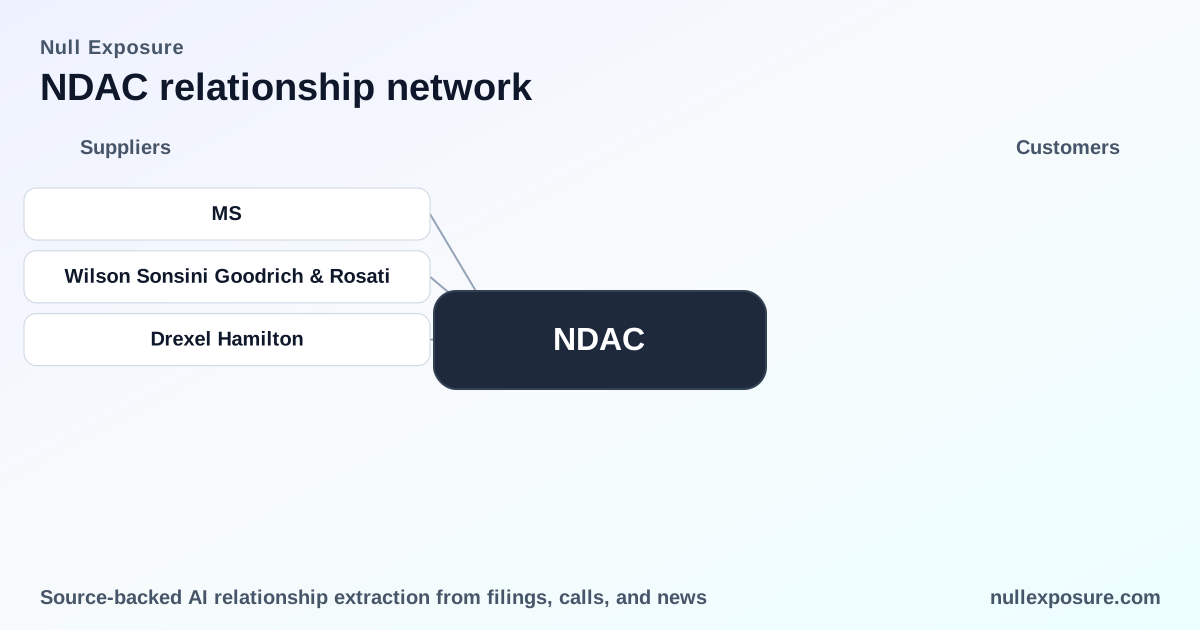
Morgan Stanley & Co. LLC — Morgan Stanley acted as the lead book-running manager on NDAC’s FY2021 initial public offering, providing primary underwriting and distribution responsibilities for the deal, which positions the bank as NDAC’s principal capital markets intermediary. According to a Wilson Sonsini insight on the offering, Morgan Stanley served in this lead role (FY2021).
-
Wilson Sonsini Goodrich & Rosati — Wilson Sonsini advised NightDragon Acquisition Corp. on the initial public offering, supplying legal counsel for the transaction structure, disclosures, and regulatory filings, which is consistent with the firm’s technology-and-capital-markets practice. The firm published an advisory note describing its role on the FY2021 IPO.
-
Drexel Hamilton — Drexel Hamilton participated as a co-manager in the offering, supporting distribution and underwriting alongside the lead book-runner and expanding investor outreach for the IPO. Wilson Sonsini’s advisory post on the IPO lists Drexel Hamilton as a co-manager in FY2021.
What these supplier choices reveal about NDAC’s operating model
Treat these findings as company-level signals about how NDAC runs its capital-raising engine:
-
Contracting posture: transactional and deal-driven. NDAC engages premier capital markets and legal advisors for specific transactions rather than maintaining broad, diversified operating vendor relationships; this is a typical SPAC posture where supplier engagement intensity spikes around IPOs and combinations.
-
Concentration of critical suppliers. The underwriting and legal roles are highly concentrated—few counterparties execute the high-value tasks—so execution risk is concentrated in a small set of vendors during transaction windows.
-
Criticality during windows of execution. These suppliers are mission-critical during IPO and combination activity; their performance directly affects timing, pricing, and regulatory compliance.
-
Maturity and market positioning. Using an institutional lead bank and a recognized capital markets law firm signals a professionalized market approach to fundraising, which supports access to institutional investors and more efficient syndication.
Investment implications and operational risks
For investors and operators, the supplier map produces a clear set of tradeoffs:
-
Upside: Engagements with Morgan Stanley and Wilson Sonsini improve execution probability, market credibility, and access to institutional distribution, which supports the ability to raise capital on favorable terms and to close business combinations efficiently.
-
Downside: The transactional and concentrated nature of these relationships creates timing and single-event risk—delays or reputational issues with any lead counterparty can materially affect NDAC’s capital timelines and sponsor economics. Additionally, dependence on market conditions and underwriter appetite means NDAC’s ability to monetize is cyclical and highly correlated with capital markets sentiment.
-
Operational oversight required: Investors should monitor ongoing disclosures around pending combinations, underwriting commitments, and any changes to advisor roles; operators should ensure engagement letters and fee schedules are transparent and aligned to outcome timelines.
If you want a deeper supplier-risk profile or to benchmark NDAC’s advisors against peers, start here: https://nullexposure.com/.
How to act on this intelligence
-
For portfolio risk management: mark NDAC as transaction-dependent with concentrated supplier exposure in any scenario analysis; stress-test the timeline and counterparty performance outcomes.
-
For deal teams and operators: negotiate clear performance milestones and termination protections in engagement letters to reduce single-counterparty execution risk.
-
For monitoring: watch for updates in public filings, advisor announcements, and syndicate changes ahead of any announced business combination.
Final takeaways
NDAC’s supplier roster for its FY2021 IPO—Morgan Stanley as lead underwriter, Wilson Sonsini as legal advisor, and Drexel Hamilton as co-manager—is consistent with a SPAC that prioritizes institutional distribution and experienced legal support for deal-making. That setup boosts execution credibility but concentrates execution risk, so investors must treat supplier performance and market appetite as first-order drivers of near-term valuation and deal outcomes.
For an extended analysis and supplier benchmarking tools, visit https://nullexposure.com/.