NDRA (ENDRA Life Sciences) — supplier relationships and what they mean for investors
ENDRA Life Sciences (NASDAQ: NDRA) commercializes the TAEUS® liver imaging system and funds operations through a mix of product development, partnerships, and increasingly sophisticated treasury management. The company monetizes by advancing its medical imaging technology toward clinical and commercial adoption while preserving capital via yield-generating treasury arrangements rather than recurring equity dilution. For investors, the shift toward structured treasury partnerships and established industrial collaborators signals a dual focus on capital efficiency and commercialization readiness.
Explore deeper supplier and partner intelligence at https://nullexposure.com/.
Why these relationships matter to NDRA’s business model
NDRA runs a technology commercialization playbook common to early-stage medtechs: develop differentiated intellectual property, rely on third-party manufacturers and service vendors for production and IT support, and use partnerships to accelerate market access. The recent wave of treasury partnerships adds a financial engineering layer that materially changes balance-sheet risk and cash runway dynamics. Operational partners such as GE Healthcare reflect efforts to shorten commercialization cycles through equipment, advisory and channel introductions.
Visit https://nullexposure.com/ to benchmark NDRA against peer supplier ecosystems.
Who NDRA is working with — the relationships you should know
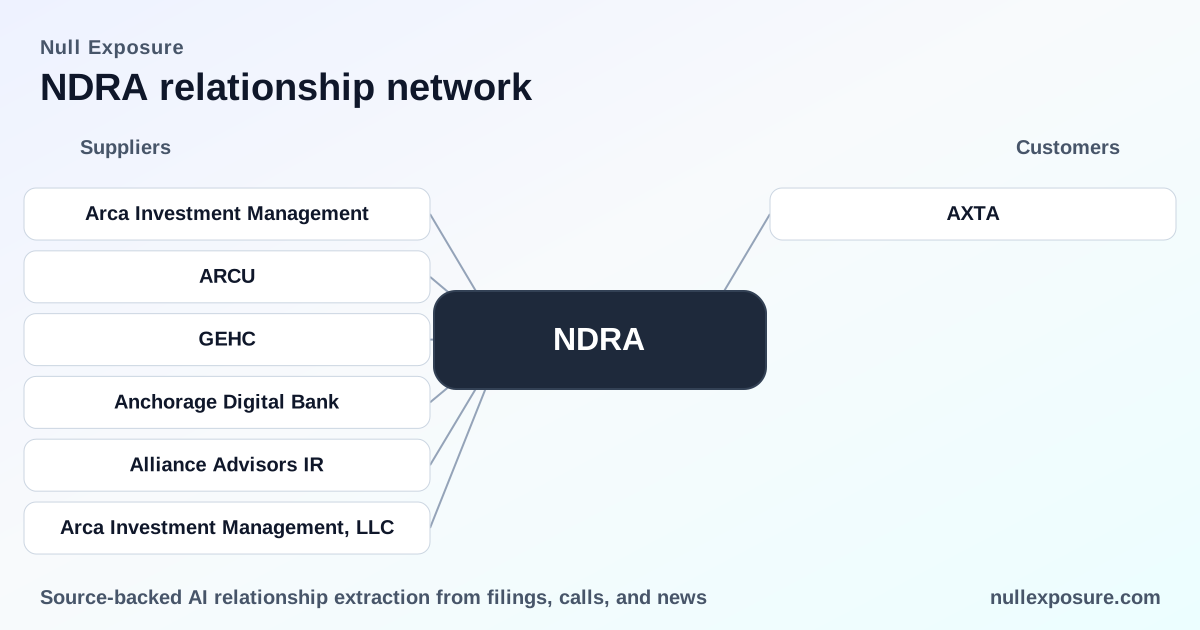
Arca Investment Management
NDRA has engaged Arca Investment Management to manage a newly announced Digital Asset Treasury (DAT) strategy that converts idle cash into targeted decentralized finance allocations and other yield-generating instruments. Multiple news outlets reported the arrangement as part of NDRA’s FY2025 treasury strategy rollout. According to FinancialContent and related press coverage in December 2025, Arca is the active manager of the firm’s next‑generation treasury allocation (news reports, Dec 2025–Mar 2026).
Arca U.S. Treasury Fund (ARCU)
NDRA has aligned a portion of its treasury with the Arca U.S. Treasury Fund (ARCU) as a conservative complement to its DAT allocations; press commentary in early FY2026 described the ARCU alignment as part of a “dual-engine” financial strategy. OpenPR and other industry write-ups in FY2026 noted the company’s use of ARCU to build a stable, yield‑oriented cash engine (OpenPR, FY2026).
Anchorage Digital Bank
For custody of digital-asset holdings within the DAT strategy, NDRA designated Anchorage Digital Bank as custodian. TradingView and related news items from FY2025 report that DAT assets will be held in custody by Anchorage, establishing an external custody link between NDRA’s treasury and regulated digital-asset infrastructure (TradingView, Mar 2026).
GE Healthcare (GEHC)
GE Healthcare has an historic commercial and technical collaboration with NDRA to support commercialization of the TAEUS system, supplying equipment, technical advice, and introductions to clinical ultrasound customers. This strategic OEM and channel-type relationship was documented in a PR Newswire announcement dating back to FY2016 and remains a material commercialization signal for the company (PR Newswire, FY2016).
Alliance Advisors IR
Alliance Advisors IR serves as NDRA’s investor‑relations contact for press and shareholder communications, listed in Biospace and company press releases across FY2025–FY2026. The firm’s contact details appear in clinical and corporate announcements, indicating an ongoing external communications arrangement (BioSpace, FY2025–FY2026).
Operating constraints and what they imply for execution
NDRA’s publicly reported constraints reveal a blended operational posture:
- Contracting posture and supplier mix: Company filings state explicit use of component suppliers and contract manufacturers for designing, assembling, and testing the TAEUS liver system. This signals a reliance on external manufacturing capacity rather than in‑house production, which reduces fixed capital needs but increases supplier management risk.
- Service vendor reliance and cyber posture: NDRA’s cybersecurity risk management is supported by third‑party information technologies and vendors, with specific references to platforms such as Squarespace and Google Workspace for IT monitoring and response support. This reflects a lean IT operating model that outsources key monitoring and administrative functions.
- Business segment orientation: The company’s operating model includes a meaningful services element—vendor and service relationships underpin both communications and IT operations rather than manufacturing alone.
Collectively, these constraints indicate an operational profile focused on capital efficiency, vendor dependency, and outsourcing maturity rather than vertically integrated manufacturing.
Risk/reward synthesis for investors
- Capital efficiency upside: The Arca-managed DAT and allocation to ARCU materially alter NDRA’s cash-return profile; if deployed prudently, these treasury initiatives extend runway without dilutive financing. The involvement of Anchorage for custody adds an institutional control layer to the crypto exposures.
- Execution and counterparty risk: Heavy reliance on third-party manufacturers and outsourced IT raises supply-chain and operational continuity risk. GE Healthcare’s historical collaboration reduces go‑to‑market execution risk for clinical adoption, but commercialization still depends on third-party integration and regulatory progress.
- Concentration and maturity trade-offs: The supplier mix and IR relationships show a mature communications posture but a concentrated manufacturing approach, which is standard for early commercial medtechs but requires active supplier oversight.
Key takeaway: NDRA’s supplier and treasury relationships together position the company to extend its cash runway and accelerate commercialization pathways while increasing dependence on external service providers and financial counterparties.
Practical next steps for market participants
- Review NDRA’s treasury disclosures and custody agreements to quantify counterparty exposures to Arca-managed vehicles and Anchorage custody arrangements.
- Monitor operational updates from GE Healthcare collaborations for concrete channel and equipment deployment milestones.
- Track supplier continuity and third-party IT vendor notices that could affect device release timelines.
For a consolidated view of NDRA’s partner map and to compare supplier risk across peers, go to https://nullexposure.com/.
Final read: where this leaves investors
NDRA combines a classic medtech supplier model—contract manufacturers and external technical partners—with an aggressive, modern approach to treasury management. That blend creates a distinctive risk/return profile: improved capital efficiency on the balance sheet, offset by elevated vendor and counterparty exposure off it. Investors should prioritize active monitoring of treasury allocations, custody arrangements, and the cadence of commercialization milestones delivered through partners like GE Healthcare.
If you want ongoing supplier intelligence and curated partner mappings for NDRA and comparable medtechs, visit https://nullexposure.com/ for regularly updated coverage and research resources.