NECB: Liquidity counterparties and what they reveal about funding posture
Northeast Community Bancorp (NECB) operates as the holding company for Northeast Community Bank, a regional lender that monetizes through net interest income on loans, fee income, and a modest dividend return to shareholders. The bank’s capital-light retail and commercial lending franchise is supported by deposit funding supplemented by short-term borrowing capacity from third parties and government facilities; those borrowing lines function as the on-demand liquidity backstop that underpins day-to-day balance sheet management. For investors evaluating supplier and counterparty risk, the composition and scale of these lines—especially the concentration toward central-bank facilities—are a primary lens for assessing funding resilience. Learn more about supplier risk analysis at https://nullexposure.com/.
What NECB disclosed in its Q4 2025 filing — the headline numbers
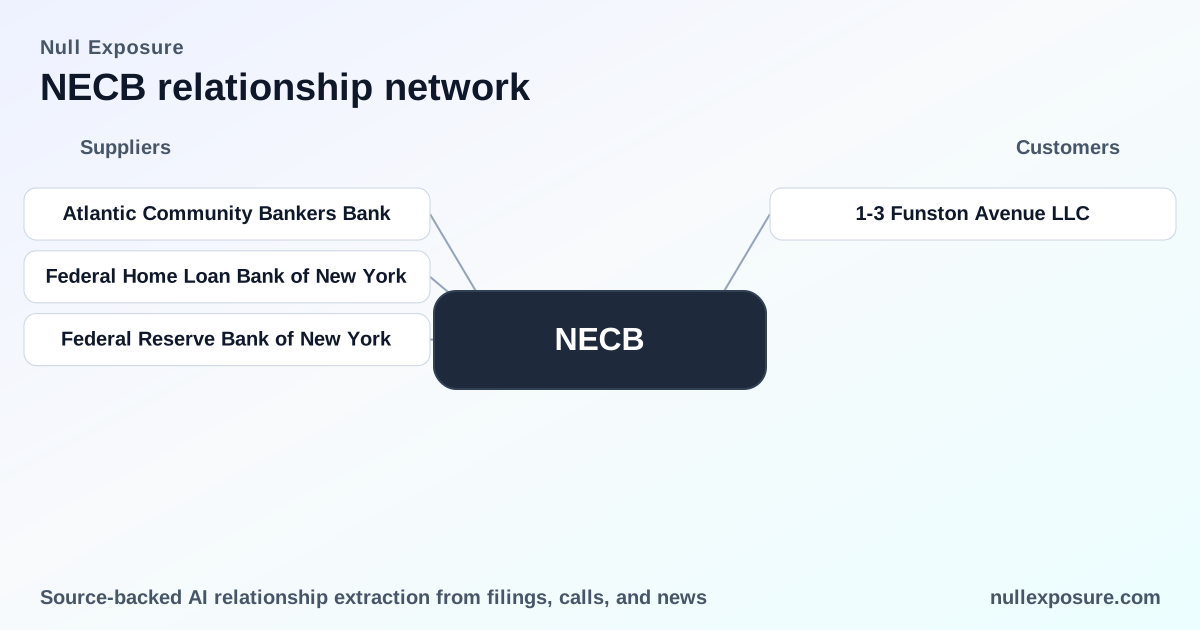
A company press release summarizing Q4 2025 results reported NECB’s ability to borrow $768.8 million from the Federal Reserve Bank of New York, $35.8 million from the Federal Home Loan Bank of New York, and $8.0 million from Atlantic Community Bankers Bank as of December 31, 2025. That disclosure serves as the operative inventory of committed (or accessible) short-term liquidity that management cites when describing contingency funding capacity. A consolidated news release of those figures was published via QuiverQuant on March 10, 2026.
The three active supplier relationships — plain-English summaries with sources
Atlantic Community Bankers Bank
NECB reported an $8.0 million ability to borrow from Atlantic Community Bankers Bank as of December 31, 2025, representing a modest correspondent or reciprocal facility for short-term needs. This tranche is small relative to NECB’s other lines and functions as a tertiary liquidity source. Source: QuiverQuant news release summarizing NECB Q4 2025 results (published March 10, 2026).
Federal Home Loan Bank of New York
NECB lists $35.8 million of borrowing capacity from the Federal Home Loan Bank of New York, which is a conventional GSE liquidity source that regional banks use for secured advances. This line provides a senior, collateralized funding channel distinct from central-bank discount facilities. Source: QuiverQuant news release summarizing NECB Q4 2025 results (published March 10, 2026).
Federal Reserve Bank of New York
NECB disclosed $768.8 million of borrowing capacity from the Federal Reserve Bank of New York, effectively designating the Federal Reserve as NECB’s primary contingent lender of last resort in its liquidity ladder. That magnitude dominates NECB’s external borrowing profile and signals a reliance on short-term central bank access for emergency or window-based funding. Source: QuiverQuant news release summarizing NECB Q4 2025 results (published March 10, 2026).
How these relationships define NECB’s operating and funding model
NECB’s supplier map signals a short-term, contingency-focused funding posture. Corporate disclosures and excerpts explicitly frame borrowings as Discount Window and FHLB advances—both short-tenor instruments—so contract durations are operationally short and tactical, not structural. The constraint extraction from NECB’s own language classifies contract type as short-term and counterparty type as government where the excerpt names the Federal Reserve and FHLB, which is consistent with the two largest facilities reported.
- Concentration: NECB’s liquidity profile is heavily concentrated toward the Federal Reserve Bank of New York ($768.8M), with materially smaller capacity at the FHLB ($35.8M) and a negligible $8.0M line from Atlantic Community Bankers Bank. That concentration elevates the central bank facility to a critical component of NECB’s contingency funding plan.
- Criticality: Because the FRBNY line accounts for the bulk of accessible external borrowings, it functions as a primary emergency backstop; operational continuity under stress scenarios is therefore tied to access to central-bank liquidity.
- Counterparty posture: The selection of government-affiliated counterparties (FRBNY, FHLB) underscores a conservative counterparty taxonomy for large-capacity lines—NECB prioritizes high-credit, programmatic liquidity providers for its major backstops.
- Maturity and intent: The borrowings are described as short-term/discoun window-style instruments, indicating intent for temporary balance sheet support rather than long-term wholesale funding.
If you are benchmarking funding risk across a peer set, this concentration dynamic is a decisive input; more details and comparative supplier maps are available at https://nullexposure.com/.
Investment implications — risks and positive signals
- Positive: NECB demonstrates strong profitability metrics for a regional bank: trailing Return on Equity is 13.3%, profit margin 42.3%, and a trailing P/E of 7.19 with a price-to-book below 1 (0.877). These figures support the view that NECB’s core franchise generates cash and can service contingent lines without structural stress in baseline conditions.
- Risk: High reliance on a single central-bank facility creates a concentration risk; an operational impediment to FRBNY access or reputational stigma associated with Discount Window use would be materially disruptive relative to the size of NECB’s disclosed capacity. The smaller FHLB and correspondent lines do not materially diversify that exposure.
- Stability signal: The mix of government-affiliated counterparties for major capacity is a credit-positive design choice—when markets function normally, these facilities provide reliable short-term liquidity.
Analyst coverage is sparse (consensus rating is Hold with an analyst target price of $25.50), which reinforces the need to combine balance-sheet disclosure with supplier mapping when sizing downside scenarios.
What investors and operators should watch next
- Confirm whether the FRBNY capacity is formal pledged access or a contingent, operationally constrained window; the distinction affects stress-test outcomes.
- Track changes in the size of FHLB advances and correspondent lines over successive quarters: declining non-government lines with static FRBNY capacity would increase funding concentration risk.
- Observe liquidity usage in periodic call reports and earnings releases to determine whether disclosed capacity is precautionary or operationally utilized.
For a deeper look at how counterparty concentration alters funding stress outcomes, see our analysis hub at https://nullexposure.com/.
Bottom line
NECB runs a competitively profitable regional banking model backed by significant short-term central-bank capacity, a modest FHLB program, and a negligible correspondent line. The dominant FRBNY exposure is the defining supplier relationship—it is both the bank’s largest liquidity resource and the principal concentration risk. Investors should weigh NECB’s strong operating returns against the structural implications of concentrated, short-term contingency funding.