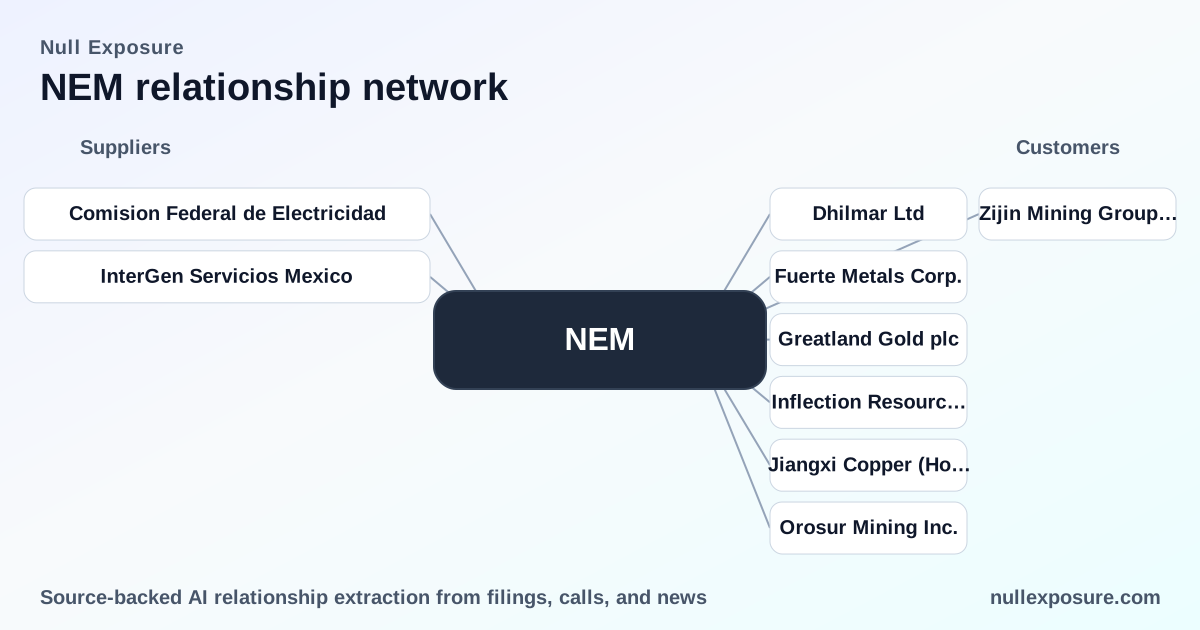
Newmont (NEM) — Power suppliers and what they signal to investors
Newmont operates and monetizes as a global gold producer: it extracts and processes gold and by‑product metals across multiple continents and sells finished ounces into spot and contractual markets, while managing operations through a mix of owned assets and large-scale third‑party contracts. Revenue and margin volatility are tightly coupled to energy inputs and long‑dated purchase agreements, making supplier relationships—especially for power—an underappreciated lever on cash flow and project economics. For a fast read on counterparty exposures and supplier risk, visit the NullExposure homepage: https://nullexposure.com/
Why power counterparties are a financial issue, not just operational
Power is a material input in open‑pit and underground mining, and Newmont’s disclosures treat it as both a cost and a hedgable risk. Long-term power purchase agreements (PPAs) lock in availability and pricing for core mines; short‑term hedges and currency forwards manage treasury exposure tied to cross‑border capital and operating spend. These features create a contracting posture that blends multi‑year fixed commitments with active market risk management, and that structure flows directly into EBITDA and capital allocation decisions.
Disclosed supplier relationships in the FY2024 10‑K
Newmont’s FY2024 Form 10‑K lists specific power suppliers connected to the Peñasquito operation in Mexico and references other long‑dated energy arrangements globally. Below are the supplier relationships explicitly named in the filing, with concise investor‑grade summaries and source notes.
Comision Federal de Electricidad (CFE)
Newmont reports that power is supplied to Peñasquito from the Mexican Federal Electricity Commission’s central grid via the El Salero–Peñasquito powerline, reflecting reliance on national transmission infrastructure for baseload supply. According to Newmont’s FY2024 Form 10‑K, this grid connection is a direct supplier relationship used to feed the mine’s electricity needs. (Source: Newmont 2024 Form 10‑K, FY2024 disclosure.)
InterGen Servicios Mexico (now Saavi Energia) — Peñasquito PPA
Peñasquito entered a 20‑year power delivery agreement in January 2011 with a subsidiary of InterGen Servicios Mexico (now Saavi Energia) under which Peñasquito purchases electricity from a nearby gas‑fired generating facility; the agreement commenced in August 2015 and serves as a long‑dated, asset‑specific supply contract. This is described in Newmont’s FY2024 10‑K and is presented as a core contracted source of power for the operation. (Source: Newmont 2024 Form 10‑K, FY2024 disclosure.)
What these relationships mean for investors
- Energy is a financially binding input. Long‑dated PPAs like the InterGen agreement convert energy price and availability risk into contract performance risk; this supports predictable operating costs but also creates fixed obligations if market dynamics change.
- Grid dependency creates systemic exposure. The CFE grid feed links Peñasquito to national transmission quality, regulatory regime, and sovereign counterparty performance—factors that can influence operational continuity and cost recovery.
- Counterparty concentration and contractual tenor matter. Newmont’s mix of long‑term PPAs and global procurement creates a profile where a handful of supplier agreements have outsized operational and cash‑flow impact.
For a curated supplier risk scorecard and deeper counterparty analytics, see the NullExposure platform: https://nullexposure.com/
Company‑level constraints and operating model signals (investor lens)
Newmont’s public disclosures provide a set of recurring operational constraints that shape supplier risk and capital planning. Treat these as company‑level signals rather than relationship‑level attributions unless the filing explicitly names a counterparty.
- Long‑term contracting posture: The company references a 15‑year Cadia PPA acquired through the Newcrest transaction, signaling a strategy of securing multi‑year power arrangements to stabilize mine‑level cash flows. (Source: FY2024 Form 10‑K disclosures.)
- Active short‑term hedging: Newmont initiated foreign currency fixed‑forward hedges in June 2024 to cover AUD and CAD cash flows from October 2024 through December 2025, demonstrating a nimble treasury approach to currency and project‑phase exposure. (Source: FY2024 Form 10‑K.)
- Government counterparty exposure: Newmont conducts activity under land and permitting regimes granted by host governments, creating licensing and sovereign‑risk elements to supplier and operating relationships. (Source: FY2024 Form 10‑K.)
- Global sourcing and regional concentration: Disclosures reference material spend and operations across APAC, LATAM, Canada and Australia—indicating both geographic diversification and regional concentrations that align with energy and logistics risk. (Source: FY2024 Form 10‑K.)
- High spend and project scale: Capital projects cited (Tanami Expansion 2, Cadia Panel Caves, Ahafo North) carry multi‑hundred‑million to billion‑dollar capital forecasts, implying that supplier engagements are often at the high spend band level and contractually significant. (Source: FY2024 Form 10‑K.)
- Contractor reliance and supplier criticality: Newmont reports roughly 22,200 employees and approximately 20,400 contractors supporting operations, highlighting the operational dependency on third‑party service providers and the need for rigorous third‑party risk processes. (Source: FY2024 Form 10‑K.)
Operational risk implications and investor checklist
Investors should convert these disclosures into actionable monitoring items:
- Track the expiry and extension options on major PPAs and grid supply contracts; an approaching expiration (such as a 2026 expiry noted for a Bluewaters contract in disclosures) requires active engagement and stress testing of alternate supply scenarios. (Source: FY2024 Form 10‑K.)
- Model energy price sensitivity in mine‑level EBITDA and test scenarios where contracted supply is curtailed or re‑priced.
- Monitor currency hedge schedules and the company’s hedge accounting roll‑forward to understand treasury‑level offsets to project capex and operating spend.
- Evaluate sovereign and grid stability metrics for jurisdictions supplying power, especially where national utilities are the primary counterparty.
If you need a tailored supplier risk memo or portfolio exposure brief, NullExposure can produce a concise counterparty report: https://nullexposure.com/
Conclusion — the investor takeaway
Newmont’s disclosed supplier relationships in FY2024 underscore the strategic importance of long‑dated energy contracts and national grid connections to mining economics. For investors, the combination of high capital intensity, long tenors on power supply, active hedging, and heavy contractor reliance creates a profile where supplier execution directly alters EBITDA and project returns. Monitor PPA expiries, currency hedge rollovers, and jurisdictional grid risk as part of any valuation or operational due diligence.
For a supplier‑focused risk assessment tailored to your portfolio, request an analysis at NullExposure: https://nullexposure.com/