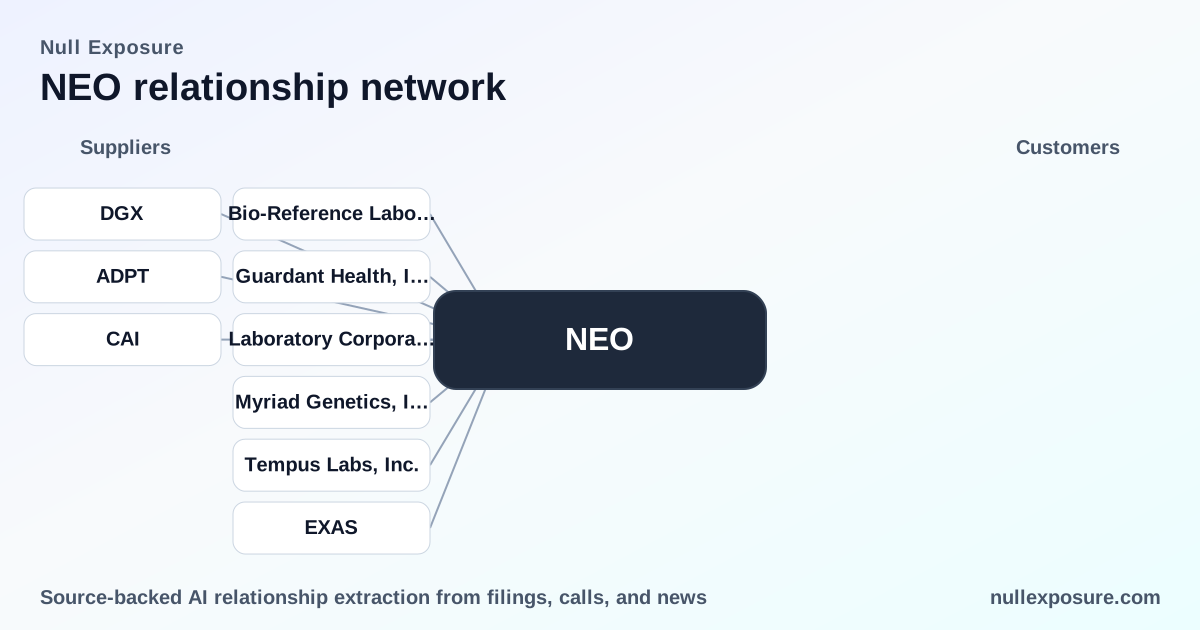
NeoGenomics (NEO): supplier posture, competitive map, and what operators should price into models
NeoGenomics is a cancer-focused diagnostics lab network that monetizes by selling molecular and anatomic pathology testing to hospitals, community oncology practices, and biopharma clients across the U.S., Europe and Asia. The company delivers revenue through fee-for-service testing, higher-margin reference assays and strategic partnerships that extend its product offering; cash flow depends on test volumes, reimbursement mix and the ability to integrate complementary technologies into its lab network. For investors and operators, the critical questions are vendor concentration, contract tenor for supplies, and how NeoGenomics positions itself relative to larger lab competitors that can compress pricing and referral flows. Learn more at https://nullexposure.com/.
The operating model that matters for supplier risk
NeoGenomics runs a capital-light, lab-service business that still requires steady working capital for reagents, instruments and logistics. Three company-level signals from filings and disclosures clarify supplier risk:
- Contracting posture: short-term purchase commitments. NeoGenomics discloses purchase commitments that expire in 2025, signaling a largely short-term procurement stance and limited multi-year lock-in with vendors.
- Role and sourcing direction: buyer of national lab supplies. The company explicitly states it orders laboratory and research supplies from large national laboratory supply companies, consistent with standard vendor relationships rather than captive supply arrangements.
- Committed spend is modest. Total purchase commitments disclosed for 2025 are $782,000, placing committed vendor exposure in the $100k–$1m band, which implies flexibility to switch suppliers but also limited bargaining power on small-volume items.
These points together indicate operational flexibility on procurement but also limited scale leverage with suppliers — a profile that benefits nimble cost management but increases exposure to price moves in critical inputs such as reagents or sequencing consumables.
Competitive context: suppliers and competitors shape pricing leverage
NeoGenomics explicitly catalogs competitors and specialist providers in its FY2024 10‑K, which matters because these are alternative outlets for clinician referrals and for procurement volume aggregation that can influence pricing. The FY2024 filing lists large integrated labs and niche molecular players as direct competitive pressures.
Refer to NeoGenomics’ investor page and filings for more detailed filings at https://nullexposure.com/.
The relationship map — every referenced company and what it signals
Below I summarize each relationship mentioned in the company disclosures and media coverage, with a clear one- to two-sentence takeaway and the source cited.
-
Bio-Reference Laboratories — NeoGenomics identifies Bio-Reference Laboratories as a competitor within the broader genomics profiling market. According to NeoGenomics’ FY2024 10‑K, Bio‑Reference is a named alternative provider that competes for the same referral and testing volumes. (FY2024 10‑K)
-
Guardant Health, Inc. — Guardant is listed among specialized laboratories that increase competition, particularly in liquid biopsy and large-panel molecular testing; NeoGenomics recognizes Guardant as a specialist competitor in its FY2024 10‑K. (FY2024 10‑K)
-
Laboratory Corporation of America (LabCorp) — LabCorp is named as a competitor in the broader genomics profiling space, representing a national full-service competitor capable of scaling reimbursement and logistics advantages. NeoGenomics cites LabCorp in its FY2024 10‑K. (FY2024 10‑K)
-
Myriad Genetics, Inc. — Myriad is included on NeoGenomics’ list of specialized and panel-focused laboratories, underscoring competition on hereditary and tumor panel assays; the reference appears in the FY2024 10‑K. (FY2024 10‑K)
-
Tempus Labs, Inc. — Tempus is identified as a specialized laboratory competitor in tissue and molecular profiling, per NeoGenomics’ FY2024 10‑K, signaling pressure from data-driven, integrated diagnostic offerings. (FY2024 10‑K)
-
Exact Sciences Corp (EXAS) — Exact Sciences is called out among competitors focused on large tissue‑based molecular panels; NeoGenomics includes Exact Sciences in its FY2024 10‑K competitive landscape. (FY2024 10‑K)
-
Quest Diagnostics (DGX) — Quest is named with LabCorp and Bio‑Reference as a major national competitor in genomics profiling, representing scale-based pricing and distribution risk identified in the FY2024 10‑K. (FY2024 10‑K)
-
Adaptive (ADPT) — NeoGenomics discussed a partnership with Adaptive during its Q4 2025 earnings commentary, describing the relationship as strategically valuable for extending offerings to customers rather than as a primary revenue driver. This positioning was reported in Q4 2025 earnings call transcripts covered by The Globe and Mail and other outlets. (Q4 2025 earnings call transcripts; The Globe and Mail / InsiderMonkey coverage)
-
Caris Life Sciences (CAI) — Caris is listed as a specialist competitor for large panel and tissue-based molecular testing; NeoGenomics cites Caris among competitors in the FY2024 10‑K. (FY2024 10‑K)
Each named competitor highlights a different pressure point—scale, specialization, or integrated tech partnerships—which investors should model when projecting referral trends and price erosion.
What the supplier posture implies for valuation and operations
- Low committed spend reduces stranded-cost risk but limits negotiating leverage. The disclosed $782k of purchase commitments for 2025 indicates NeoGenomics has limited long-term supplier lock-in and the ability to reprice or re-source quickly, but this also means vendors with scarce reagents can exert pricing power for single-source items.
- Short-term contracts suggest volume sensitivity. The procurement horizon implies that supply costs will move in lockstep with test volumes; rapid volume declines could pressure margins before procurement terms reset.
- Strategic partnerships are additive, not core revenue drivers. The Adaptive partnership was described publicly as strategic and customer-facing rather than a primary revenue engine, implying NeoGenomics continues to rely on core testing revenue while using alliances to broaden product sets.
These dynamics should be reflected in operating models by assuming modest fixed commitments to suppliers, sensitivity of gross margins to reagent price changes, and conservative revenue attribution from partnerships.
Learn how supplier exposure shifts comparable valuations at https://nullexposure.com/.
Actionable takeaway for investors and operators
- For investors: build sensitivity scenarios where reagent or instrument price inflation compresses gross margin by several hundred basis points given NeoGenomics’ short-term procurement posture. Model limited supplier stickiness and higher variable cost exposure.
- For operators and procurement leads: prioritize supplier diversification for critical reagents and negotiate contingency terms for instrument uptime given limited committed spend; short-term contracts increase flexibility but require vigilant spot-market management.
If you want a structured vendor exposure brief or a tailored supplier risk assessment for NeoGenomics, start here: https://nullexposure.com/.
NeoGenomics competes against both national labs and niche molecular players while maintaining a procurement profile characterized by short commitments and modest committed spend; investors should price in competitive pressure on referral flows and the operational sensitivity of margins to reagent pricing. For more supplier-level intelligence and comparable company analysis visit https://nullexposure.com/.