Minerva Neurosciences (NERV): Supplier relationships, capital partners, and what operators need to know
Minerva Neurosciences runs a classic clinical-stage biotech commercial model: it develops central nervous system candidates (notably roluperidone for negative symptoms of schizophrenia), outsources manufacturing and trial execution, and funds development through targeted private financings and institutional investors. The company monetizes through eventual product sales and licensing partners once regulatory milestones are met, while current value is driven by trial progress and capital sufficiency to complete Phase 3. For a concise supplier-risk snapshot and investor intelligence, visit https://nullexposure.com/.
How Minerva contracts and why that matters to investors
Minerva is a lean, outsourced operator. Public disclosures show the company does not own manufacturing capacity and relies on third-party contract manufacturers and CROs for development and, if approved, commercialization. One explicit company disclosure names a long-term commercial supply arrangement with Catalent in Schorndorf, Germany, which signals an established supply chain for finished dose manufacturing in the EMEA region. This licensing and outsourcing posture drives several practical constraints:
- Contracting posture: Minerva relies on licensing for some IP and long-term supply contracts for finished dose manufacturing, indicating negotiated, dependency-prone relationships rather than vertical integration.
- Concentration and criticality: With manufacturing outsourced and critical supply capacity located in Germany under a long-term contract, disruption at a key contract manufacturer would have immediate program-level implications.
- Service maturity and execution risk: The company routinely uses contract research organizations for trial execution; CRO performance is directly material to timing and data quality.
- Capital sensitivity: As a clinical-stage company with no reported revenue, access to capital and the structure of financings are core to sustaining operations.
These dynamics mean operators and investors should track counterparty commitments, supply continuity clauses, and the financing syndicate's alignment with commercialization timelines. For more supplier mapping and counterparty risk insights, see https://nullexposure.com/.
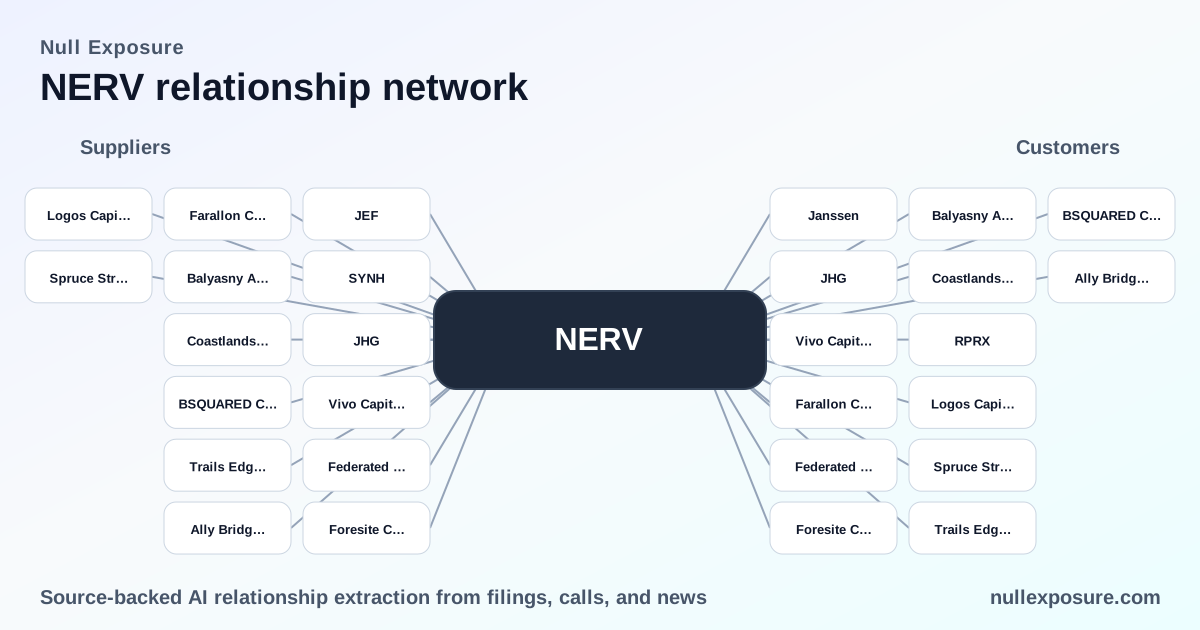
Who Minerva is partnering with now — the full relationship list and what each partner does
Below are the named counterparties captured in recent public reporting and the plain-English role each played.
Jefferies LLC
Jefferies acted as the sole placement agent for Minerva’s financing of up to $200 million announced in the company press release. According to Minerva’s October 21, 2025 press release via GlobeNewswire, Jefferies managed the placement process.
Vivo Capital LLC
Vivo Capital led the financing syndicate that agreed to provide up to $200 million to advance roluperidone toward a Phase 3 confirmatory trial, per the October 21, 2025 GlobeNewswire announcement.
Janus Henderson Investors
Janus Henderson participated as a financing investor in the October 21, 2025 financing round, joining other institutional and healthcare-focused funds in the syndicate according to the same GlobeNewswire release.
Federated Hermes Kaufmann Funds
Federated Hermes Kaufmann Funds was listed among participating investors in the announced financing, as cited in Minerva’s October 21, 2025 press release on GlobeNewswire.
Farallon Capital Management
Farallon Capital Management joined the financing group that supported Minerva’s Phase 3 program financing, per the company’s October 2025 public release.
Coastlands Capital
Coastlands Capital is included in the investor list for the financing that backs the Phase 3 program, according to the October 21, 2025 GlobeNewswire statement.
Balyasny Asset Management
Balyasny Asset Management participated in the financing syndicate supporting the roluperidone program, as noted in Minerva’s October 2025 announcement.
Logos Capital
Logos Capital was named as one of the participating investors in the up-to-$200 million financing, per the GlobeNewswire release dated October 21, 2025.
BSQUARED Capital
BSQUARED Capital joined other healthcare-focused funds in the financing for Minerva’s Phase 3 program, according to the October 2025 press release.
Trails Edge Capital Partners
Trails Edge Capital Partners was listed among the financing participants supporting the Phase 3 financing, per the GlobeNewswire announcement.
Ally Bridge Group
Ally Bridge Group participated in the financing syndicate backing Minerva’s development program, as reported in the October 21, 2025 company release.
Foresite Capital
Foresite Capital is among the institutional and strategic investors that participated in the financing, according to Minerva’s GlobeNewswire announcement.
Spruce Street Capital
Spruce Street Capital was named as a participating investor in the announced financing supporting roluperidone’s Phase 3 program, per the October 2025 press release.
Syneos
Minerva selected Syneos as its contract research organization (CRO) for the Phase 3 program, citing Syneos’s recent schizophrenia trial experience; a March 2026 report on Yahoo Finance summarized the CRO selection and trial focus.
Each of the above items is drawn from public company disclosures and press coverage: the financing participants were enumerated in the October 21, 2025 GlobeNewswire press release and related investor coverage, while the CRO selection was reported in March 2026 by Yahoo Finance.
What the partner list implies for capital strategy and operational risk
The financing syndicate led by Vivo Capital and supported by multiple institutional healthcare funds is a material signal: Minerva has secured committed capital specifically to advance its Phase 3 program, which reduces near-term dilution risk and increases run‑way visibility relative to companies without such backing. The use of a sole placement agent (Jefferies) concentrates execution risk in the financing execution process but also reflects a targeted placement strategy.
Operationally, the selection of Syneos as CRO and the long-term supply commitment with Catalent indicate Minerva is outsourcing to experienced, large-scale service providers—a conventional and defensible model for small biotechs, but one that shifts program risk from in-house execution to vendor performance and contract enforcement. The company-level constraints—licensing of IP, long-term manufacturing contracts in EMEA, and reliance on CROs—are consistent with a high-dependency, low-capex operating posture.
For investors and operators, the key practical takeaways are:
- Monitor CRO milestones and vendor audits for timely trial execution; CRO delays will directly delay value realization.
- Review supply agreements and contingencies tied to the long-term manufacturing relationship in Germany for commercial readiness.
- Track tranche conditions in the financing (timing, milestones, conversion features) that could trigger dilution or restrict strategic flexibility.
If you want a deeper counterparty risk profile and supplier continuity scoring, explore bespoke supplier intelligence at https://nullexposure.com/.
Practical next steps for investors and partners
- Request or review the financing documentation summary and milestone triggers that govern the up-to-$200 million facility. Capital structure details materially affect downside protection and dilution.
- Demand CRO governance transparency: trial timelines, backup recruitment plans, and data monitoring arrangements with Syneos. Operational execution is the single greatest timing risk.
- Verify manufacturing change‑of‑control and force majeure clauses in the long-term Catalent supply agreement to assess resilience for commercialization.
For a structured supplier-risk review and access to the sourced press releases and coverage that underpin this note, visit https://nullexposure.com/.
Conclusion Minerva’s model is capital-backed, outsourced, and execution-dependent. The financing syndicate and CRO selection reduce near-term funding and operational uncertainty but concentrate program risk in external vendors and contract terms. Investors and operators should prioritize contract-level transparency and milestone governance as the Phase 3 program advances. For ongoing signal monitoring, vendor scoring, and investor-ready supplier dossiers, go to https://nullexposure.com/.