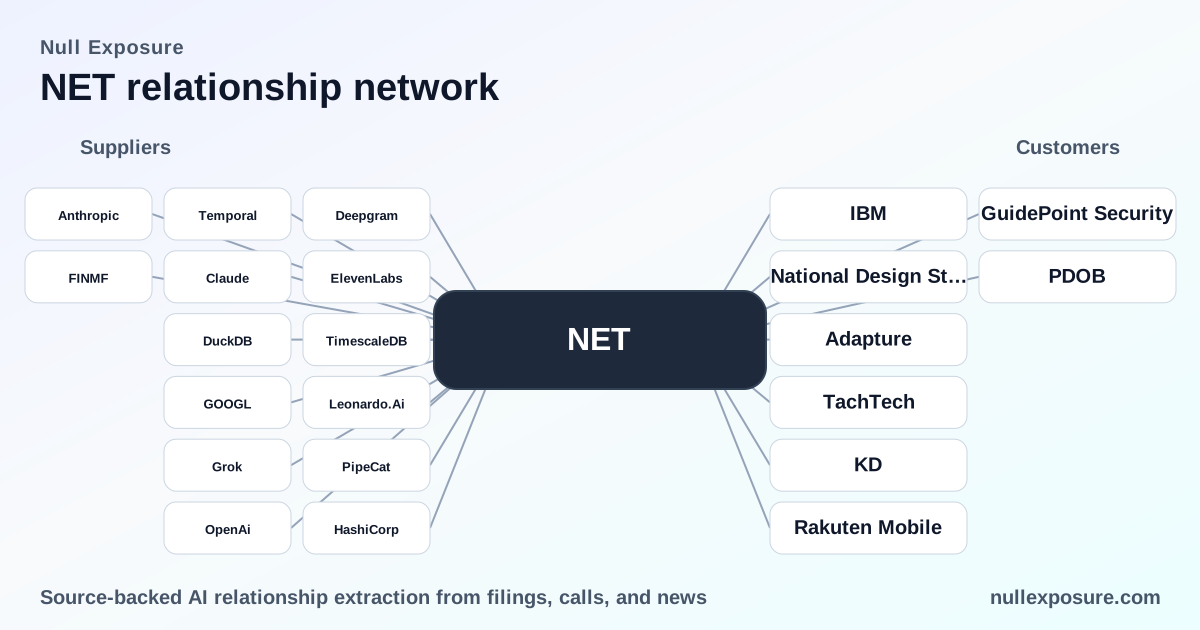
Cloudflare (NET) — supplier map and what it means for investors
Cloudflare operates a global edge network and monetizes through subscription and usage-based services that accelerate, secure, and now host AI inference at the edge for enterprises and developers. Revenue comes from a mix of recurring SaaS contracts and growing usage fees for new compute and AI services, while cost structure is driven by network infrastructure, co-location, and third‑party model partnerships. For investors evaluating supplier risk and strategic optionality, the supplier set disclosed in Cloudflare’s blog posts shows a deliberate pivot toward multi‑provider AI plumbing combined with persistent reliance on a concentrated hardware and bandwidth supply chain. Learn more at https://nullexposure.com/.
How Cloudflare makes money and how suppliers fit the model
Cloudflare sells network security, performance, and edge compute services to a broad base of customers and layers AI inference (Workers AI, AI Gateway) on top of that stack. The company captures margin from subscription fees and per‑call/compute usage while outsourcing model inference and some encryption/operations capabilities to third parties. At the same time, Cloudflare continues to bear direct infrastructure costs for servers, bandwidth, and colocation facilities.
- Contracting posture: Evidence supports a hybrid contracting posture — Cloudflare has long‑term bandwidth and colocation commitments while concurrently buying servers and many hardware components on spot/purchase‑order terms. This mix reduces fixed capital exposure but preserves concentration risk in key hardware suppliers.
- Concentration and criticality: Cloudflare states it relies on a limited number of suppliers for critical equipment, making those relationships material to operations and cost control.
- Service vs. manufacturing roles: The company behaves as a customer of both manufacturers (servers, networking equipment) and service providers (AI model vendors, encryption services), with the latter increasingly strategic as Cloudflare sells AI-enabled edge offerings.
For a proactive read on supplier relationships and risk exposure, visit https://nullexposure.com/.
Supplier relationships investors should track
Below I cover every supplier relationship flagged in Cloudflare’s public blog posts and summarize the business relevance and source for each.
Deepgram
Cloudflare announced Deepgram’s speech‑to‑text and text‑to‑speech models are now available on Workers AI, running in Cloudflare locations worldwide, making Deepgram a live inference partner for voice workloads (Cloudflare blog post, "Cloudflare Realtime Voice AI", March 2026: https://blog.cloudflare.com/cloudflare-realtime-voice-ai/). This is a commercial model partnership that enables Cloudflare to offer voice AI without developing those models in‑house.
ElevenLabs
Cloudflare published a WebRTC demo that uses the ElevenLabs text‑to‑speech API for real‑time voice synthesis, indicating integration for developer voice features (Cloudflare blog post, "Cloudflare Realtime Voice AI", March 2026: https://blog.cloudflare.com/cloudflare-realtime-voice-ai/).
TimescaleDB
Cloudflare adopted TimescaleDB to support its analytics platform, enabling aggregated, compressed time‑series analytics for long‑term query performance — a backend analytics supplier rather than a customer‑facing AI partner (Cloudflare blog post, "Shadow AI Analytics", July 2025: https://blog.cloudflare.com/shadow-AI-analytics/).
Leonardo.Ai / Leonardo
Cloudflare expanded Workers AI with image generation models from Leonardo.Ai (listed under AI Week wrap up), making Leonardo a partner for image generation capabilities on Cloudflare’s edge (Cloudflare blog post, "AI Week 2025 Wrapup", March 2026: https://blog.cloudflare.com/ai-week-2025-wrapup/).
PipeCat
Cloudflare identified PipeCat’s smart‑turn‑v2 turn detection model — the first model with WebSocket support — as a component for natural conversation handling in real‑time voice demos, positioning PipeCat as a niche inference provider for conversational control (Cloudflare blog post, "Cloudflare Realtime Voice AI", March 2026: https://blog.cloudflare.com/cloudflare-realtime-voice-ai/).
HashiCorp
Cloudflare uses HashiCorp’s Vault Transit Secret Engine to limit the exposure of unencrypted customer credentials, a cryptographic/encryption service underpinning public API security and a direct operational dependency (Cloudflare blog post, "Shadow AI Analytics", July 2025: https://blog.cloudflare.com/shadow-AI-analytics/).
Temporal
The scanner control plane integrates with Temporal for scan orchestration, and Cloudflare already relies on Temporal for other internal services — this is an internal orchestration dependency that supports scanning and automation at scale (Cloudflare blog post, "Shadow AI Analytics", July 2025: https://blog.cloudflare.com/shadow-AI-analytics/).
Claude (Anthropic)
Cloudflare lists Claude among third‑party LLM options available via Workers AI and AI Gateway, marking Anthropic/Claude as a strategic LLM supplier for customers who want alternative model providers (Cloudflare blog post, "Cloudflare Realtime Voice AI", March 2026: https://blog.cloudflare.com/cloudflare-realtime-voice-ai/).
DuckDB
Cloudflare notes integrations with query engines like DuckDB for data workflows and notebooks, a developer tooling integration that supports analytics and experimentation (Cloudflare blog post, "Cloudflare Data Platform", March 2026: https://blog.cloudflare.com/cloudflare-data-platform/).
Gemini (Google)
Cloudflare supports connecting to Google Gemini as one of multiple LLM inference options, reflecting multi‑cloud model access for customers who prefer Google’s models (Cloudflare blog post, "Cloudflare Realtime Voice AI", March 2026: https://blog.cloudflare.com/cloudflare-realtime-voice-ai/).
Grok
Grok is listed alongside other third‑party LLMs available through Cloudflare’s inference plumbing, giving customers access to a variety of model vendors (Cloudflare blog post, "Cloudflare Realtime Voice AI", March 2026: https://blog.cloudflare.com/cloudflare-realtime-voice-ai/).
OpenAI / OpenAi
Cloudflare explicitly supports OpenAI integrations across product lines (Workers AI, AI Gateway, Cloudflare One/API CASB), positioning OpenAI as a foundational LLM partner for both inference and API security features (Cloudflare posts, March–July 2025: https://blog.cloudflare.com/cloudflare-realtime-voice-ai/ and https://blog.cloudflare.com/shadow-AI-analytics/).
Anthropic
Cloudflare highlights Anthropic as a model provider for AI Search and API integrations, reinforcing multi‑vendor LLM access and competitive choice for enterprise customers (Cloudflare blog post, "Cloudflare Developer Platform", March 2026: https://blog.cloudflare.com/cloudflare-developer-platform-keeps-getting-better-faster-and-more-powerful/).
Google (Alphabet)
Cloudflare’s Cloudflare One and API CASB integrations were the first to offer API integrations with Google Gemini and other providers, signaling a strategic interoperability with Alphabet’s AI stack (Cloudflare blog post, "Shadow AI Analytics", July 2025: https://blog.cloudflare.com/shadow-AI-analytics/).
What this supplier map means for investors
- Strategic diversification in AI: Cloudflare deliberately supports many third‑party models (OpenAI, Anthropic, Gemini, Claude, Deepgram, Leonardo) to offer customers choice and to accelerate product adoption without large‑scale model R&D spend. This enables faster monetization of edge AI features with lower upfront capital.
- Persistent infrastructure concentration risk: Despite multi‑vendor AI suppliers, Cloudflare retains material exposure to a limited set of hardware and bandwidth suppliers, which creates vulnerabilities to component shortages, tariff shifts, or price volatility. These are company‑level signals reflected in public filings and the constraint excerpts.
- Mixed contracting reduces fixed cost risk but increases supply variability: The coexistence of long‑term bandwidth/colocation commitments and spot purchases for servers improves flexibility but requires active supplier management to avoid service disruptions.
- Operational criticality across categories: Some suppliers are operationally critical (HashiCorp for encryption, Temporal for orchestration, TimescaleDB for analytics), not just optional model partners, which elevates concentration considerations beyond pure product integrations.
For investors building supplier-risk screens or vendor concentration models, map Cloudflare’s AI partners against its infrastructure suppliers to assess revenue upside vs. operational risk. For an investor-grade supplier analysis toolkit, visit https://nullexposure.com/.
Bottom line and next steps
Cloudflare’s public disclosures show a clear commercial strategy to monetize edge AI via multi‑vendor integrations while retaining significant exposure to a concentrated set of infrastructure suppliers. Investors should weigh rapid revenue opportunities from AI partnerships against the operational and cost risks embedded in hardware and bandwidth sourcing.
If you want a structured supplier risk report or to monitor changes in Cloudflare’s partner set over time, explore the resources available at https://nullexposure.com/.