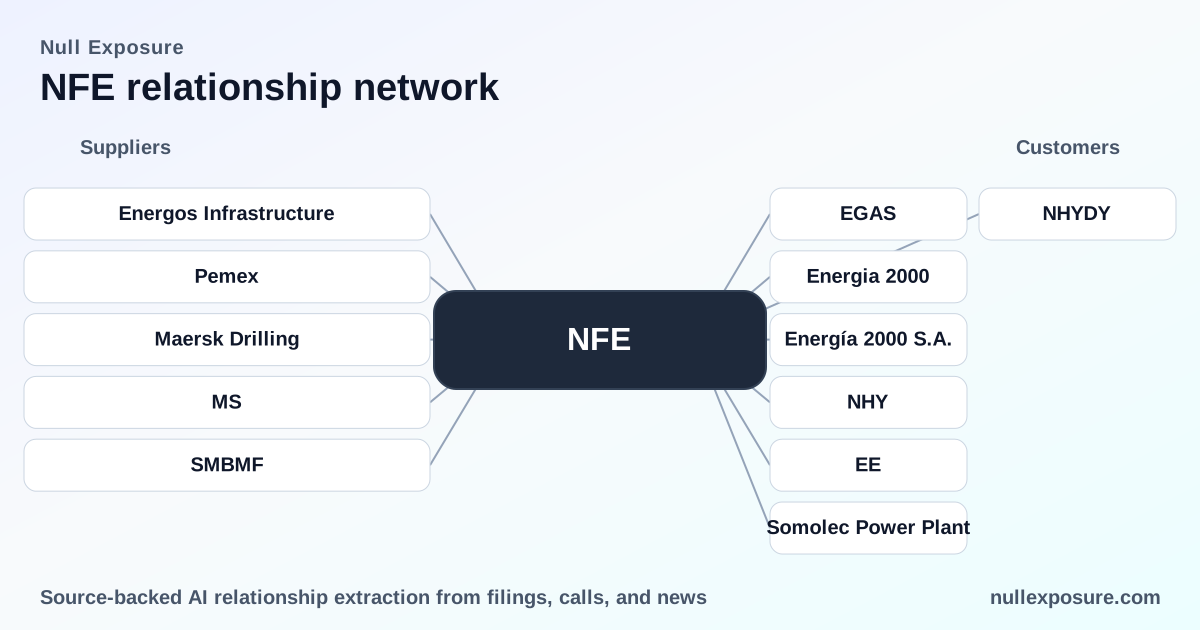
New Fortress Energy (NFE): Supplier Relationships and What They Signal for Investors
New Fortress Energy operates as an integrated gas-to-power infrastructure company that builds, owns, and operates floating and land-based LNG and power assets and monetizes through long-term fuel and power contracts, asset charters, and project development fees. Its commercial model combines contracted LNG supply, vessel charters (FSRUs/FLNG), and power sales to emerging-market and industrial customers, creating multiple revenue streams tied to project deployment and contract duration. For investors, the supplier relationships around vessels, drilling rigs, underwriters and strategic partners illuminate both the operational dependencies and the path to scaling run-rate cash flows. Explore a concise supplier map and implications below — or visit the home page for broader supplier intelligence: https://nullexposure.com/.
Why suppliers matter: a short operating thesis
NFE’s economics depend on aligning capital-intensive asset delivery (FSRUs, FLNGs, drilling rigs) with long-term customer contracts that lock in fuel sales and power tariffs. Suppliers therefore function both as execution partners and as counterparties that determine cost, timing and operational uptime. Delays or counterparty failures translate directly into revenue deferrals and margin compression, while reliable supplier execution accelerates run-rate cash generation from deployed assets.
- Capital delivery risk is front and center: vessels and Fast LNG assets are mission-critical.
- Contracting posture is tilted toward long-term supply and service agreements, which stabilizes revenue but concentrates execution risk on a smaller set of vendors.
Visit https://nullexposure.com/ for a practical supplier-risk checklist tailored to energy infra portfolios.
The supplier relationships investors should know
Below are every supplier relationship surfaced in the results, summarized plainly with source references.
Energos Infrastructure — long-term charter partner for FSRU
Energos Infrastructure (owner of the Energos Celsius) operates a marine infrastructure platform backed by Apollo funds and New Fortress Energy, and the vessel is on a long-term charter to NFE in Brazil. This structure effectively outsources vessel ownership while securing long-dated access to regas capacity. (Source: MarineLink, March 2026.)
Seatrium — builder and deliverer of FSRU assets
Seatrium delivered the FSRU Energos Celsius to New Fortress Energy, providing the physical regasification unit NFE deploys under charter; that delivery is central to NFE’s Brazil operations. The delivery illustrates NFE’s reliance on specialized shipyards and marine OEMs for timely asset commissioning. (Source: MarineLink, March 2026.)
Pemex — strategic JV for upstream gas access
New Fortress has a joint venture with Pemex to develop the Lakach gas field using a Fast LNG vessel, a deal structured to secure below-market cost gas and thus widen NFE’s power contract margins. This JV links NFE to a major national oil company for upstream feedstock and demonstrates a vertical integration move to control fuel cost. (Source: Morningstar analysis, March 2026.)
Maersk Drilling — seller of drilling assets
NFE purchased two jack-up drilling rigs from Maersk Drilling for $31 million, signaling a strategy to internalize certain offshore development services and potentially reduce third-party drilling expense. The transaction reflects asset acquisition to support offshore Fast LNG development. (Source: OE Digital, March 2026.)
Morgan Stanley & Co. LLC — capital markets partner / underwriter
Morgan Stanley acted as representative underwriter in a $400 million offering of NFE Class A common stock, a capital markets relationship that underpinned equity funding for growth initiatives and balance-sheet flexibility. This relationship illustrates how investment banks support NFE’s access to public capital. (Source: Vinson & Elkins advisory notice, FY2024.)
What the constraints tell us about NFE’s operating model
The relationship constraints provide company-level signals that explain how NFE structures supplier engagements and the consequential business-model characteristics:
- Contracting posture — long-term orientation (confidence 80%): NFE sources LNG through long-term supply agreements, creating predictable fuel input and supporting long-dated power contracts. Long-term contracts reduce spot exposure but increase execution risk if supplier or asset delivery lags.
- Counterparty profile — large enterprise counterparties (confidence 75%): NFE contracts with major financial institutions and large vendors, indicating concentrated counterparty credit exposure but also access to scale and institutional credit support.
- Supplier role — service providers as execution partners (confidence 80%): NFE treats many vendors as service providers—vessel providers and construction vendors take operational lead while contract terms can shift costs back to NFE. This delegating posture reduces in-house operational load but raises dependence on vendor performance.
- Relationship maturity — ramping stage (confidence 60%): NFE’s Fast LNG program is in a ramping phase; the first FLNG unit entered service in late 2024 with run-rate production expected in 2025, reflecting early-stage operational scale-up rather than steady-state production.
Together, these constraints describe a company that locks revenue with long-term contracts while concentrating operational risk in a few specialized suppliers, and that is transitioning from development to commercial ramp.
Investment implications — where value and risk concentrate
- Value driver: Successful execution by vessel builders and charter counterparties converts large, lumpy capital expenditures into sustained cash flows under power contracts. The Pemex JV is a high-impact lever to lower fuel costs and improve margins.
- Execution risk: Dependence on specialized marine yards (Seatrium) and drilling sellers/buyers (Maersk Drilling) creates single-point delivery risk; commissioning delays will depress near-term operating leverage.
- Capital access: The Morgan Stanley underwriting demonstrates markets remain a funding channel for NFE; continued access to capital markets is essential to finance growth while internal cash flow ramps.
If you want structured supplier risk scoring and a prioritized remediation roadmap for infra portfolios, start here: https://nullexposure.com/.
Final read — what to watch next
Monitor three variables over the next 12 months: (1) operational uptime and throughput for delivered FSRUs/FLNGs (evidence of commissioning success), (2) JV production metrics with Pemex (impact on fuel cost and gross margins), and (3) vendor performance on scheduled deliveries from shipyards and drilling service providers. Each will determine whether NFE turns development spend into durable cash flows or faces repeated revenue deferral.
For a deeper, transaction-level view of supplier exposures and their quantified impact on projected cash flow, visit the platform landing page: https://nullexposure.com/.
Bottom line: NFE’s supplier map shows deliberate vertical moves to secure fuel and assets while relying on a small set of specialized vendors—this structure amplifies upside if execution goes right and concentrates downside if delivery slips.