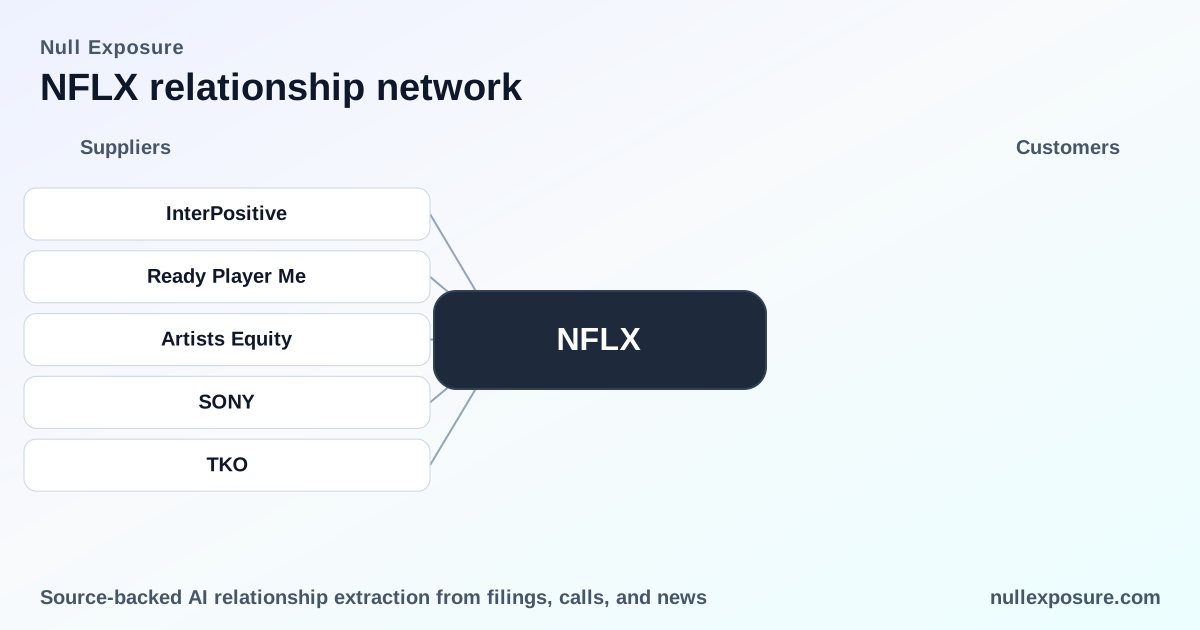
Netflix (NFLX) — supplier relationships that shape content economics
Netflix operates a subscription streaming platform and in-house production engine, monetizing primarily through recurring subscription fees while investing heavily in content ownership and licensing to retain and grow subscriber engagement. The company balances multi-year licensing commitments, in-house production, and selective acquisitions to control content supply and distribution windows that feed its subscriber revenue stream.
Explore deeper supplier signals and transaction context at https://nullexposure.com/.
Recent deal activity: acquisitions and first-look partnerships that matter
Netflix has accelerated M&A and strategic content partnerships in FY2026, expanding both its production toolset and its content pipeline. These moves are not casual: they reflect an operational shift toward building proprietary production capabilities and securing premium first-run content for streaming windows.
InterPositive — AI filmmaking technology
Netflix acquired InterPositive, an AI-powered filmmaking startup co-founded by Ben Affleck, to streamline production workflows while preserving human creative control. Reporting across outlets describes the purchase as a forward-looking bet on production automation and in-house tooling (Hollywood Reporter; Fortune; AV Club — March 2026 / FY2026).
Source: Hollywood Reporter and Fortune coverage of the InterPositive acquisition (FY2026).
Ready Player Me — avatar platform
In December, Netflix completed the purchase of Ready Player Me, an avatar creation platform, signaling a push into immersive and identity-layer technologies that support interactive or avatar-driven products. This acquisition preceded InterPositive and underscores a pattern of targeted buys to expand technology capabilities (The Globe and Mail; Hollywood Reporter — FY2026).
Source: The Globe and Mail and Hollywood Reporter reporting on Netflix’s Ready Player Me purchase (FY2026).
Artists Equity — first-look production deal
Ben Affleck and Matt Damon’s Artists Equity signed a streaming first-look deal with Netflix, positioning the streamer as the primary home for that production slate after theatrical runs. The pact strengthens Netflix’s access to established creative talent and exclusive streaming premieres (Hollywood Reporter; Page Six; The Globe and Mail — FY2026).
Source: Hollywood Reporter and Page Six coverage of the Artists Equity first-look agreement (FY2026).
Sony — pay-1 distribution relationship
Netflix retains a recent pay-1 licensing agreement with Sony, which routes films to the streamer following their theatrical windows. That arrangement secures a predictable flow of high-profile titles into Netflix’s post-theatrical catalog and complements Netflix’s own productions (Page Six — FY2026).
Source: Page Six reporting on Netflix’s pay-1 deal with Sony (FY2026).
TKO Group Holdings — content distribution partnership
TKO Group Holdings has partnered with Netflix (and ESPN) for WWE content distribution, illustrating Netflix’s willingness to partner for event and library sports-entertainment content outside its produced catalog. This expands genre reach and subscriber appeal in live and near-live entertainment (SAHM Capital — FY2026).
Source: SAHM Capital reporting on the TKO and Netflix distribution partnership (FY2026).
What these relationships tell investors about Netflix’s operating model
Netflix is operating as an integrated content platform that mixes traditional long-term licensing with targeted acquisitions and exclusive talent relationships. Several company-level signals define the business posture:
- Contracting posture: multi-year and licensing-centric. Netflix routinely enters multi-year licenses and treats licensed titles as capitalized assets with associated liabilities, a posture that enforces long-term content commitments and predictable shelf life for titles. The company explicitly notes multi-year commitments for studio licensing and fixed-fee windows for rights.
- Spend scale and commitment. Content liabilities are material and persistent: as of December 31, 2025, Netflix reported approximately $5.7 billion of total content liabilities, a clear signal that content spend runs in the high hundreds of millions annually and that licensing and production commitments drive balance-sheet and cash-flow dynamics.
- Dual role in the rights ecosystem. Netflix acts as both licensor (when it sells or routes rights) and licensee (when it acquires content or distribution windows), which requires flexible contracting, robust rights tracking, and staged cash outflows that align with release schedules.
- Concentration and criticality. Content relationships are strategically concentrated: first-look deals with high-profile producers (Artists Equity), pay-1 agreements with major studios (Sony), and technology buys that integrate production workflows (InterPositive, Ready Player Me) show Netflix selectively concentrates spend on partners that move the needle on subscriber retention and content uniqueness.
- Maturity and integration. The mix of internal production, licensing, and small strategic acquisitions indicates an evolving maturity: Netflix is institutionalizing production technology and exclusive pipelines, shifting some cost elements from variable licensing to capitalized internal assets.
These operating characteristics translate into predictable content commitments but also substantial capital intensity—a central lens for assessing both valuation and operational risk.
Explore supplier risk analytics and relationship maps at https://nullexposure.com/.
Financial and strategic implications for investors
Netflix’s recent supplier activity has three measurable implications:
- Margin and cash flow profile. Capitalizing license fees and absorbing acquisition costs increases near-term content liabilities and cash outflows, while successful integration that reduces marginal production cost per title supports medium-term operating margin expansion.
- Competitive differentiation. Proprietary production tools (InterPositive, Ready Player Me) and first-look deals (Artists Equity) enhance content differentiation and speed-to-market, reinforcing subscriber retention economics that underpin recurring revenue.
- Concentration risk and leverage. Heavy multi-year licensing and sizeable content liabilities create sensitivity to content ROI and subscriber growth; underperformance in key releases or higher-than-expected churn would pressure free cash flow given the front-loaded nature of content spend.
Key takeaway: Netflix is deliberately shifting some economics from external licensing to owned production and tooling, which increases both operational leverage and execution risk — a trade-off investors must price into growth and margin expectations.
Practical risk checklist for supplier exposure
When evaluating Netflix’s supplier relationships, prioritize these questions:
- Are first-look and pay-1 deals sufficiently exclusive and long-dated to defend subscriber windows?
- How quickly will acquired technologies (InterPositive, Ready Player Me) lower marginal production costs?
- What proportion of content liabilities is associated with third-party licenses versus capitalized internal productions?
Answering these will clarify whether Netflix’s commitments convert to durable competitive advantages or become fixed-cost drag.
Bottom line and recommended next steps
Netflix is executing a coherent strategy: lock premium content windows, convert key production capabilities in-house, and secure talent pipelines through exclusive arrangements. These supplier moves are consistent with a platform optimizing subscriber lifetime value through both content ownership and selective external partnerships.
For investors and operators wanting deeper supplier-level signals and continuous monitoring, visit https://nullexposure.com/ for analytics, relationship maps, and alerting.
Final action items:
- Monitor quarterly filings for updates to content liabilities and any disclosures about InterPositive and Ready Player Me integration costs.
- Track release schedules tied to Sony pay-1 windows and Artists Equity first-look output to measure box-office-to-stream conversion and retention effects.
Stay current with supplier exposure insights at https://nullexposure.com/.