NFRX supplier relationships: what investors need to know now
Thesis — Harrison Street launched the Harrison Street Infrastructure Active ETF (ticker: NFRX) and monetizes the product through standard ETF economics: management and operating fees charged by Harrison Street Asset Management, distribution via an external fund services provider, and market liquidity enabled through a national exchange listing. The ETF is managed by a team inside Harrison Street’s private wealth arm, distributed by a third-party intermediary, and trades on NASDAQ — a business model that is simple to describe and straightforward to stress-test from a supplier-risk perspective.
For an operational supplier-risk sweep and ongoing monitoring, visit https://nullexposure.com/ for structured coverage and alerts.
Why the launch matters: a concise investor view
This is a new, concentrated product launched by an established alternative-asset manager. Harrison Street is leveraging its private-wealth investment team to run the fund while outsourcing distribution and relying on an exchange for tradability. From an operating model standpoint, that combination produces a clear set of supplier dependencies: internal management capability, third-party distribution, and exchange infrastructure. Each of those pillars carries distinct counterparty and execution risk that affect both revenue realization and market access.
Who the suppliers and partners are today
-
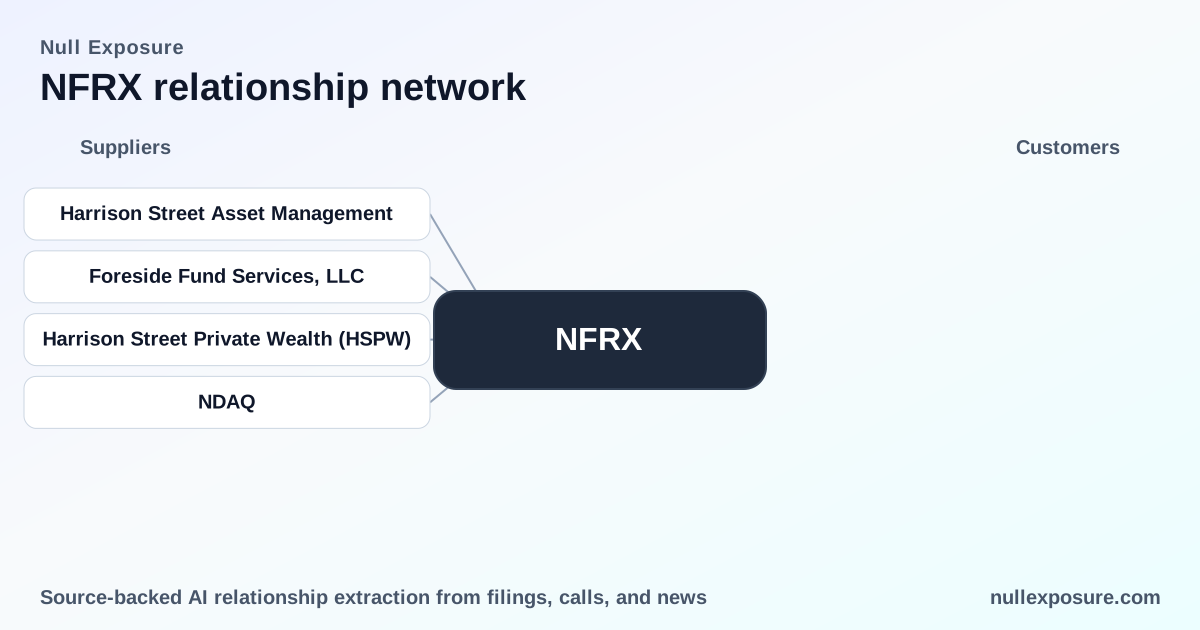
Harrison Street Asset Management — Harrison Street is the sponsor behind the new ETF and has publicly announced the product launch as the firm’s first ETF offering; the launch is framed as a direct extension of Harrison Street’s infrastructure investment platform. (ConnectCRE, March 10, 2026: https://www.connectcre.com/stories/harrison-street-asset-management-launches-firms-first-etf/)
-
Harrison Street Private Wealth (HSPW) — The ETF will be managed by a team inside Harrison Street’s private wealth division, which Harrison Street has positioned as the asset-management engine for this product and the primary portfolio decision-maker. (AlternativesWatch, January 30, 2026: https://www.alternativeswatch.com/2026/01/30/harrison-street-launches-infrastructure-etf-nfrx/)
-
Foreside Fund Services, LLC — Distribution and intermediary services for the fund are handled by Foreside Fund Services, a common industry distributor that will manage the fund’s distribution and related operational communications. (Manila Times / GlobeNewswire, January 30, 2026: https://www.manilatimes.net/2026/01/30/tmt-newswire/globenewswire/harrison-street-asset-management-launches-active-global-listed-infrastructure-etf/2268721)
-
NASDAQ — The ETF began trading on NASDAQ under ticker NFRX, providing the market-access layer and liquidity venue that make the ETF a tradable product for institutional and retail counterparties. (AlternativesWatch / NASDAQ announcement, January 30, 2026: https://www.alternativeswatch.com/2026/01/30/harrison-street-launches-infrastructure-etf-nfrx/)
Each of the relationships above is material to the ETF’s economics and go-to-market execution: HSAM supplies the product, HSPW supplies portfolio management, Foreside supplies distribution, and NASDAQ supplies market access.
Operating-model signals and supplier constraints
At the company level, the available public information produces several clear signals about how the business is structured and what that implies for supplier risk:
-
Concentration: This is Harrison Street’s first ETF and a focused infrastructure product. That concentration increases single-product risk for near-term revenue projections and elevates the importance of getting distribution and market-making right.
-
Contracting posture: Harrison Street uses third-party distribution (Foreside) rather than fully internalized selling. That posture accelerates time-to-market and offloads regulatory and distribution operations, but it creates contractual dependency on a single distributor for retail/intermediary access.
-
Criticality: The NASDAQ listing is critical infrastructure — without exchange access, tradability and liquidity would be impaired. Exchange operational or delisting risk is therefore a direct supplier risk vector for the product.
-
Maturity: The ETF is newly launched in early 2026, so the product’s commercial and performance track record is immature. Early flows, distribution agreements, and seed capital provisions will drive survival and scale dynamics over the first 12–24 months.
These are company-level signals generated from the launch disclosures and industry reports; they frame where supplier diligence should focus for NFRX.
For a structured assessment of counterparties and contractual exposures, see https://nullexposure.com/ for the full supplier map and monitoring tools.
What this means for investors and operators
-
Revenue gating: Management fees depend on asset-gathering. Given the product’s launch status, distribution effectiveness and early NAV growth are the primary revenue levers. That puts immediate importance on the Foreside relationship and on the HSPW team’s ability to generate institutional and wealth-channel flows.
-
Execution risk: Tradeability and bid/ask tightness depend on NASDAQ liquidity provision and market-maker participation. Exchange access is non-negotiable; investors should watch listing status, quoting behavior, and the presence of authorized participants.
-
Governance and continuity: Management by an internal private-wealth team concentrates portfolio expertise in a single group. Governance over succession, investment process documentation, and continuity of personnel are high-impact items for long-term performance.
Action checklist for investor diligence:
- Review the fund’s prospectus and fee schedule for explicit service agreements and fee splits.
- Confirm the Foreside distribution arrangement and any exclusivity or termination clauses.
- Track initial trading liquidity metrics on NASDAQ and AP activity.
- Evaluate the HSPW team’s track record on comparable strategies and operational depth.
Closing: a focused supplier-risk lens
Harrison Street’s NFRX is a straightforward ETF product with compact supplier relationships: internal management (HSPW), third-party distribution (Foreside), and exchange listing (NASDAQ). The dominant risks are concentration of a new product, dependency on an external distributor for flows, and reliance on exchange liquidity. These are addressable through contract review, monitoring of early flows and liquidity, and governance due diligence.
For a deeper, operational supplier analysis and periodic alerts tied to NFRX counterparties, visit https://nullexposure.com/ and subscribe for tailored coverage.
Investors and operators who prioritize supplier resilience should treat those three relationships as the primary levers to monitor and control.