National Grid (NGG) — supplier relationships that shape big‑ticket transmission risk and opportunity
Thesis: National Grid plc monetizes regulated electricity and gas transmission and distribution through long‑lived, capital‑intensive networks and project‑based procurement for major transmission upgrades; profitability derives from regulated returns on invested capital and execution of grid‑scale projects such as the Eastern Green Link series, where suppliers for converter stations and high‑voltage cable systems determine execution risk and schedule. For investors and operators evaluating NGG, the supplier roster for EGL3/EGL4 is a direct lens on delivery risk, contract concentration, and the company's ability to convert authorized capex into revenue and regulated asset base growth.
Explore more supplier intelligence at Null Exposure: https://nullexposure.com/
Why supplier relationships matter to National Grid’s investment case
National Grid is a regulated utility with capital intensity, long asset lives, and predictable tariff returns, but the company’s execution of multi‑billion‑pound projects creates concentrated vendor exposures. Contracts for converter stations and subsea/underground cabling are typically awarded to specialist engineering firms and cable manufacturers, and delays, technical issues, or supplier insolvency can translate directly into schedule slippage and cost pressure that affects near‑term cash flow and long‑term regulated asset base additions.
Key operating characteristics:
- Contracting posture: National Grid awards large, multi‑year EPC and supply contracts to established specialist vendors, favoring suppliers that can meet technical and delivery scope for HVDC and high‑voltage AC systems.
- Concentration: A small number of suppliers handle mission‑critical components (converter stations, subsea and underground cables), concentrating counterparty and performance risk.
- Criticality: These suppliers are mission-critical to project timelines and to avoiding regulatory scrutiny over project delivery.
- Maturity: The company’s procurement process is mature and overseen by governance structures, but the scale of EGL projects elevates execution risk relative to steady‑state transmission maintenance.
For a deeper supplier breakdown and monitoring, visit Null Exposure: https://nullexposure.com/
Supplier map: the counterparties named in recent reporting
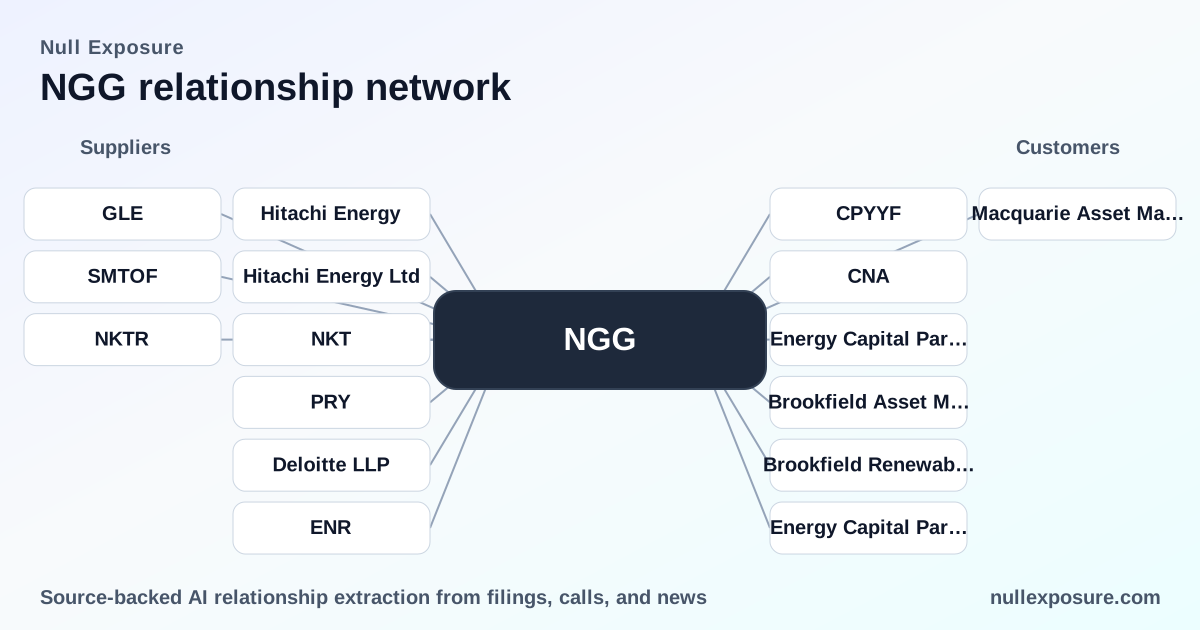
Below I list every supplier relationship surfaced in the results and summarize what each means in plain English.
Hitachi Energy
National Grid awarded contracts for the converter stations on the Eastern Green Link 3 (EGL3) project to Hitachi Energy as part of supply awards approaching GBP 3 billion, positioning Hitachi as the lead for converter technology on a major transmission upgrade (source: TS2 / March 10, 2026 — https://ts2.tech/en/national-grid-plc-signs-3bn-eastern-green-link-3-contracts-with-hitachi-energy-and-nkt/).
Hitachi Energy Ltd (alternate mention)
Reporting repeated the Hitachi Energy appointment for EGL3 converter stations within March 2026 coverage, confirming market recognition of Hitachi’s role on EGL3 (source: Rigzone / March 5, 2026 — https://www.rigzone.com/news/britains_national_grid_awards_4b_supply_contracts_for_egl3-05-mar-2026-183134-article/).
NKT A/S (NKT / NKTR)
NKT was tapped to supply the subsea and underground cables for EGL3, forming the other half of the near‑£3 billion supply package and anchoring cable delivery responsibility with a specialist manufacturer (source: Rigzone / March 5, 2026 — https://www.rigzone.com/news/britains_national_grid_awards_4b_supply_contracts_for_egl3-05-mar-2026-183134-article/; also reported via TS2 / March 10, 2026 — https://ts2.tech/en/national-grid-plc-signs-3bn-eastern-green-link-3-contracts-with-hitachi-energy-and-nkt/).
Prysmian SpA
National Grid previously awarded a GBP 2 billion contract for the EGL4 cable to Italy’s Prysmian SpA, indicating that Prysmian remains a strategic supplier for other legs of the Eastern Green Link programme and establishing multi‑vendor cable sourcing across projects (source: Rigzone / March 5, 2026 — https://www.rigzone.com/news/britains_national_grid_awards_4b_supply_contracts_for_egl3-05-mar-2026-183134-article/).
Deloitte LLP
After a formal competitive tender led by the Audit & Risk Committee, National Grid's board proposed the re‑appointment of Deloitte LLP as external auditor effective from the fiscal year ending March 2028, subject to shareholder approval — a governance decision that affects audit continuity and external assurance over project cost recognition and controls (source: TS2 / December 11, 2025 RNS summary — https://ts2.tech/en/national-grid-plc-stock-ng-l-ngg-latest-news-analyst-forecasts-dividend-outlook-and-key-catalysts-on-16-december-2025/).
Siemens Energy
National Grid stated Siemens Energy will be appointed to build converter stations for certain projects, reflecting historical or alternate procurement choices for converter station delivery and demonstrating that National Grid uses multiple engineering partners across its transmission programme (source: TS2 / December 2025 coverage — https://ts2.tech/en/national-grid-plc-stock-ng-l-ngg-latest-news-analyst-forecasts-dividend-outlook-and-key-catalysts-on-16-december-2025/).
Sumitomo Electric Industries
Sumitomo Electric Industries was named as a supplier of high‑voltage cable in project-level coverage, indicating National Grid’s practice of engaging multiple global cable manufacturers to meet capacity and technical specifications (source: TS2 / December 2025 report — https://ts2.tech/en/national-grid-plc-stock-ng-l-ngg-latest-news-analyst-forecasts-dividend-outlook-and-key-catalysts-on-16-december-2025/).
Societe Generale
Societe Generale was cited as stabilisation coordinator for an anticipated €500 million securities offering by National Grid Electricity Transmission plc, indicating the bank’s role in capital markets transactions that underpin project financing and liquidity for grid investment (source: TS2 / March 2026 news roundup — https://ts2.tech/en/national-grid-share-price-slips-as-gilt-yields-climb-what-to-watch-next-for-ng-l/).
What the supplier roster implies for investors
- Execution risk is concentrated: A small number of specialized suppliers control key project scopes—converter stations and cables—so vendor performance is a first‑order driver of schedule and cost outcomes. The EGL series shows National Grid both diversifying suppliers (Prysmian, NKT, Sumitomo) and concentrating large scope with premier engineering firms (Hitachi, Siemens).
- Counterparty and delivery risk are material: Contracts of GBP‑scale size create exposure to supplier delivery capability, geopolitical supply chains, and commodity inputs. Investors should treat supplier credit and manufacturing footprint as investment signals.
- Regulatory and financing overlay: External auditor continuity (Deloitte) and capital markets intermediaries (SocGen) support governance and funding; financing readiness reduces the probability that delivery issues become liquidity events but does not eliminate timetable risk.
How to use this intelligence
- For portfolio managers: monitor supplier delivery milestones and public notices from Hitachi, NKT, and Prysmian for early signals of slippage or cost variation.
- For operators and contractors: assess sub‑supplier capacity and logistics for subsea cable delivery windows, and map counterparty concentration to procurement contingency plans.
- For credit analysts: incorporate supplier counterparty risk into project‑level recovery scenarios and covenant stress tests.
Final takeaway: National Grid’s regulated business model mitigates steady‑state earnings volatility, but its growth vector — large transmission projects — creates concentrated supplier risk that directly affects project timing and capital deployment. Track converter station and cable vendors closely as leading indicators of execution.
Continue monitoring supplier exposures and procurement developments at Null Exposure: https://nullexposure.com/
For direct follow‑up, I can produce a supplier risk dashboard or a watchlist of milestone dates tied to each counterparty.