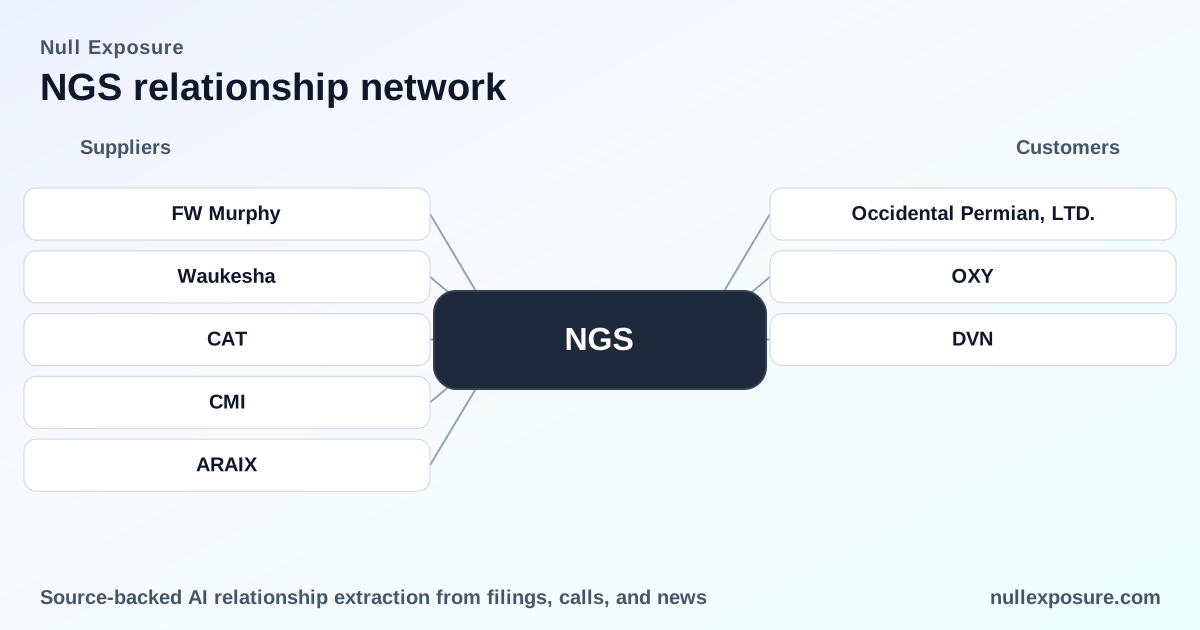
Natural Gas Services Group (NGS): supplier relationships that shape margins and operational risk
Natural Gas Services Group (NGS) rents, sells, designs, installs and services natural gas compression equipment, monetizing through rental fleets, engineered sales and aftermarket service agreements. The company sources major OEM components — engines, compressor frames and control systems — and assembles units on skids for deployment, capturing recurring revenue from maintenance and rentals while depending on third‑party suppliers for critical hardware. For investors, supplier relationships are a direct lever on margin stability, fleet uptime and capital turn. Learn more about provider exposure and supplier signals at NullExposure.
How NGS’s business model ties into its supplier network
NGS operates as a capital‑light equipment supplier and service operator: it invests in compressor units and then monetizes through rental contracts, installations and field service. The gross and operating margins depend on availability and cost of OEM components because NGS performs limited in‑house assembly and relies on suppliers for engines, frames and controls. Financially, NGS shows Revenue TTM of $166.8M, EBITDA of $74.6M and an EV/EBITDA of ~9.2, indicating a mid‑cycle valuation where operational leverage to supplier efficiency is meaningful.
The company’s procurement posture is transactional: components are acquired through periodic purchase orders on an “as needed” basis, with lead times that necessitate forward planning. This creates a predictable working‑capital cadence but introduces exposure to supply disruption or price swings for critical parts. For a closer read of NGS fundamentals, visit NullExposure.
Who supplies NGS and what they provide
NGS’s FY2024 10‑K lists a compact set of OEM vendors whose components are integral to compressor units. Below I summarize each named relationship in plain English, with source context.
- Caterpillar — NGS lists Caterpillar among the OEM vendors supplying engines for its compressor units; these engines are a core component for field reliability and fleet availability. According to NGS’s FY2024 10‑K, Caterpillar is named explicitly as an engine supplier.
- Cummins — Cummins is another primary engine supplier cited by NGS, providing alternative engine platforms that NGS integrates into its skid assemblies. The FY2024 10‑K identifies Cummins as a key OEM for engines.
- Waukesha — Waukesha is named as an engine provider alongside Caterpillar and Cummins, reinforcing that NGS sources engines from several established OEMs to support fleet diversity. The relationship is documented in the FY2024 10‑K.
- Ariel — Ariel supplies compressor frames to NGS, a structural element of compression units that affects lifecycle and rebuild economics; the FY2024 10‑K includes Ariel as the compressor frame supplier.
- FW Murphy — FW Murphy is identified as the controls supplier for NGS’s compressor units, providing the instrumentation and control systems that drive field automation and service diagnostics, per the FY2024 10‑K.
Each of these supplier mentions is drawn directly from NGS’s FY2024 10‑K disclosure, which lists Caterpillar, Cummins, Waukesha, Ariel and FW Murphy as the named OEM vendors providing engines, frames and controls.
What the procurement excerpts reveal about operating constraints
NGS’s filings contain explicit operating constraints that are company‑level signals about procurement and assembly.
- Contracting posture — buyer. NGS purchases engines, compressors, coolers, frames and other components through periodic purchase orders placed with third‑party suppliers on an “as needed” basis. This buyer posture means NGS has procurement flexibility but limited upstream pricing power. (FY2024 10‑K disclosure.)
- Assembly and manufacturing role — limited in‑house assembly. The company assembles OEM components primarily through third‑party service providers and performs limited in‑house assembly, indicating a reliance on external integration capacity rather than full vertical manufacturing. (FY2024 10‑K.)
- Lead‑time and cadence — 3–12 month lead times. Major components typically require three to twelve months prior to delivery, which creates inventory planning needs and exposes the business to supplier lead‑time volatility. (FY2024 10‑K.)
- Criticality and concentration — concentrated and critical suppliers. The company names a small set of OEMs as “key” — a signal that specific vendors are critical to unit construction and uptime; concentration increases operational risk if a supplier experiences capacity constraints. (FY2024 10‑K.)
- Maturity — reliance on established OEMs. The suppliers named are established equipment manufacturers, which reduces technology execution risk but does not eliminate supply chain or allocation risk in tight markets.
These characteristics collectively describe a business that is procurement‑sensitive but operationally efficient, trading the capital cost and complexity of full manufacturing for agility in fleet deployment and service.
How these supplier relationships create risks and opportunities
Investors should weigh three practical axes:
- Supply disruption risk: With lead times of up to a year and a concentrated set of OEMs, prolonged supplier outages or allocation decisions by manufacturers could slow fleet growth or increase costs.
- Margin leverage: Because NGS’s operating margin is strong (Operating Margin TTM ~24.7%), procurement improvements — price, lead time compression or better terms — would flow directly to EBITDA. Supplier negotiations are therefore high‑leverage for investors.
- Operational continuity: Controls (FW Murphy) and engines (Caterpillar/Cummins/Waukesha) are mission‑critical; failures or obsolescence in either category would affect rental uptime, warranty spend and reputational risk.
Monitor OEM production cycles, macro parts inflation and any supplier consolidation among engine or compressor manufacturers. Mid‑cycle OEM order books and lead‑time indicators are leading signals for NGS’s capacity to grow rentals or cut capex per unit.
For a deeper supplier exposure read, visit NullExposure to see how these relationships map against contract terms and inventory cycles.
Actionable next steps for investors
- Review upcoming supplier order books and any public statements from Caterpillar, Cummins, Waukesha, Ariel and FW Murphy about capacity or allocation.
- Track NGS purchase‑order cadence and inventory days in quarterly filings for signs of improving or worsening lead times.
- Monitor aftermarket service revenue as a hedge: rising service margins can offset short‑term component inflation.
Bottom line
NGS runs a high‑margin rental and service franchise that deliberately outsources critical hardware to established OEMs. That setup reduces capital intensity but concentrates operational risk in a small supplier set with multi‑month lead times. For investors, the path to higher returns is clear: improve supplier terms, reduce lead times, and preserve fleet uptime through diversified OEM sourcing and proactive inventory management. Final due diligence should prioritize supplier capacity trends and any changes in OEM pricing or allocation.
If you want a structured supplier risk brief or benchmarking against peers, start here: NullExposure.