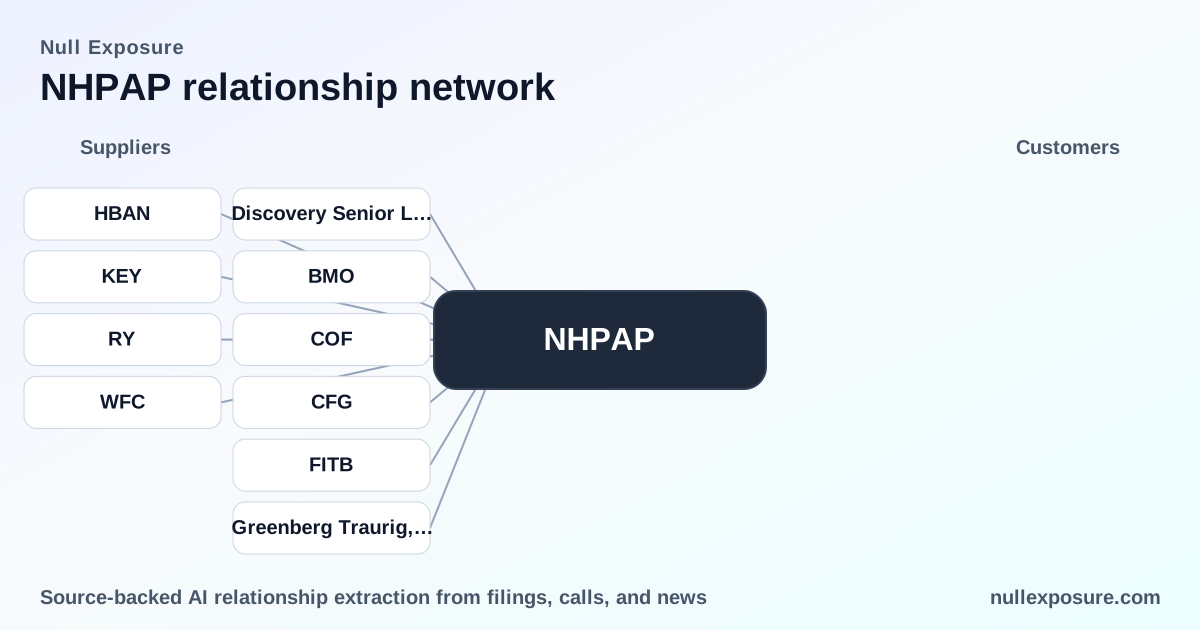
National Healthcare Properties (NHPAP): Counterparty Map and Commercial Implications for Investors
National Healthcare Properties, Inc. operates as a healthcare-focused REIT that acquires, owns and leases a diversified set of senior-living, skilled nursing and medical office properties and monetizes those assets through long-term leases, joint-venture equity arrangements and secured/unsecured financing facilities. For investors, the company’s returns hinge on asset-level occupancy and lease economics plus access to capital markets and syndicate bank facilities that fund acquisitions and refinance maturing debt. Understanding NHPAP’s counterparty ecosystem—operators, lenders, placement agents and legal counsel—reveals where execution risk, concentration and contractual leverage sit.
If you want a structured supplier and counterparty view for active diligence, start here: https://nullexposure.com/
What the relationship roster tells you about the business model
NHPAP’s public disclosures and press releases show a two‑track commercial model: (1) asset-level operating partnerships and RIDEA joint ventures that transfer operating responsibility to specialized managers, and (2) syndicated financing and legal support that sustain balance-sheet flexibility. The company relies on repeat banking relationships and placement agents for liquidity, and on experienced senior‑living operators for day‑to‑day property performance.
- Contracting posture: NHPAP uses master credit facilities and long‑form documentation (a framework contracting approach) for financing and liquidity management; those arrangements are durable and amendable rather than ad hoc.
- Concentration and criticality: A concentrated set of lead banks and investment banks are material to NHPAP’s ability to execute growth and refinance events—loss of any lead arranger would raise short‑term execution risk.
- Maturity: The firm operates under established facilities that date back to 2016 and have been amended, reflecting an institutionalized financing program rather than one-off transactions.
- Service‑provider signal: NHPAP engages third‑party IT and cybersecurity firms for network and endpoint monitoring and incident response assessment, indicating reliance on outsourced operational security to protect tenant and corporate systems.
For more supplier intelligence and relationship analytics, visit https://nullexposure.com/
Counterparty rundown — who NHPAP works with and what they do
Below is a concise, relationship‑by‑relationship summary drawn from the company’s recent public releases.
-
Discovery Senior Living
NHPAP will acquire several senior housing communities through a RIDEA‑structured joint venture where Discovery Senior Living will continue as the operator after closing, preserving operational continuity at the assets. This was disclosed in a GlobeNewswire press release on March 3, 2026. -
BMO Bank N.A.
BMO served as a joint bookrunner on NHPAP’s closing of a new $550 million senior unsecured credit facility, indicating institutional financing support on the unsecured side of the capital structure. Source: GlobeNewswire press release dated December 11, 2025. -
Capital One, National Association
Capital One acted as one of the joint bookrunners and documentation agents on the December 2025 senior unsecured facility, underscoring its role in arranging and documenting NHPAP’s syndicated financings. Source: GlobeNewswire press release dated December 11, 2025. -
Citizens Bank, N.A.
Listed among the joint bookrunners for the $550 million facility, Citizens Bank participates in NHPAP’s institutional lending syndicate and helps distribute credit risk across regional lenders. Source: GlobeNewswire press release dated December 11, 2025. -
Fifth Third Bank, National Association
Fifth Third Bank joined as a joint bookrunner on the senior unsecured credit facility, reflecting the company’s strategy of broad syndication to secure commitment capacity. Source: GlobeNewswire press release dated December 11, 2025. -
Greenberg Traurig, LLP
Greenberg Traurig served as legal counsel to NHPAP for the closing of the $550 million facility, providing transactional and regulatory legal services central to capital markets execution. Source: GlobeNewswire press release dated December 11, 2025. -
Huntington National Bank
Huntington participated as a joint bookrunner in the December 2025 financing, contributing distribution and underwriting capacity to the syndicated facility. Source: GlobeNewswire press release dated December 11, 2025. -
KeyBanc Capital Markets Inc.
KeyBanc Capital Markets was named among the bookrunners supporting the unsecured credit facility, positioning it as an investment‑banking partner on NHPAP’s capital markets activity. Source: GlobeNewswire press release dated December 11, 2025. -
KeyBank National Association
KeyBank appears as a documentation agent and is referenced in NHPAP’s master credit facility arrangements, consistent with a deeper, framework-style secured lending relationship that traces back to earlier master facility agreements. Source: GlobeNewswire press release dated December 11, 2025 and company facility disclosures referencing master agreements dated October 31, 2016 (as amended). -
Royal Bank of Canada
RBC acted as a joint bookrunner on the $550 million senior unsecured facility, signaling cross‑border institutional bank support for NHPAP’s unsecured funding needs. Source: GlobeNewswire press release dated December 11, 2025. -
Wells Fargo Bank, National Association
Wells Fargo Bank acted as the administrative agent for the new unsecured facility and played a central role in facility administration and agent responsibilities. Source: GlobeNewswire press release dated December 11, 2025. -
Wells Fargo Securities, LLC
Wells Fargo Securities functioned as a joint bookrunner alongside BMO for the unsecured credit facility, providing capital markets execution and placement services. Source: GlobeNewswire press release dated December 11, 2025.
What these relationships imply for investors: risk and opportunity
The roster is weighted toward bank syndicates and placement agents for unsecured debt and experienced operators for asset management, which maps directly to NHPAP’s core levers: access to capital and operational execution at property level. Key commercial implications:
- Liquidity and refinancing risk are central: The reliance on syndicated unsecured facilities means NHPAP’s credit spread and market access directly influence acquisition pacing and debt maturity management. The participation of large banks and dealers mitigates but does not eliminate this risk.
- Operational continuity through third‑party operators: The Discovery Senior Living JV under a RIDEA structure preserves operator continuity, which reduces short‑term operational execution risk post‑acquisition while preserving upside through JV economics.
- Framework contracting for secured facilities: Evidence of master credit facility agreements (originally documented in 2016 and amended) indicates a mature, standardized approach to secured lending that supports scalability but creates covenants that management must actively manage.
- Outsourced cybersecurity and IT services: Company-level disclosures show reliance on external IT/cybersecurity service providers for monitoring and incident response; this is a critical operational control but introduces third‑party operational dependency.
Tactical takeaways for portfolio teams
- Prioritize covenant and amendment language when underwriting future purchases; master facilities and unsecured syndications materially affect refinancing flexibility.
- Monitor lead arranger relationships—Wells Fargo, BMO and KeyBank are visibly central to execution—and track any shifts in bank appetite for healthcare REIT unsecured paper.
- Treat operator continuity (e.g., Discovery Senior Living) as a value‑preserving feature in acquisition underwriting and stress‑test occupancy and reimbursement scenarios under the operator’s management plan.
For further supplier-level intelligence and counterparty scoring, explore our research hub: https://nullexposure.com/
Conclusion
NHPAP’s counterparty ecosystem is consistent with a stabilized healthcare REIT: institutional bank syndicates and legal counsel enable capital access, while operational partnerships and RIDEA structures delegate property-level execution to specialized operators. Investors should underwrite both capital markets access and operator performance when modeling downside scenarios. For deeper supplier maps and relationship scoring that accelerate diligence, visit https://nullexposure.com/ and request the detailed report.