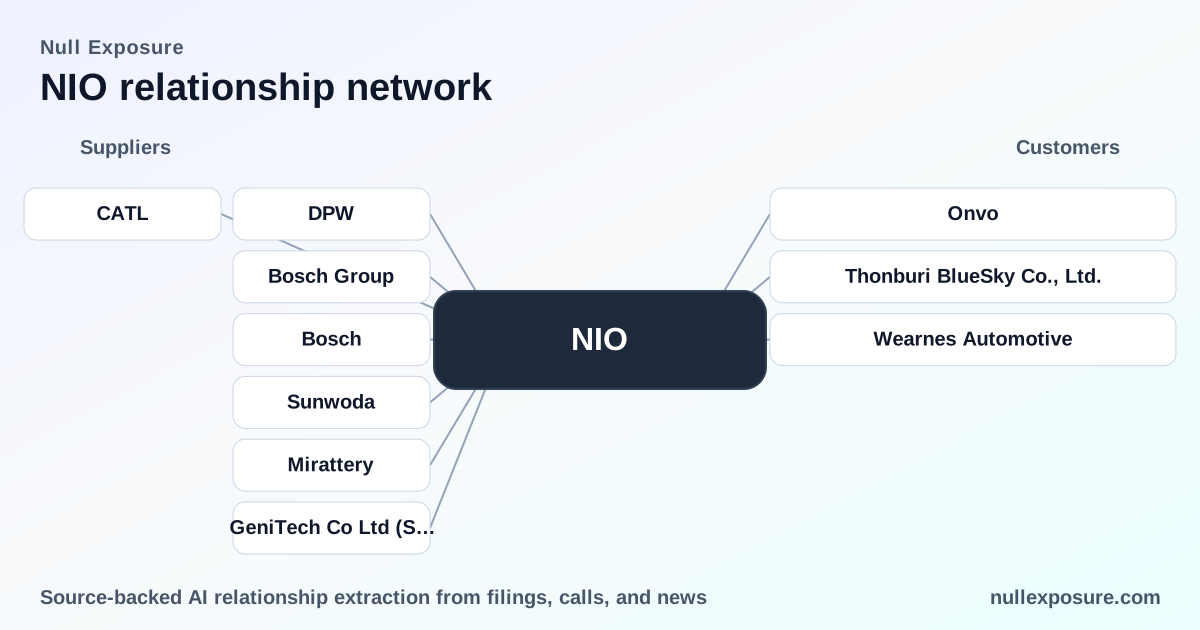
NIO's supplier map: strategic partners, critical inputs and what investors need to know
NIO Inc. designs, develops, manufactures and sells smart electric vehicles and related services, monetizing primarily through vehicle sales and adjacent service offerings tied to battery and aftersales capabilities. The company is scaling supply relationships across batteries, chips, parts and logistics to support international expansion and asset-backed service models, and investors should evaluate how those relationships change cost structure, operational concentration and capital intensity.
Explore broader supplier intelligence and comparable profiles at https://nullexposure.com/ to track how partner shifts affect NIO's operating leverage.
How these relationships reflect NIO's operating model and commercial posture
NIO operates as a product-led OEM that increasingly treats upstream suppliers as strategic partners rather than transactional vendors. The supplier set documented in recent news shows a mix of global incumbents (Bosch, DHL), specialized battery suppliers and asset operators (Sunwoda, CATL, Mirattery) and a nascent chip-sourcing/production arm (GeniTech/Shenji). This mix signals several company-level characteristics:
- Contracting posture: Strategic cooperation agreements (for example with Bosch) indicate collaborative, long-term contracting for systems and modules rather than spot-buying of components.
- Concentration and criticality: Battery and chip supply chains are critical to vehicle availability and technology differentiation; relationships with multiple battery players and an internal chip unit point to deliberate diversification and partial verticalization.
- Maturity of supply chain: Engaging established logistics and parts suppliers such as DHL and Bosch demonstrates a progression from early-stage domestic sourcing to globalized, industrial-grade supplier arrangements.
- Capital and balance-sheet implications: Battery asset securitization through entities like Mirattery converts operating assets into financeable receipts, affecting cash flow volatility and capital returns without diluting core manufacturing economics.
NIO’s FY2025 metrics — substantial revenue (RMB-equivalent revenue TTM shown as USD 87.5B) with negative EPS and operating margin compression — frame these supply moves as necessary for scale but also costly in the near term. Investors should treat supplier shifts as operational levers that materially affect margin recovery and delivery capacity.
Explore coverage of supplier developments and scenario analysis at https://nullexposure.com/ for regular updates.
Supplier-by-supplier: what each relationship contributes
DHL (DPW)
NIO named DHL as its logistics partner for aftermarket services across Northwestern Europe, signaling a push to industrialize parts distribution and service logistics in a priority regional market; this is a logistics and aftersales capacity play that supports international expansion (news report, March 2026: StockTwits summary) (https://stocktwits.com/news-articles/markets/equity/will-nio-stock-extend-its-winning-streak-goldman-boosts-stake-but-es8-demand-raises-concerns/cZRTfkrR4Au).
Bosch / Bosch Group
NIO signed a strategic cooperation agreement with Bosch during German Chancellor Friedrich Merz’s visit to China, positioning Bosch as a systems partner for automotive components and engineering collaboration rather than a simple parts supplier; this elevates NIO’s access to mature vehicle subsystems and European supply-chain know-how (company press release, 2026-02-27: NIO; corroborated by industry coverage) (https://www.nio.com/news/20260227001, https://cnevpost.com/2026/02/27/nio-inks-bosch-deal/).
Sunwoda
NIO’s Firefly powertrain for right-hand-drive markets uses a 42.1 kWh lithium iron phosphate (LFP) pack supplied by Sunwoda, reflecting Sunwoda’s role as a cell/pack supplier in lower-cost, high-volume configurations where LFP chemistry suits the product mix (market coverage, March 2026) (https://globalchinaev.com/post/nios-firefly-brand-officially-enters-thailand-as-its-2nd-right-hand-drive-marke).
Mirattery (Wuhan Weineng)
Mirattery, the battery asset operator affiliated with NIO, completed a REITs issuance and asset securitization, demonstrating a capital strategy to monetize deployed battery assets and offload part of balance-sheet risk tied to battery ownership while preserving service models like battery swapping (financial news, February 2026) (https://cnevpost.com/2026/02/11/mirattery-issues-72-5-million-reits-securitization-effort/).
GeniTech Co Ltd (Shenji)
NIO’s chip unit (reported as GeniTech / Shenji) has initial orders primarily from NIO and is expanding into robotics and agent reasoning, indicating NIO is vertically integrating critical semiconductor and compute capabilities to reduce external dependency and support advanced vehicle software stacks (industry coverage, February 2026) (https://cnevpost.com/2026/02/26/nio-confirms-chip-unit-funding/).
CATL
Industry reporting highlights partnerships with CATL as influential for standardizing battery swap models in China, making CATL an important ecosystem partner for energy-storage formats that underpin NIO’s differentiated battery-swap and modular-service offerings (market analysis, March 2026) (https://www.tradingview.com/news/zacks:fcbb106d5094b:0-tesla-or-nio-which-stock-is-worth-retaining-in-your-portfolio/, https://www.theglobeandmail.com/investing/markets/stocks/NIO/pressreleases/258104/tesla-or-nio-which-stock-is-worth-retaining-in-your-portfolio/).
What investors should watch next — risk, timing and opportunity
- Supply concentration risk on batteries and chips is the primary operational vulnerability. NIO’s mix of external suppliers (Sunwoda, CATL, Mirattery) and in-house capability (GeniTech) reduces single-source exposure but increases complexity in procurement and quality control.
- Strategic partnerships with Bosch and DHL are de-risking steps for international markets. These relationships shorten time-to-market for European systems integration and aftersales scale, improving delivery economics for overseas rollout.
- Asset monetization via Mirattery changes capital dynamics. Battery REITs convert recurring capital items into financeable assets; investors should treat securitizations as cash-flow management tools that influence reported leverage and margin timing.
- Verticalization of chips is a long-horizon value driver. GeniTech’s orientation toward NIO’s internal demand and adjacent robotics work positions the company to capture more software-to-hardware margin but requires continued R&D spend and manufacturing discipline.
Key takeaway: NIO’s supplier blueprint is shifting from tactical sourcing to strategic partnership and partial verticalization, which improves control over critical inputs but raises near-term capital and execution risk.
Explore granular supplier impact scenarios and supplier-event alerts at https://nullexposure.com/ to stay ahead of supply-chain-driven earnings surprises.
Bottom line
NIO is architecting a supplier ecosystem that balances global incumbents for system reliability (Bosch, DHL), diversified battery sourcing and asset finance (Sunwoda, CATL, Mirattery) and internal chip capability (GeniTech) to support scale and product differentiation. Investors should treat supplier announcements as material signals about delivery risk, margin trajectory and capital strategy. For continuing coverage and supplier risk scoring, visit https://nullexposure.com/.