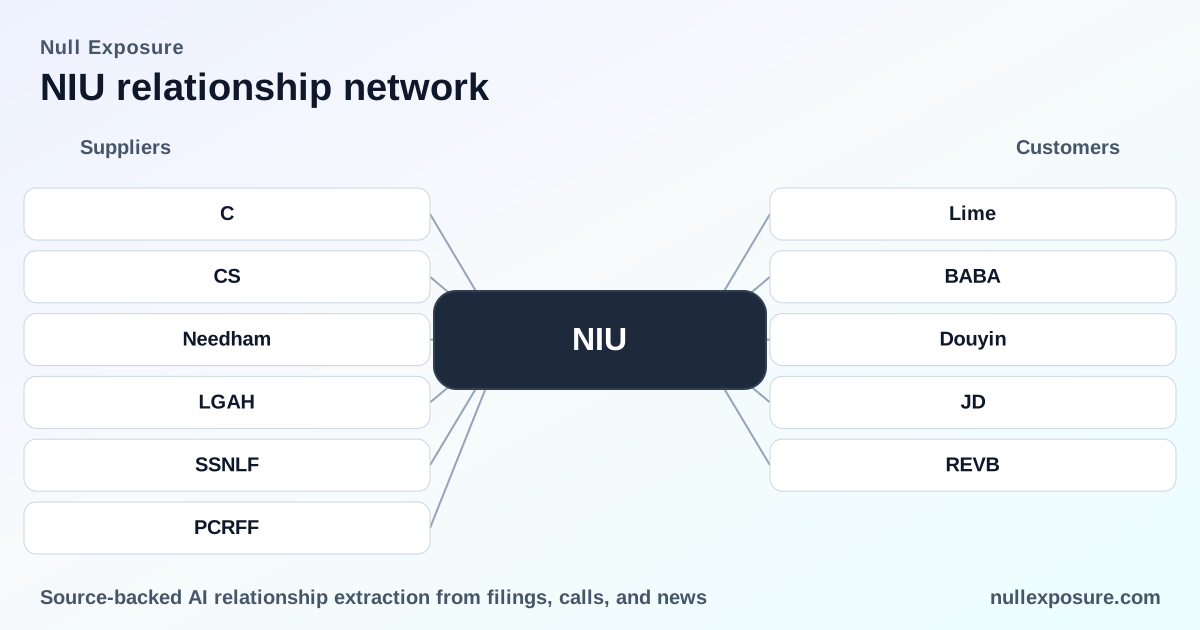
NIU Technologies: supplier relationships that shape product economics and risk
Niu Technologies designs and sells connected electric scooters and monetizes primarily through unit sales of vehicles, replacement parts and accessories, and related services tied to its smart mobility platform. The company sources critical components—most notably lithium-ion battery cells—from established electronics suppliers and has used global investment banks to access capital markets. Investors should evaluate NIU by tracking battery supply quality, supplier concentration, and the durability of its capital-market relationships. For ongoing supplier intelligence and relationship mapping visit https://nullexposure.com/.
Why supplier links matter for an EV scooter specialist
Battery chemistry, cell provenance, and underwriter credibility directly influence product safety, warranty costs, and the cost of capital. NIU’s use of major battery brands is a structural advantage: reputable cell suppliers reduce downstream reliability risk and preserve brand value, while historical engagement with global underwriters indicates the company can access Western capital markets when needed.
Key takeaways:
- Batteries are critical inputs: cell quality drives safety, warranty, and residual value.
- Supplier brand matters: Panasonic, LG, and Samsung provide bench‑marked performance and supply chain visibility.
- Capital relationships affect strategic optionality: past engagement with major banks supports market access for equity or debt raises.
If you want a consolidated view of NIU’s external relationships and their commercial implications, explore more at https://nullexposure.com/.
What the record shows — relationship-by-relationship rundown
Below are every supplier and external partner relationship identified in the available results, each summarized in plain English with source context.
Citigroup (Citi Group)
NIU tapped Citi as one of the joint underwriters for its U.S. IPO process, signaling early willingness to work with major global banks to structure public capital raises. According to Caixin Global’s coverage of NIU’s 2018 filing, Credit Suisse and Citi Group were listed as joint underwriters for the deal (Sept 25, 2018).
Credit Suisse
Credit Suisse served alongside other international banks as a joint underwriter for NIU’s 2018 public offering, establishing a link to Western institutional distribution channels. CNBC’s report from Sept 26, 2018 noted Credit Suisse, Citigroup and Needham as underwriters for the public offering.
Needham
Needham appears as a co‑underwriter on NIU’s 2018 U.S. IPO, representing boutique investment bank involvement that can complement global banks with targeted U.S. institutional coverage. CNBC’s Sept 26, 2018 article lists Needham together with Credit Suisse and Citigroup for the offering.
LG
NIU relies on battery cells from prominent manufacturers including LG, which supports battery durability and perceived safety for its scooters. ThePack’s FY2024 overview of NIU’s urban mobility solutions cites LG among the reputable lithium‑ion brands NIU uses.
Samsung
Samsung is identified as one of NIU’s battery‑cell sources, contributing to the company’s reliance on established electronics suppliers for core powertrain components. ThePack’s FY2024 profile of NIU mentions Samsung as a supplier of high‑quality lithium‑ion batteries.
Panasonic
Panasonic is cited as a source of high‑performance battery cells for NIU models, an endorsement that aligns NIU with a longstanding battery manufacturer known for automotive and consumer applications. ThePack’s CES 2020 coverage referenced Panasonic as the provider of high‑performance battery cells for NIU’s new vehicles, and ThePack’s FY2024 article reiterated Panasonic among NIU’s battery partners.
Operating model signals and business‑model constraints
The data payload did not extract any explicit contractual constraints, deliveries or supplier disputes; no supplier constraints were listed in the available results, which is itself an informative company‑level signal about what the public record highlights (or omits).
From the relationship mix we can infer clear operating characteristics:
- Contracting posture: NIU contracts with multiple tier‑one battery cell manufacturers rather than relying on single-source specialty suppliers, indicating an active approach to securing quality and mitigating supplier concentration risk.
- Concentration: While NIU draws cells from several large suppliers, the business remains dependent on a small set of global battery brands, which is common in EV hardware supply chains and reduces unit‑cost volatility but does not eliminate supplier concentration risk entirely.
- Criticality: Batteries are mission‑critical to product functionality, safety, and warranty economics; a disruption or quality issue would have immediate operational and reputational consequences.
- Maturity: Engagement with major underwriters in the 2018 IPO reflects sufficient corporate maturity to access international capital markets, which supports strategic flexibility for funding growth or smoothing cash flow.
If you need a deeper, custom analysis of NIU’s supplier concentration and contractual posture, start your investigation at https://nullexposure.com/.
Risk and opportunity checklist for investors and operators
- Risk — battery supply incidents: a product recall or cell defect would drive warranty costs and brand damage given battery criticality.
- Opportunity — supplier credibility: relationships with Panasonic, LG, and Samsung support product quality claims and ease market entry where brand trust matters.
- Capital access: prior work with Credit Suisse, Citigroup and Needham demonstrates market access capacity that can be reactivated for expansion or refinancing needs.
What investors and operators should do next
Operators: document multi‑vendor cell validation and maintain visible quality KPIs tied to each supplier to reassure customers and underwriters. Investors: monitor vendor shipment mix and any supplier scorecards disclosed in quarterly reporting or regulatory filings; prioritize management commentary on battery sourcing and inventory buffers.
For an aggregated and investor‑grade view of NIU’s external relationships and their materiality, visit https://nullexposure.com/ and request the supplier relationship briefing.
Conclusion: NIU combines product engineering with pragmatic supplier selection and has historically leveraged international underwriters for market access. Battery supplier quality and concentration are the dominant supply‑side themes to track, and the company’s choice of recognized battery brands is a structural advantage that reduces—but does not eliminate—execution risk.