NIXX: Supplier relationships that reshape an edge-to-AI stack
Nixxy, Inc. (NASDAQ: NIXX) operates as a hybrid technology and services company that monetizes through a blend of cloud-based SaaS analytics, AI-driven fintech modules, and recently expanded edge infrastructure services. Revenue comes from software licensing, managed data-infrastructure contracts, and embedded payments integrations — augmented by targeted acquisitions to accelerate go-to-market in telecom and AI verticals. Investors should assess supplier ties both as cost centers and strategic enablers of distribution and product breadth. For a concise supplier-risk scorecard and ongoing monitoring, visit https://nullexposure.com/.
Why supplier relationships matter for NIXX’s business model
Nixxy’s model relies on three linked capabilities: proprietary software and licensed fintech IP, operational telecom/edge infrastructure, and embedded payments/settlement services layered on telecom channels (SMS, voice, messaging). Supplier partners provide both the intellectual property and the physical infrastructure that convert product concepts into billable services, so vendor posture and contract tenor directly affect revenue durability and margin structure. Company filings for FY2024–FY2025 show aggressive expansion funded by asset acquisition and licensing arrangements, indicating a deliberate tradeoff of capital deployment for immediate capability build-out.
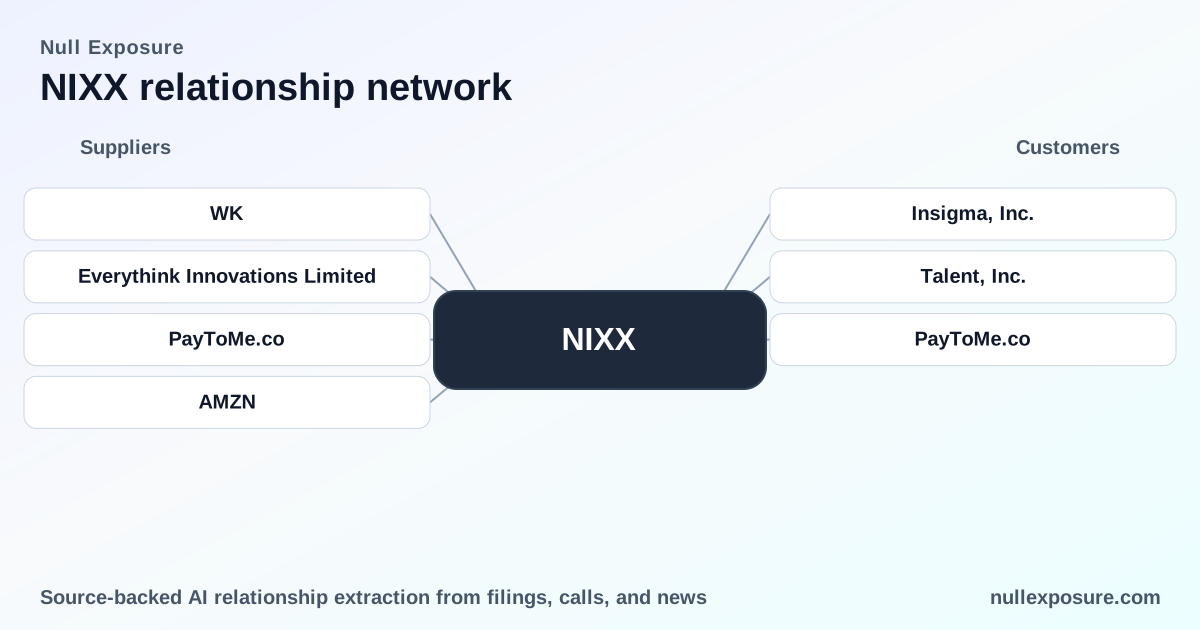
Deal map: the four supplier relationships to know
Workiva — enterprise SEC reporting platform
Nixxy adopted Workiva’s enterprise-grade SEC reporting platform to strengthen institutional reporting and governance. According to a March 10, 2026 press release reported on The Globe and Mail, the company implemented Workiva to standardize regulatory filings and governance workflows, supporting the firm’s scaling public-company requirements (https://www.theglobeandmail.com/investing/markets/stocks/NIXX-Q/pressreleases/388797/nixxy-nasdaqnixx-strengthens-institutional-reporting-infrastructure-through-workiva-adoption-while-expanding-ai-fintech-ecosystem-with-strategic-partner-paytome-co/).
Everythink Innovations Limited — EDGE data center asset acquisition
Nixxy announced an acquisition of EDGE data center assets from Everythink Innovations Limited, taking control of carrier-grade operations in Fremont, CA, and Vancouver, Canada. The press release published via AccessWire (FY2025) describes that the EDGE assets transfer is intended to underpin Nixxy’s enterprise, telecom, and AI infrastructure offerings (https://www.accessnewswire.com/newsroom/en/business-and-professional-services/nixxy-inc.-nasdaq-nixx-acquires-edge-data-center-and-telecom-ass-1060164).
PayToMe.co — embedded payments and invoicing integration
Nixxy entered a partnership to embed PayToMe.co’s payment and invoicing capabilities into its telecom footprint, bringing payments, settlement, and compliance automation closer to customer engagement channels. The collaboration was outlined in a March 2026 news item, which highlights integration of payments into SMS, voice, and messaging touchpoints to simplify monetization of telecom services (Bitget News, March 2026; https://www.bitget.com/amp/news/detail/12560605195988).
Amazon Web Services (AWS) — hybrid failover and routing infrastructure
Infrastructure integration includes Amazon Web Services hybrid failover capability alongside carrier-grade routing and switching acquired with Everythink’s assets. The company’s FY2025 announcement specifies AWS will power hybrid failover for Nixxy’s data infrastructure across enterprise, telecom, and AI sectors, improving resilience and scalability (AccessWire, FY2025; https://www.accessnewswire.com/newsroom/en/business-and-professional-services/nixxy-inc.-nasdaq-nixx-acquires-edge-data-center-and-telecom-ass-1060164).
What these relationships reveal about operating posture and strategic constraints
Company-level signals from filings and disclosures show a mixed contracting posture: long-term exclusive licensing where IP is critical, and short-term commercial finance where working capital needs exist. For example, NIXX holds a long-term exclusive technology license with a 10-year term and auto-renewals (company filings, FY2024–FY2025), indicating strategic dependence on licensed fintech IP for product differentiation. Simultaneously, NIXX uses short-term factoring arrangements for receivables with rolling 12-month terms, demonstrating active working-capital management and potential cash-flow sensitivity.
Other company-level signals:
- Concentration and criticality: The firm relies on related-party providers for software development and platform maintenance (Mauritius-based services) and pays material amounts to those firms, implying operational concentration in a small set of suppliers (NIXX filings, 2023–2024).
- Maturity and spend profile: Disclosed spend bands show a mix of sub-$100k, $100k–$1M, and $1M–$10M engagements, and promissory note balances in the low millions, which point to growth-stage capital intensity rather than large-scale enterprise procurement.
- Contract tenor risk: Long-term licensing (10-year exclusive terms) creates dependency on licensed IP for product revenue; short-term financing agreements create rolling liquidity pressures around receivables monetization.
These factors collectively mean supplier relationships are strategic levers for growth but also concentrated operational risks; investors should treat licenses and edge assets as both revenue enablers and potential single points of failure for specific product lines.
How supply-side moves change the investment thesis
- Upside: Owning edge assets and integrating AWS failover improves gross margin potential on infrastructure services and reduces third-party colocation costs; embedded payments via PayToMe.co accelerates monetization of messaging channels and captures transaction-level revenue.
- Risk: Related-party reliance for development and material licensing commitments create concentration risk and governance questions; short-term factoring arrangements indicate persistent cash-cycle pressure.
- Operational implication: The combination of licensed fintech IP, acquired edge assets, and third-party cloud failover is a rapid build-out strategy that trades near-term cash for longer-term differentiated offerings.
For a structured assessment of NIXX supplier exposure and a tailored supplier risk matrix, see https://nullexposure.com/.
Practical next steps for investors and operators
- Validate contract tenors and renewal mechanics for the GOLQ-style licensing arrangements disclosed in filings; contract duration and exclusivity materially affect future revenue defensibility.
- Quantify revenue sourced from newly acquired edge assets versus legacy SaaS to determine capital allocation effectiveness.
- Conduct targeted vendor due diligence on related-party development suppliers and payment partners to assess concentration and governance controls.
Access our full supplier-monitoring toolkit and subscribe to alerts at https://nullexposure.com/.
Bottom line: supplier exposure is now a competitive asset
Nixxy has converted supplier relationships into product capabilities—license-controlled fintech IP, acquired edge infrastructure, embedded-payments partnerships, and enterprise reporting tools—that collectively shift the company from a pure software vendor to an infrastructure-enabled services provider. That strategic shift increases both upside (higher-margin integrated services, transaction revenue) and supplier-driven risks (concentration, cash-cycle dependence, and contract complexity). Investors should weigh NIXX’s recent asset-backed expansion and long-term licenses against short-term financing patterns and related-party operational dependencies when updating valuation and risk frameworks.