Nektar Therapeutics: supplier footprint, financing partners, and what investors should price in
Nektar Therapeutics is a clinical-stage biopharma that monetizes through drug development, strategic partnerships and periodic equity markets access, while outsourcing nearly all manufacturing and specialty services. The company develops immunology and oncology assets and relies on third‑party manufacturers for reagents, biologics and finished drug product; funding is supplemented by transaction-driven capital raises and underwritten offerings. Investors should evaluate Nektar less as a vertically integrated manufacturer and more as a development-stage sponsor whose operating performance is tightly coupled to external supply continuity and capital markets access.
For a deeper supplier risk view, visit https://nullexposure.com/.
The operating model that matters to a balance sheet
Nektar’s public disclosures present a clear operating posture: manufacturing is outsourced, commercial-scale supply relationships become long‑term only as products near approval, and services such as cyber risk management are provided by third parties. These characteristics drive three practical investment signals:
- Concentration and criticality: The sale of the Huntsville manufacturing facility transferred direct production responsibility to an affiliate buyer and introduced a critical supplier dependency for PEG reagents and finished‑product capacity.
- Contracting posture: Early‑phase work is procured on purchase orders; the company only negotiates long‑term supply arrangements as assets approach registrational milestones, which preserves flexibility but elevates execution risk if a partner fails.
- Service dependencies: Managed security and other third‑party services are in use, so operational risk includes vendor cyber and systems continuity.
These are company-level signals drawn from the FY2024 filing and subsequent disclosures; they inform concentration, contingency planning, and required monitoring cadence for investors.
How to read the supplier and banker relationships
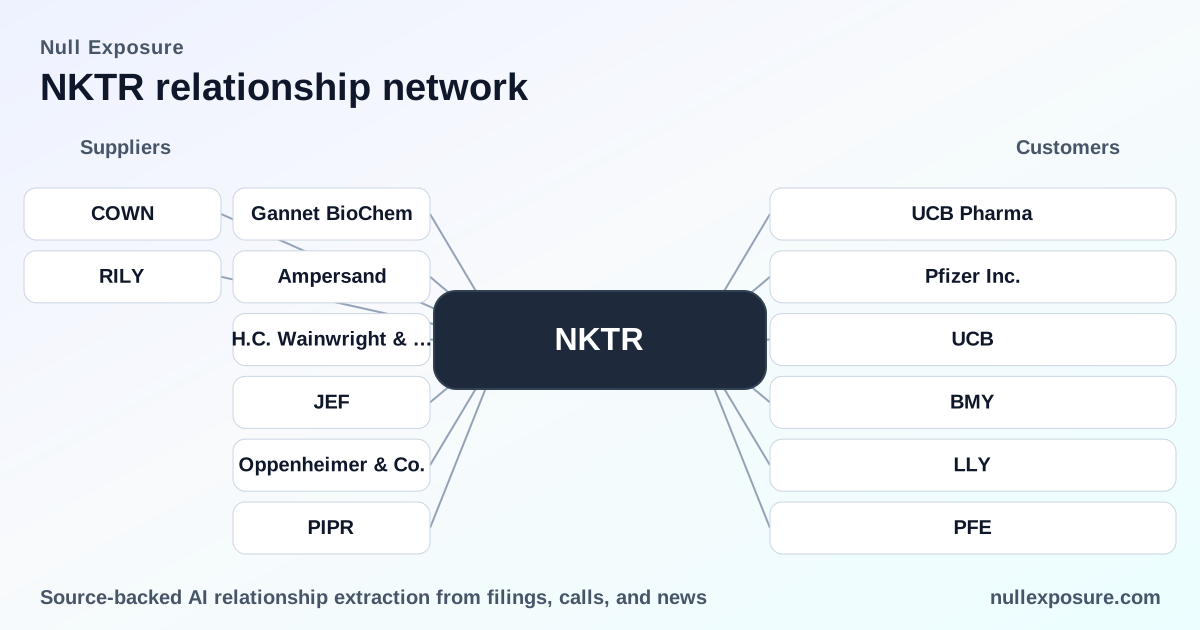
Nektar’s supplier map is a mix of manufacturing counterparties and underwriters who provide capital. Below I summarize every relationship reported in the available source set and cite the originating disclosure.
Gannet BioChem
Nektar assigned manufacturing and supply obligations to Gannet BioChem after selling the Huntsville facility, making Gannet the primary supplier of PEG reagents used in rezpegaldesleukin and NKTR‑255. This is documented in Nektar’s FY2024 Form 10‑K, which explains the facility sale and the resulting supplier dependency (FY2024 10‑K).
Ampersand (Ampersand Management LLC / Ampersand Capital Partners)
Gannet is an affiliate of Ampersand; the 10‑K states the sale transferred certain manufacturing assets and obligations to Gannet, an affiliate of Ampersand, effectively outsourcing legacy manufacturing functions to a private‑equity‑affiliated operator (FY2024 10‑K).
Jefferies (JEF)
Jefferies acted as a joint bookrunning manager on Nektar’s $460 million public offering that closed in early 2026, signaling primary sell‑side support and distribution muscle for the equity raise (press releases reported March 2026 via PR Newswire and Aspen Daily News).
TD Cowen (COWN)
TD Cowen served as a joint bookrunning manager on the same offering, providing institutional placement capabilities for the transaction that closed in March 2026 (PR Newswire/Aspen Daily News, Mar 2026).
Piper Sandler (PIPR)
Piper Sandler was listed as a joint bookrunning manager for the March 2026 offering, participating in the underwriting syndicate that executed the equity raise (PR Newswire/Aspen Daily News, Mar 2026).
Oppenheimer & Co.
Oppenheimer & Co. is named among the lead managers for the March 2026 public offering, indicating one of the key distribution and pricing partners used to access public equity (PR Newswire/Aspen Daily News, Mar 2026).
H.C. Wainwright & Co.
H.C. Wainwright & Co. acted as a lead manager alongside Oppenheimer for the March 2026 offering, underscoring Nektar’s reliance on specialty biotech underwriters to place large equity tranches (PR Newswire/Aspen Daily News, Mar 2026).
B. Riley Securities (RILY)
B. Riley Securities was listed as a manager on the same offering, participating in the syndicate for the $460 million transaction that closed in March 2026 (PR Newswire/Aspen Daily News, Mar 2026).
What those relationships mean for investors
The supplier and underwriting map reveals two vectors that determine near‑term equity value:
- Supply execution is a single point of failure for specific reagents and manufacturing capacity. The FY2024 Form 10‑K explicitly ties PEG reagent supply for rezpegaldesleukin and NKTR‑255 to Gannet BioChem after the facility sale, which elevates operational risk for programs that require those reagents (FY2024 10‑K).
- Capital access is active and functioning. The March 2026 underwritten offering that closed for $460 million, run by a syndicate including Oppenheimer, Jefferies, H.C. Wainwright and others, shows market receptivity to dilutive financing when needed, but also makes future dilution a live option for the company (PR Newswire/Aspen Daily News, Mar 2026).
For a structured supplier risk score and ongoing supplier monitoring, see more at https://nullexposure.com/.
Practical risk checklist for operators and procurement
- Validate alternate sources for PEG reagents and ensure tech‑transfer plans are documented and tested.
- Request contract term summaries and ramp milestones for any long‑term supply agreement as assets transition toward approval.
- Monitor the counterparty that acquired the facility (Gannet/Ampersand) for capacity investments and regulatory compliance.
- Track underwriter relationships and market windows to anticipate future financings and dilution.
Bottom line and next steps
Nektar runs a capital‑intensive, outsourced operating model where supplier continuity and access to equity markets are the principal drivers of near‑term valuation. The company’s sale of its manufacturing facility concentrated reagent and production risk with Gannet BioChem (an Ampersand affiliate), while its successful March 2026 underwritten offering demonstrates functional capital markets access. Investors should prioritize monitoring contractual terms around reagent supply, the operational performance of Gannet/Ampersand, and the cadence of equity raises that affect dilution.
For ongoing supplier intelligence and tracking of Nektar’s counterparty exposures, start here: https://nullexposure.com/. For institutional monitoring and alerts tied to supplier changes, visit https://nullexposure.com/.