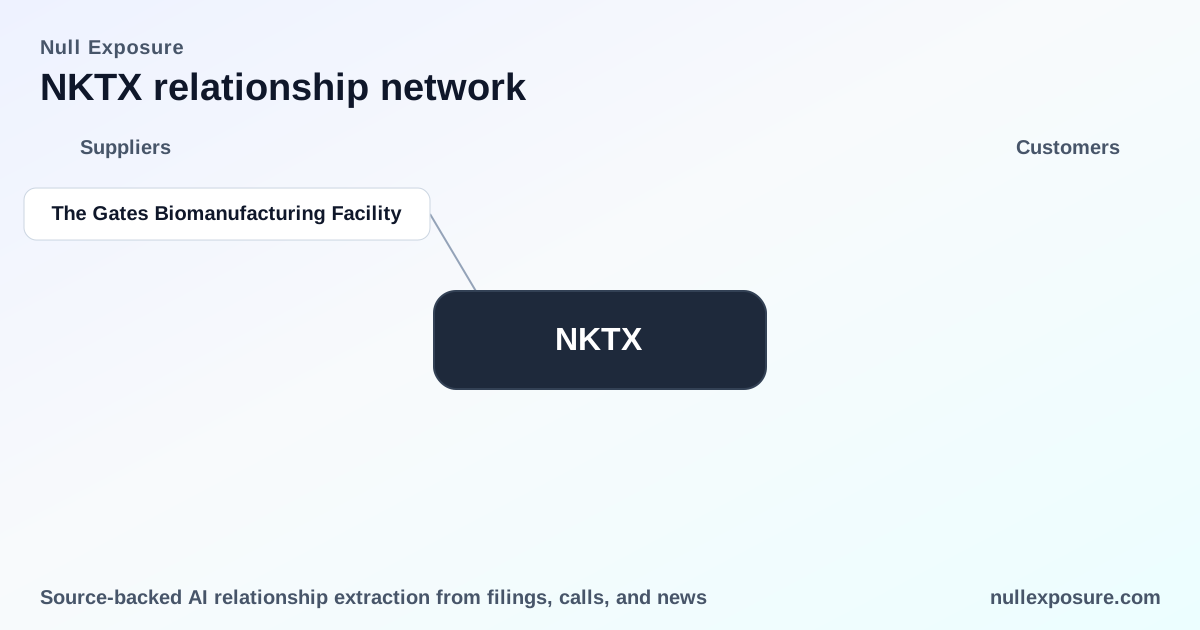
Nkarta (NKTX) — supplier relationships and what they mean for investors
Nkarta is a clinical-stage cell therapy company that develops and intends to commercialize Natural Killer (NK) cell products for oncology. The company monetizes by advancing product candidates through clinical development toward potential licensing or product sales, relying on third-party manufacturers and service providers to produce clinical supply and support trials; revenue is not yet material while development and manufacturing partnerships drive near-term capital needs and execution risk. For investors evaluating supplier risk and operational leverage, the central question is whether Nkarta’s external partners are stable, scalable, and single-source dependent for critical manufacturing steps. For a deeper look at counterparties and sourcing exposure, visit https://nullexposure.com/.
The short story: external manufacturing is central to the plan
Nkarta outsources significant portions of manufacturing and trial support. That outsourcing structure compresses fixed capital but creates execution concentration — manufacturing partners are critical to timelines and clinical progress. This is not a company that will rapidly internalize large-scale manufacturing without meaningful capital and time. According to Nkarta’s public disclosures, third-party contract manufacturers produce clinical supplies and Nkarta leases laboratory and manufacturing space under long-term commitments, which together shape both cost structure and operational flexibility.
Supplier snapshot: the relationship you need to know
The available supplier intelligence identifies at least one explicit external manufacturing partner:
- The Gates Biomanufacturing Facility: Nkarta has a strategic manufacturing agreement for clinical supply of therapeutic NK cells. According to a PR Newswire release, the Gates Biomanufacturing Facility announced a continued strategic agreement with Nkarta to manufacture clinical supply of therapeutic NK cells (PR Newswire, March 2026: https://www.prnewswire.com/news-releases/gates-biomanufacturing-facility-announces-strategic-manufacturing-agreement-with-cell-therapy-pioneer-nkarta-301392437.html). This relationship positions Gates as a clinical manufacturer supporting Nkarta’s development-stage product candidates.
How each named relationship functions (plain-English, investor-focused)
Gates Biomanufacturing Facility — Nkarta contracted Gates to manufacture clinical-grade NK cell product for trials, providing a capacity and quality-controlled source of clinical supply that supports near-term development timelines. Source: PR Newswire announcement, March 2026.
Note: Nkarta’s public filings also document supplier dependencies that name other providers and outline company-level sourcing characteristics; those signals are summarized below as company-level constraints and specific named dependencies.
Constraints and what they reveal about the operating model
Nkarta’s filings and company disclosures surface a clear operating posture: the company runs a lean, outsourced manufacturing model with critical single-source dependencies and multi-year property commitments. Key signals:
- Long-term contracting posture: Nkarta leases office, laboratory and manufacturing space under non-cancelable operating leases. This indicates a fixed-cost baseline and a commitment to maintain in-house presence while still outsourcing production activities—creating a blended model of leased capacity plus external contract manufacturing (Company filings, FY2025–2026).
- Critical single-source dependency with Miltenyi: Nkarta explicitly discloses that NKX019 manufacturing depends on the Miltenyi CliniMACS® Plus system and related reagents, which Miltenyi supplies as the sole source. That supplier is a single-point dependency that directly affects clinical trial timelines if disrupted (Company filings).
- Manufacturer role and external reliance: The company regularly uses third-party contract manufacturing organizations (CMOs) for clinical supply of NKSTIM cells and retroviral materials, and it relies on external CROs, contract labs and medical institutions to run trials and investigator-supported studies. These relationships are integral to the development plan but create vendor concentration and operational exposure (Company filings).
- Service provider exposure for IT and trial infrastructure: Nkarta uses cloud-hosted applications and third-party service providers for security and systems operations; disruptions or vendor performance issues in these areas translate into trial and regulatory risk (Company filings).
Together these constraints paint a company-level signal: Nkarta’s commercial progress and clinical timelines are highly sensitive to third-party manufacturing and single-supplier reagents, while balance-sheet commitments (leases) reduce near-term flexibility.
Why this matters for valuation and risk
Manufacturing concentration and sole-source reagent dependencies translate into quantifiable investor exposures:
- Timeline risk becomes execution risk: Any interruption with a sole supplier (Miltenyi) or a manufacturing partner can delay trials, which in early-stage biotech equates to value destruction through delayed milestones and higher cash burn.
- Negotiation leverage and pricing pressure: Sole suppliers and specialized CMOs hold pricing and scheduling leverage. Nkarta’s cost of goods for eventual commercialization and its trial expense trajectory will be shaped by these counterparties.
- Operational fragility vs. capex flexibility: Outsourcing reduces upfront capital needs but increases counterparty risk. Nkarta’s long-term leases indicate some fixed commitments to in-house capacity, producing a hybrid model that can be costly to alter quickly.
Investors should weigh these structural characteristics when modeling timelines, cash needs, and downside scenarios for Nkarta’s market capitalization and funding pathway.
Practical risk checklist for investors
- Confirm backup sourcing and contingency plans for Miltenyi-dependent processes during diligence.
- Assess the duration and terms of manufacturing agreements with Gates and other CMOs, especially capacity commitments and termination triggers.
- Monitor issuance schedules and capital needs tied to manufacturing scale-up, since long-term leases create fixed-cost obligations irrespective of clinical success.
- Evaluate regulatory inspection histories and quality records for named CMOs, as manufacturing quality will drive approval timelines and launch readiness.
For a consolidated view of Nkarta’s supplier exposures and to track changes across counterparties, see https://nullexposure.com/ for supplier-level intelligence.
Final read: investment posture and next steps
Nkarta’s operating model is optimized for rapid clinical iteration through external partners, but that optimization produces material supplier concentration and single-source risk that directly affects near-term development outcomes and funding cadence. Investors should treat manufacturing partners as strategic counterparties: the stability, redundancy, and contractual detail of those relationships materially influence valuation.
If you are evaluating Nkarta for portfolio inclusion or counterparty exposure, prioritize diligence on Miltenyi reagent availability and the contractual terms with Gates and other CMOs. For ongoing monitoring of supplier relationships and to integrate supplier risk into valuation models, visit https://nullexposure.com/ — our platform aggregates supplier-level signals and public disclosures to support investment and operational decisions.
Key takeaway: Nkarta’s clinical progress and valuation are tightly coupled to third-party manufacturing and single-supplier reagents; understanding contractual terms and contingency planning for those partners is essential for any investor underwriting NKTX.