NL Industries (NL): Insurance Battles, Commodity Exposure, and Where Value Hides
NL Industries operates through its CompX International subsidiary as a manufacturer of component products for security and protection markets, monetizing through product sales, selective aftermarket parts, and corporate insurance recoveries when litigation affects legacy liabilities. Revenue comes from manufacturing and distribution; cash flow and valuation are materially influenced by commodity input costs and the company’s ability to access insurance proceeds for legacy lead-paint claims. For a quick company view, see the NL profile and supplier intelligence at NullExposure. https://nullexposure.com/
What the operating model tells investors
NL is a small-cap industrial with an asset base tied to manufacturing and a concentrated input-cost profile. The company’s operating posture combines a buyer’s need for stable raw material flow with centralized risk management for insurance and corporate-level services.
- Short-term commodity contracts underline operational flexibility but increase earnings sensitivity to raw-material price swings. CompX reports occasional short-term commodity-related raw material supply arrangements to blunt future cost increases, a contracting posture that favors agility over long-term price certainty.
- Material cost is a central margin driver. Total material costs represented roughly 46% of CompX’s cost of sales in 2024, with commodity-related raw materials about 13% of cost of sales; these percentages make margins highly responsive to commodity moves and purchasing effectiveness.
- Dual relationship roles are visible: buyer of components and purchaser of shared insurance/risk services. The company operates as a buyer of zinc, brass, aluminum and stainless steel and participates in grouped insurance purchases with affiliates, indicating a centralized approach to risk financing.
These are company-level signals derived from public disclosures on procurement and insurance practices rather than being tied to a single counterparty. Investors should interpret these constraints as structural characteristics: short contract tenors, high material intensity, and centralized insurance arrangements.
Legal and insurance counterparties that drive optionality and risk
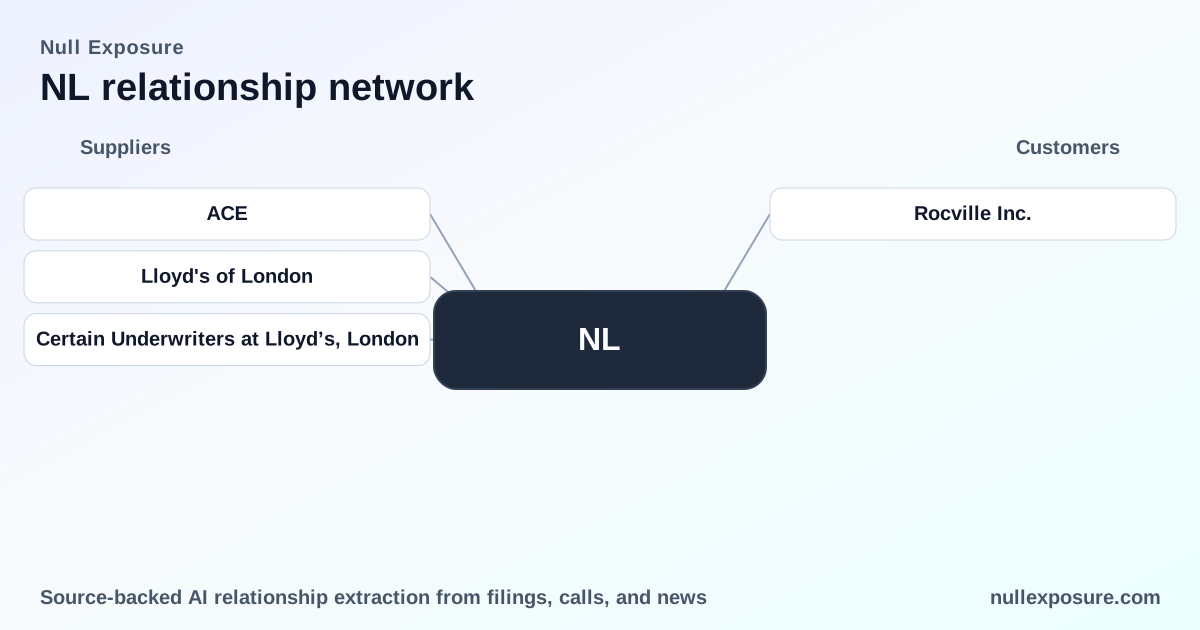
Below I cover every supplier/insurer relationship flagged in the available records and summarize the direct implications for NL’s balance sheet and cash flow.
Ace — coverage refusal reported
A 2022 news report recounts that when NL sought coverage from former insurers, Ace and Lloyd’s initially refused coverage in the context of legacy lead-paint liabilities, creating recoverability uncertainty for a large settlement exposure (Claims Journal, April 4, 2022: https://www.claimsjournal.com/news/national/2022/04/04/309602.htm). This refusal had direct cash-flow implications while litigation over coverage progressed.
Lloyd’s of London — appellate decision shifts liability
The same April 2022 coverage story notes that the New York Appellate Division affirmed a decision finding Lloyd’s of London and other insurers liable for NL’s claim, which represents a meaningful legal precedent and potential source for recovery of settlement costs (Claims Journal, April 4, 2022: https://www.claimsjournal.com/news/national/2022/04/04/309602.htm). The appellate outcome changes economics for the claim and shifts potential cash obligations away from NL if recoveries are realized.
Certain Underwriters at Lloyd’s, London — coverage permitted in state court
A New York Supreme Court ruling allowed NL to pursue insurance coverage for its nearly $102 million share of a settlement tied to lead-based paint litigation, establishing that the paint-maker could seek contribution from underwriters (JD Supra summary, FY2021: https://www.jdsupra.com/legalnews/new-york-supreme-court-allows-paint-3292827/). This outcome is significant for NL’s contingent liabilities and the company’s potential to offset settlement costs through insurer payments.
How these relationships feed the financial picture
NL’s public metrics show modest scale and a valuation that prices both operational exposure and litigation optionality: market capitalization approximately $283 million, revenue TTM $158 million, EBITDA ~$28 million, and a trailing P/E near 30.5. Given the company’s material input cost profile and active insurance litigation, insurer recoveries function as a quasi-earnings lever — they can meaningfully improve free cash flow when realized, or conversely leave NL on the hook for large settlement costs if coverage is denied.
- Insurance litigation is not an academic issue for NL; it is capital allocation and liquidity-impacting. Court decisions that permit coverage claims materially reduce net cash outflow for legacy settlements and thereby affect working capital and leverage.
- Commodity exposure is an ongoing earnings risk. With nearly half of cost of sales tied to materials, procurement strategy — including short-term contracts — strongly influences gross margin volatility and the need for working-capital flexibility.
For investors focused on supplier and counterparty risk, NL’s twin dynamics — high material cost intensity and litigation-driven insurance exposure — create both downside concentration and upside optionality through recoveries.
Practical takeaways for portfolio and operational diligence
- Monitor the status and collectability of insurance recoveries: court wins are only valuable if insurer payments are timely and complete. Recent appellate and state-court rulings strengthen NL’s legal position, but execution risk remains.
- Track commodity purchase strategy and supplier terms: short-term contracts give NL flexibility but increase margin volatility, so operational cadence around hedging, inventory, and pass-through pricing matters to quarter-to-quarter earnings.
- Assess cash-flow sensitivity: model scenarios where insurer recoveries are delayed versus realized, and stress-test EBITDA and free cash flow under different commodity price paths.
Actionable next steps for investors
- Review the company’s filings for updates to insurance receivables and contingent liability disclosures; legal outcomes discussed here were reported in FY2021–FY2022 coverage summaries (JD Supra and Claims Journal).
- Engage management on procurement strategy and hedging: confirm whether short-term supply arrangements are a temporary tactic or a structural procurement policy.
- Consider position sizing that reflects both the materiality of inputs to margins and the legal optionality tied to insurance recoveries.
For a consolidated view of NL supplier and counterparty exposures, visit NullExposure’s homepage and supplier intelligence hub: https://nullexposure.com/
By focusing on the interplay of procurement dynamics and insurance litigation, investors can make disciplined allocations into NL with a clear view of the levers that will move valuation and cash flow. For further supplier-level intelligence and ongoing monitoring, see https://nullexposure.com/ for updated relationship profiles and risk flags.