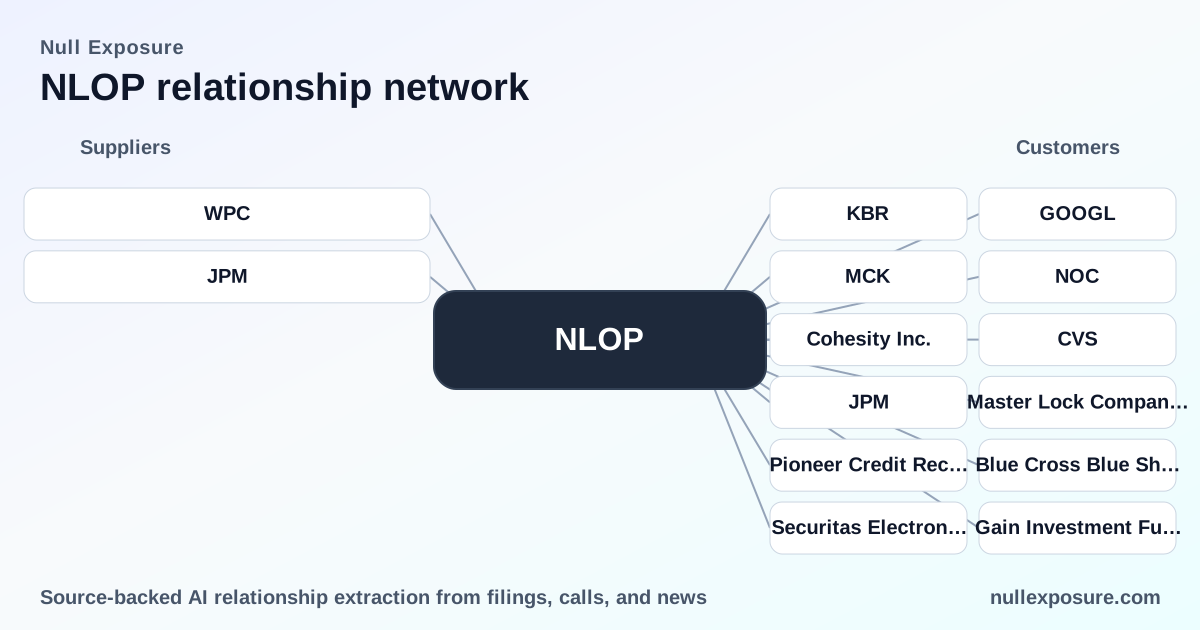
Net Lease Office Properties (NLOP): Supplier Relationships, Operating Model, and Investor Takeaways
Net Lease Office Properties (NLOP) is a net-leased office REIT that outsources core management functions to an external advisor and monetizes through long-term triple-net leases that generate stable rent streams while pursuing disciplined acquisitions in key metropolitan markets. The company’s cash flow profile is driven by leasing income from credit-quality tenants, and its operating costs include advisory and administrative fees that are material to SG&A and cash flow. For a focused supplier-risk view and benchmarking, visit the NullExposure homepage for source-level intelligence and monitoring: https://nullexposure.com/.
How NLOP runs the business and where supplier risk matters
NLOP’s corporate model is externally managed: day-to-day asset management, dispositions, SEC reporting, and borrowing negotiations are handled by an advisor rather than internal staff. This contracting posture centralizes operational control into a supplier relationship rather than internal headcount, which reduces fixed-cost leverage but increases counterparty concentration and service dependency.
- Contracting posture: Externalized management through advisory agreements rather than an internal operating team.
- Concentration: A small number of meaningful supplier relationships handle mission-critical functions and material spend.
- Criticality: Advisory services are core to NLOP’s ability to execute dispositions, maintain SEC compliance, and manage debt — these are strategic operational dependencies.
- Maturity: Advisory arrangements are active and operational today; fee history shows established recurring charge lines rather than one-off projects.
These structural choices trade operational headcount risk for vendor concentration and recurring service fees; investors should price in counterparty and governance risks when valuing distributable cash flow.
Strategic supplier relationships: what investors need to know
Below I cover each supplier relationship identified in public sources and summarize the investor-relevant facts.
W. P. Carey Inc. — external advisor and manager
W. P. Carey Inc. is the external advisor that provides full-service management to NLOP, covering asset management, dispositions, financial management, and SEC filings under the NLOP Advisory Agreements. According to a TradingView summary of NLOP’s FY2026 filings, wholly-owned affiliates of W. P. Carey externally manage NLOP under advisory agreements (TradingView, March 2026: https://www.tradingview.com/news/tradingview:c190dd9356c8b:0-net-lease-office-properties-sec-10-k-report/). This relationship is operationally critical because the advisor executes disposals, borrowing negotiations, and regulatory reporting.
J.P. Morgan — mezzanine lender repaid in FY2025 activity
J.P. Morgan provided a mezzanine loan facility that NLOP announced it has repaid; this indicates active capital-structure interactions with major banks during 2025/2026. A Finviz news item reported on NLOP’s repayment of a J.P. Morgan mezzanine loan (Finviz, March 2026: https://finviz.com/news/302543/net-lease-office-properties-announces-tax-treatment-of-2025-distributions). The repayment reduces immediate leverage counterparty exposure but reflects active liability management and relationships with large banking institutions.
What the constraints tell us about NLOP’s supplier posture
The constraint signals drawn from NLOP’s filings and public disclosures present a concise picture of the operating model rather than an isolated metric.
- Service-provider relationship role (company-level signal): Public disclosures describe an advisor responsible for “all aspects of operations,” which indicates the firm operates under an outsourced management model rather than an internal operations team; this elevates governance and contract-performance monitoring as first-order risks.
- Active relationship stage (company-level signal): Fee accruals and affiliate payables recorded on the balance sheet show that advisory arrangements are operational and recurring, not theoretical or terminated.
- Spend band: $10m–$100m (company-level signal): NLOP reported approximately $10.2 million in advisory fees and reimbursements for the year ended December 31, 2024, which places supplier spend squarely in a material band relative to operating income. That level of recurring external spend is economically significant to distributable cash flow and margin construction.
These constraints reinforce the commercial reality: NLOP’s supplier relationships are not peripheral — they are central to delivering results and must be monitored as financial counterparties and operational vendors.
Investor implications and risk checklist
- Governance concentration: External management concentrates operational knowledge and execution in a vendor relationship; investors must evaluate contract terms, termination rights, and fee alignment with shareholders. The advisory arrangement is a core governance lever.
- Cash-flow transparency: With $105.9M trailing revenue and advisory fees in the low tens of millions, fee structures materially influence distributable cash flow and yield calculations. Negative EPS and leverage metrics require focus on cash flow and balance-sheet durability rather than headline earnings.
- Counterparty credit and continuity: Relationships with large institutions such as W. P. Carey (advisor) and J.P. Morgan (credit counterparty) provide operational depth but also create single points of failure if contracts change; the J.P. Morgan loan repayment reduces one specific credit exposure but does not change the advisor dependency.
- Operational execution risk: Because the advisor executes asset dispositions and debt negotiations, execution outcomes (timing, pricing) will directly affect NAV and liquidity. Track disposition cadence and borrowing strategies in quarterly reporting.
Practical next steps for investors
- Review the NLOP Advisory Agreements and fee tables in the FY2026 filings to confirm termination provisions, fee escalators, and indemnities that affect long-term cash flows. The public reporting cited above (TradingView summary of the FY2026 10‑K) highlights the advisory role and fee principal lines.
- Monitor quarterly payables and reimbursements to affiliates for variability in spend versus realized disposition proceeds and to detect any shifts in the advisor relationship.
- Evaluate the balance sheet impact of recent liability transactions such as the J.P. Morgan mezzanine loan repayment to determine whether leverage reduction is one-off or part of a sustained deleveraging program (Finviz, March 2026).
For ongoing monitoring and additional supplier-level intelligence, see the NullExposure research hub: https://nullexposure.com/.
Bottom line
Net Lease Office Properties runs as an externally managed REIT in which advisory contracts are a material operating lever; investors must treat supplier relationships as strategic exposures that drive cash flow, governance, and execution risk. W. P. Carey functions as the active external advisor, and J.P. Morgan has been an active credit counterparty in recent financing activity—both relationships matter for valuation and operational risk. For a source-backed supplier risk profile and continuous tracking, visit NullExposure: https://nullexposure.com/.
Explore the primary filings and news links cited above to validate assumptions and track developments in advisor performance and capital structure.