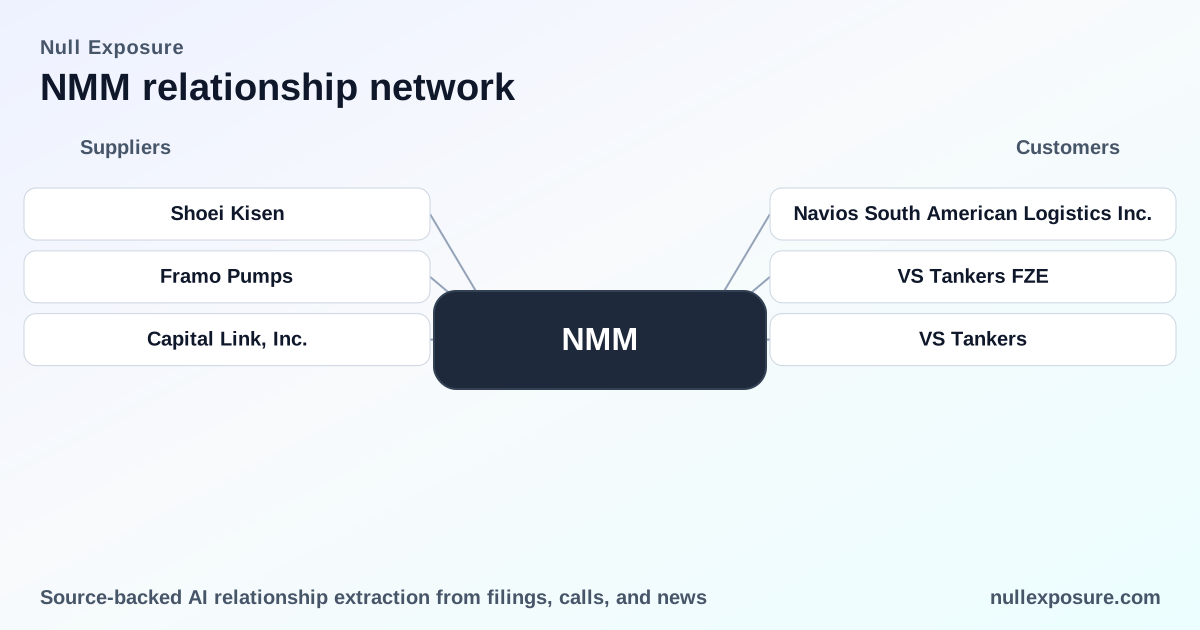
Navios Maritime Partners LP (NMM) — supplier relationship briefing for investors
Navios Maritime Partners LP operates and monetizes a fleet of dry cargo vessels through chartering and asset management: the company owns ships and generates cash by placing those vessels on time-charters, voyage charters and sub-charters, collecting freight income and returning capital to unitholders via distributions. Revenue and operating leverage are driven by charter coverage, fleet composition and counterparty stability, while margins reflect scale in freight cycles and equipment/service costs. For a quick look at supplier risk mapping and ongoing relationship monitoring, visit Null Exposure.
Explore supplier risk analysis at Null Exposure
How Navios earns and where supplier relationships matter
Navios is a classic asset-owner in marine shipping: it owns and operates dry cargo ships across major trade lanes and monetizes those assets by contracting them out to charterers and commercial operators. The company’s financial profile — USD 1.34bn revenue trailing twelve months, USD 713.6m EBITDA and a 21.2% profit margin — shows a profitable, scale operator with meaningful cash flow generation and room to underwrite vessel-level operating costs and capex. Market valuation metrics (EV/EBITDA ~4.0, P/E ~6.5) indicate the market prices the business as a cyclical, cash-generative shipping platform.
Supplier relationships are economically critical because:
- Vessel owners and technical suppliers determine uptime and charter compliance, directly affecting revenue capture.
- Third-party charter counterparties drive revenue concentration and credit exposure when a small set of charterers account for outsized utilization.
- Equipment vendors matter for regulatory and efficiency upgrades, which influence operating cost and charter desirability.
For continuous coverage of how these relationships evolve, check the platform.
Explore supplier risk analysis at Null Exposure
Supplier mentions observed in recent reporting — concise, source-linked takeaways
Below are every supplier-related relationship reference pulled from recent news coverage and filings. Each entry is a factual, one- to two-sentence summary with source context.
Shoei Kisen — ownership and bareboat structure noted
A TradeWinds report on March 10, 2026 describes the vessel Erbil as owned by Shoei Kisen and bareboat-chartered to Navios Maritime Partners, which then sub-bareboat-chartered it to VS Tankers before a time-charter to Unipec, highlighting multi-layered charter arrangements that create counterparty complexity. Source: TradeWinds article published March 10, 2026 (https://www.tradewindsnews.com/tankers/navios-partners-tears-up-contracts-with-vs-tankers-after-us-sanctions/2-1-1842480).
Framo Pumps — onboard equipment supplier for Nave Perseus
PortNews reported on March 10, 2026 that the vessel Nave Perseus is equipped with Framo Pumps and designed with energy-efficiency technology, pointing to vendor-supplied systems that support environmental performance and operational reliability. Source: PortNews coverage (https://en.portnews.ru/news/379775/).
Capital Link, Inc. — investor relations and conference hosting
A QuiverQuant aggregation noted Navios Maritime Partners hosted a Q3 2025 earnings conference call with investor relations contact details routed through Capital Link, Inc., underscoring Capital Link’s role as the external communications and investor-relations conduit. Source: QuiverQuant summary of the November 18, 2025 conference announcement (https://www.quiverquant.com/news/Navios+Maritime+Partners+L.P.+to+Host+Q3+2025+Financial+Results+Conference+Call+on+November+18%2C+2025).
Capital Link, Inc. — distribution announcement contact
A GlobeNewswire press release dated October 29, 2025 listing distribution details also referenced Capital Link for media and investor contact, reinforcing consistent use of the same IR/PR advisor for external disclosures and distribution communications. Source: GlobeNewswire release (October 29, 2025) (https://www.globenewswire.com/news-release/2025/10/29/3176842/0/en/Navios-Maritime-Partners-L-P-Announces-Cash-Distribution-of-0-05-per-Unit.html).
What the relationship map implies for contracting posture and operational constraints
Putting the facts together yields clear signals about Navios’s operating model and supplier risk posture:
-
Contracting posture: charter-centric and layered. The existence of bareboat, sub-bareboat and time-charter flows — as reported in the Shoei Kisen item — indicates Navios operates through layered contractual relationships that shift operational and credit responsibilities across counterparties. This structure enhances asset utilization flexibility while increasing complexity in counterparty risk and legal title arrangements.
-
Concentration and counterparty importance: moderate to high. Navios’s business is sensitive to a limited set of charter counterparties and IR/PR intermediaries. Institutional ownership around 33% and insider stakes near 30.5% indicate concentrated governance influence, which shapes strategic supplier choices and disclosure practices.
-
Supplier criticality: high for equipment and technical service providers. Vendors such as Framo Pumps are not optional extras; they are operationally critical because onboard systems affect safety, compliance and charter eligibility. Equipment performance links directly to vessel uptime and revenue.
-
Maturity and financial capacity: established with cyclical exposure. Financials show strong EBITDA and positive margins, giving Navios capacity to fund maintenance and vendor contracts, while valuation multiples imply market recognition of shipping-cycle volatility.
These are company-level signals drawn from corporate metrics and recent relationship reports, not assignments of constraint to any single supplier.
Risk implications and what operators should prioritize
For investors and operators assessing supplier exposures, focus on three pragmatic areas:
- Counterparty credit diligence: layered chartering increases recovery complexity if a middle counterparty defaults; prioritize counterparty credit strength and enforceable title documentation.
- Technical supplier contracts and spare-parts availability: ensure long-term service agreements and parts pipelines for high-criticality systems like pumps and fuel systems to avoid off-hire events.
- Disclosure and communications governance: consistent use of a single IR/PR advisor (Capital Link) simplifies investor engagement but concentrates disclosure risk; validate timeliness and completeness of third-party communications.
Key risk takeaway: operational uptime and charter revenue are tightly coupled to both charter-counterparty stability and supplier reliability. Investors should treat supplier relationships as active risk factors, not background noise.
Bottom line and next steps for due diligence
Navios Maritime Partners is a cash-generative, charter-focused shipowner where supplier and counterparty relationships materially affect revenue capture and asset uptime. The observed relationships — from ship-owning counterparties through critical equipment vendors to investor-relations advisors — form a network that investors must map and stress-test.
For ongoing monitoring and vendor-risk intelligence on Navios and comparable suppliers, visit Null Exposure.
Explore supplier risk analysis at Null Exposure
If you want a focused supplier-risk memo on Navios or a comparative brief against peer owners, reach out through the platform for a tailored briefing.