Nomura Holdings (NMR) as a Supplier: strategic relationships and what they mean for investors
Nomura is a global capital markets and financial services platform that monetizes through trading and underwriting, asset management fees, investment banking advisory, and proprietary and client-facing trading operations. As an investor or operator evaluating Nomura as a counterparty or supplier, the most relevant lens is counterparty breadth and strategic partnerships that extend product capability—Nomura leverages acquisitions and technology partnerships to expand asset management scale and digital advisory services while preserving fee and trading income streams. For an organized view of Nomura’s supplier relationships and implications for commercial counterparties, see the full service offering at https://nullexposure.com/.
How Nomura runs its business and why supplier ties matter
Nomura is an established, diversified capital markets operator that earns fees from asset management and advisory, spreads and trading income from markets businesses, and recurring income from client relationships. The firm’s revenue mix is balance-sheet and fee-driven, which makes it sensitive to market cycles but also dependent on external capabilities—technology partners and acquisition targets—to sustain growth in higher-margin services such as investment management.
Company-level signals worth noting as context for any supplier relationship:
- Contracting posture: relationship-driven and transaction-intensive. Nomura operates long-term institutional relationships for underwriting, asset management, and trading, while also sourcing technology and IP to scale client-facing products.
- Concentration and ownership profile: institutional equity ownership reported at roughly 2.8%, suggesting a dispersed investor base and potential governance considerations for counterparties who evaluate owner-led influence.
- Criticality: as a major Japanese financial intermediary with global operations, Nomura is systemically important to select markets and client segments, making it a high-impact counterparty for suppliers that integrate trading, custody, or market data services.
- Maturity and financial posture: Nomura shows mature profitability and returns (reported profit margin ~17.6% and return on equity ~9.93%) alongside a low trailing P/B (about 0.965) that signals valuation anchored to traditional banking metrics.
These signals frame how Nomura contracts, how critical it is to supplier revenues, and the type of contractual protections a prudent operator should expect when entering commercial arrangements with the firm.
Direct relationships identified in public reporting and press
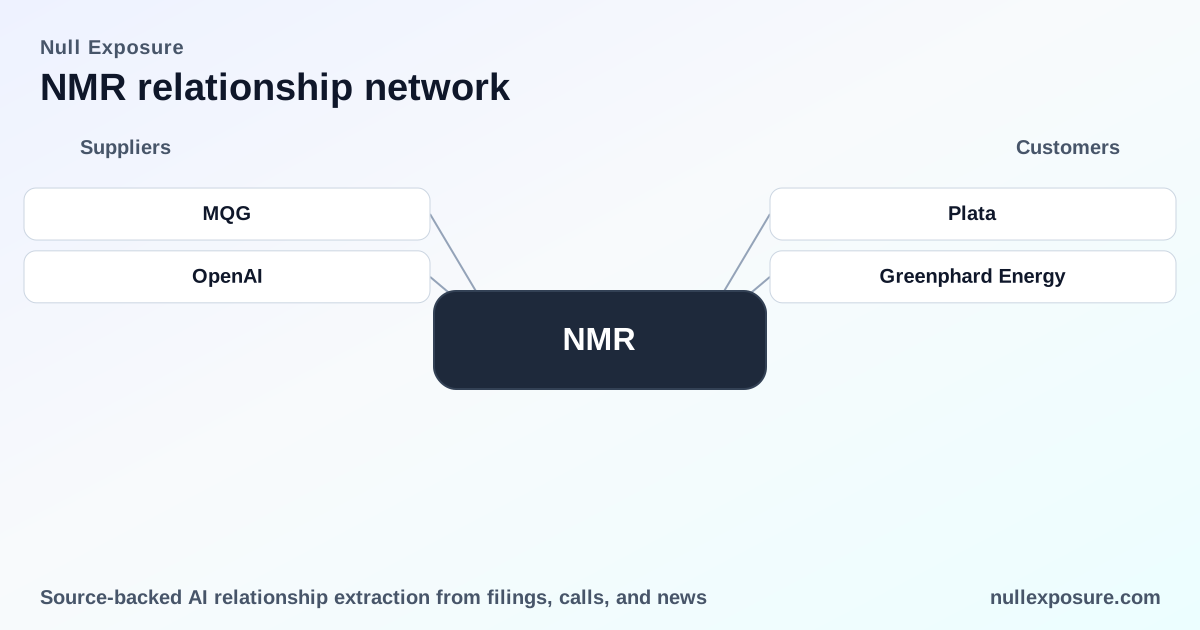
The reporting set for Nomura’s supplier relationships includes two distinct items: one acquisition-related integration tied to Macquarie Group assets and a technology partnership mention with OpenAI. Both are relevant to investors assessing Nomura’s third-party exposure and strategic direction.
Macquarie Group — scaling investment management via acquisition
Nomura integrated the public asset management business of the Macquarie Group effective December 1, 2025, and credited the consolidation for driving investment management revenue to an all-time high for the division, although investment gains and acquisition-related one-time costs reduced profit in the period. This is reported in a FY2026 earnings call transcript cited by InsiderMonkey in March 2026 (https://www.insidermonkey.com/blog/nomura-holdings-inc-nysenmr-q3-2026-earnings-call-transcript-1686012/).
Implication: this is an acquisition-driven supplier/partner dynamic—Nomura is absorbing another firm’s asset management business to buy scale rather than relying solely on arm’s-length supplier relationships.
OpenAI — technology tie to deliver AI-driven investment advice and insights
Nomura publicly tied an engagement to OpenAI in the context of launching AI-driven investment advice and market insights, with press coverage noting the initiative as part of a broader push to curb certain exposures and enhance advisory capability (TradingView/FinanceMagnates, March 2026; https://www.tradingview.com/news/financemagnates:c81daba7a094b:0-nomura-partly-attributes-10-profit-drop-to-crypto-losses-curbs-risk-at-laser-digital/).
Implication: this is a technology supplier relationship intended to augment front-office products and research; it elevates counterparty considerations around data governance, vendor risk, and platform resilience.
For a comprehensive supplier-risk evaluation and access to structured counterparty intelligence, visit https://nullexposure.com/ to see how these relationships fit broader exposure maps.
What these relationships mean for investors and counterparties
Nomura’s recent activity reflects a two-track strategy: grow investment management scale through acquisitions (Macquarie assets) while modernizing advisory via third-party AI providers (OpenAI). That combination changes the profile of Nomura as a supplier or customer in important ways:
- Operational integration risk from acquisitions. The Macquarie consolidation drives revenue scale but creates near-term earnings volatility from integration costs and one-time items; counterparties should price execution and integration risk into contract timelines.
- Technology and vendor risk from AI partnerships. Ties to OpenAI signal rapid productization of AI-driven advice, raising questions about data controls, model governance, and continuity for partners who will depend on Nomura’s digital channels.
- Diversification of revenue but increased cross-dependency. Growth in asset management reduces reliance on trading cycles, but it also concentrates execution and technology vendors as strategic nodes.
Risk checklist for investors evaluating Nomura supplier exposure
- Integration timelines and contingency planning for acquired asset management businesses—expect multi-quarter earnings noise tied to consolidation.
- Vendor governance clauses for AI suppliers that address IP, data privacy, and model performance SLAs.
- Counterparty concentration limits—determine whether Nomura’s role as client or supplier is critical to your revenue or replaceable within a reasonable procurement window.
- Financial resilience—track Nomura’s operating margins and ROE metrics to judge its ability to fund multi-year technology and acquisition programs without pressuring counterparties for concessions.
If you need a tailored counterparty diligence package on Nomura’s network and contractual posture, NullExposure provides focused supplier intelligence—details at https://nullexposure.com/.
Bottom line and investor action points
Nomura is executing a hybrid growth strategy: scale investment management through acquisitions while upgrading client-facing technology via partnerships. For counterparties and investors, that means pricing both integration risk (from M&A) and vendor/technology risk (from AI suppliers) into commercial negotiations and credit assessments. Nomura’s mature profitability and market footprint make it a strategically important counterparty, but the firm’s program of acquisitions and AI partnerships changes the practical contours of supplier risk.
To get a concise counterparty report, contract templates and a vendor-risk playbook for Nomura, start with the NullExposure home page at https://nullexposure.com/ and request a tailored briefing.