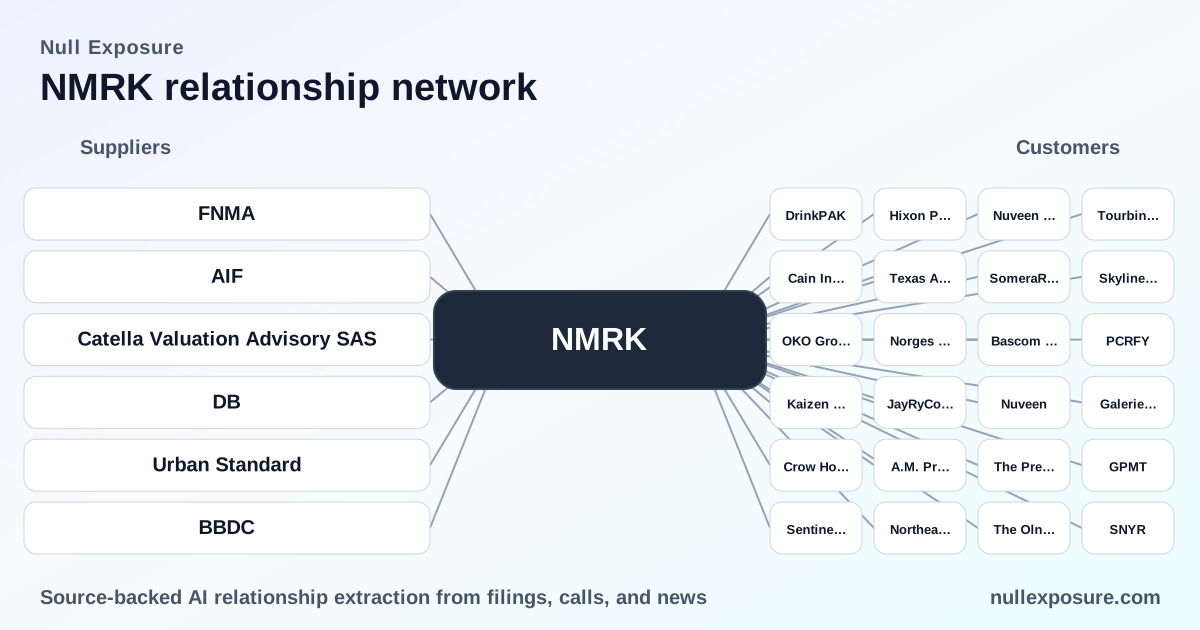
Newmark (NMRK): Supplier relationships that shape fee streams and execution risk
Newmark Group Inc. operates as a full‑service commercial real estate platform, monetizing through brokerage commissions, capital‑markets transaction fees, debt placement and refinancing advisory, property and facilities management fees, valuation and advisory services, and selective strategic acquisitions and licensing. Core revenue drivers are transaction and advisory fees supported by capital markets activity and a growing valuation/analytics capability, with FY‑TTM revenue of roughly $3.29 billion and EBITDA of $367 million supplying scale and margin cushion. For investors and operators evaluating supplier counterparty dynamics, Newmark’s recent disclosures and press activity show a pattern of transactional financing partners, strategic acquisitions to enlarge valuation capabilities, and short‑term funding practices that influence operational cadence.
Learn more about how we surface supplier risk for underwriting and monitoring at https://nullexposure.com/.
Why supplier mapping matters for a services‑heavy real estate firm
Newmark’s business model is transactional and relationship intensive: debt placement and refinancing mandates generate outsized fees, while valuation and property management widen client stickiness. Supplier relationships therefore translate directly into revenue access (capital providers), capability (valuation and analytics vendors or acquisitions), and operational delivery (third‑party contractors). Two company‑level constraints are explicit in recent materials and should be treated as structural signals:
- Short‑term contract posture in capital markets financing — warehouse facilities and similar capital markets funding are described as short‑term with annual renewal practice, which drives cyclicality in financing supply and requires active liquidity and market access management.
- Third‑party service model in property/facilities management — Newmark hires and supervises outside contractors for managed properties, reflecting an outsourcing model that reduces fixed cost but raises vendor management and quality control exposure.
Both constraints are company‑level operating characteristics that impose renewal risk and operational execution risk rather than tied to any one counterparty.
Every named relationship and what it means for revenue and risk
Fannie Mae
Newmark’s multifamily capital markets team arranged a $67.5 million refinancing for a sponsor through Fannie Mae, demonstrating the firm’s role placing agency debt on behalf of sponsors and extracting fee income from such executions. According to Newmark’s press release (March 2026), the transaction was secured through Fannie Mae and led by Newmark Multifamily Capital Markets executives. https://www.nmrk.com/insights/press-releases/newmark-arranges-67-5-million-refinancing-for-class-a-multifamily-community-rockwell-at-crown-in-maryland
Altus Group Limited
Newmark agreed to buy Altus Group’s Canadian Appraisals business and also signed a multi‑year license for global access to ARGUS Intelligence, expanding Newmark’s valuation product set and analytics backbone to support advisory and appraisal services. Quantisnow reported the definitive sale and the licensing deal in March 2026, signaling a strategic build‑out of valuation capabilities that will feed fee revenue and support institutional clients. https://quantisnow.com/insight/newmark-expands-apac-presence-with-korea-launch-appointing-john-pritchard-6316470 and https://quantisnow.com/insight/newmark-appoints-globally-recognized-real-estate-executive-peter-trollope-to-6303365
Catella Valuation Advisory SAS
Newmark announced the acquisition of Catella Valuation Advisory SAS, a Paris‑based valuation and advisory firm covering a broad set of asset types, adding European geographic depth and cross‑sell opportunities for valuation and advisory fees. The acquisition was disclosed in Newmark’s international expansion reporting in March 2026. https://quantisnow.com/insight/newmark-expands-apac-presence-with-korea-launch-appointing-john-pritchard-6316470
Deutsche Bank
Deutsche Bank acted as a funding source on a $133 million refinancing for a trophy office asset in Stamford, illustrating Newmark’s ability to place large bilateral or syndicated debt with global banking counterparties for its advisory clients. Newmark’s press release describing the transaction cites Deutsche Bank and Urban Standard as providers of the funding (March 2026). https://www.nmrk.com/insights/press-releases/newmark-arranges-133-million-refinancing-for-trophy-office-asset-the-link-in-stamford-ct
Urban Standard
Urban Standard participated alongside Deutsche Bank to provide funding for the $133 million refinancing in Stamford, positioning it as a capital partner on larger office refinancing mandates that generate placement fees for Newmark. That funding role is documented in the same Newmark press release (March 2026). https://www.nmrk.com/insights/press-releases/newmark-arranges-133-million-refinancing-for-trophy-office-asset-the-link-in-stamford-ct
Barings
Newmark’s global debt & structured finance team secured a $71.85 million loan for a Class‑A multifamily property from Barings, a repeatable source of institutional financing for Newmark’s capital markets pipeline and a direct contributor to capital‑markets fee revenue. The transaction is outlined in Newmark’s press release on the Pittsburgh financing (March 2026). https://www.nmrk.com/insights/press-releases/newmark-arranges-71-85-million-loan-for-class-a-multifamily-property-in-pittsburgh-pa
What these relationships reveal about Newmark’s operating model
- Capital markets dependence on institutional lenders: Deutsche Bank, Urban Standard, Fannie Mae and Barings show Newmark’s commercial success in placing sizable, institutional financing — a primary fee pool for the company. This commercial placement model requires continuous counterparty access and market credibility.
- Strategic capability build via acquisitions and licenses: Purchases like Catella and the Altus Canadian appraisals business, plus the ARGUS Intelligence license, indicate an explicit strategy to internalize valuation expertise and analytics, converting formerly external supplier capability into owned or long‑term licensed capability to protect margins on advisory services.
- Short renewal cycles for warehouse-style facilities create an annual refinancing/renewal cadence that demands active liquidity management and sustained counterparty relationships; this is a structural aspect of the capital markets arm, not tied to a single lender.
- Operational outsourcing in property management lowers fixed cost but increases vendor concentration risk and supervisory burden; management of third‑party contractors is a persistent operational control item.
Learn how supplier mapping informs credit and operational diligence at https://nullexposure.com/.
Investment implications and practical checklist
Newmark combines fee diversification with exposure to cyclical capital markets flows. For investment teams and operator partners, prioritize the following actions:
- Confirm the stability and tenor of the firm’s warehouse and capital markets facilities given their short‑term renewal practice.
- Monitor counterparties named on recent placements (Deutsche Bank, Barings, Fannie Mae, Urban Standard) for funding appetite and capacity changes that would directly affect dealflow monetization.
- Assess integration and utilization plans for acquired valuation assets (Catella, Altus Canada) and the ARGUS license for evidence that these assets will convert into higher recurring advisory revenue rather than one‑time costs.
- Review vendor oversight processes for property/facilities management given the third‑party service model and attendant operational risk.
For deeper supplier intelligence and continuous monitoring, visit https://nullexposure.com/ to request tailored reports.
Newmark’s supplier map is consistent with a platform strategy that balances transactional fee generation with selective capability ownership; the near‑term investor focus should be on funding continuity and the execution of the valuation‑integration playbook.