NeuroOne Medical (NMTC): Supplier relationships, commercialization posture, and investor implications
NeuroOne Medical Technologies develops intracranial electrode systems and commercializes them through a hybrid model of device sales and third‑party distribution while funding growth with equity raises. The company outsources manufacturing of its prototypes, leverages a distribution and development partnership with Zimmer Biomet for commercialization, and supplements working capital through at‑the‑market equity offerings supported by firms such as JonesTrading. For investors evaluating supplier exposure, the firm’s model trades capital lightness and speed to market against concentration and supply‑chain dependency.
Explore more supplier and partner intelligence at https://nullexposure.com/.
How NeuroOne operates and monetizes its technology
NeuroOne sells clinician‑facing medical devices—most notably the Evo SEEG system—which the company advances through regulatory clearances and then places into market channels via partners. Revenue comes from device sales and partner‑mediated commercialization; the company also monetizes equity issuance to fund operations and commercialization ramps. Outsourced manufacturing keeps fixed costs lower and shortens capital cycles, while distribution agreements scale market access without building an in‑house sales force.
The company’s financials show an early commercial revenue base with negative profitability: FY‑TTM revenue is approximately $11.7 million with negative margins and net losses, underscoring the operational dependence on partners and external capital. For a deeper supplier risk readout, visit https://nullexposure.com/.
Relationship breakdown: who NeuroOne is working with (and why it matters)
Below are the relationships surfaced in public reporting and press: each entry is a concise investor‑grade summary with its source.
-
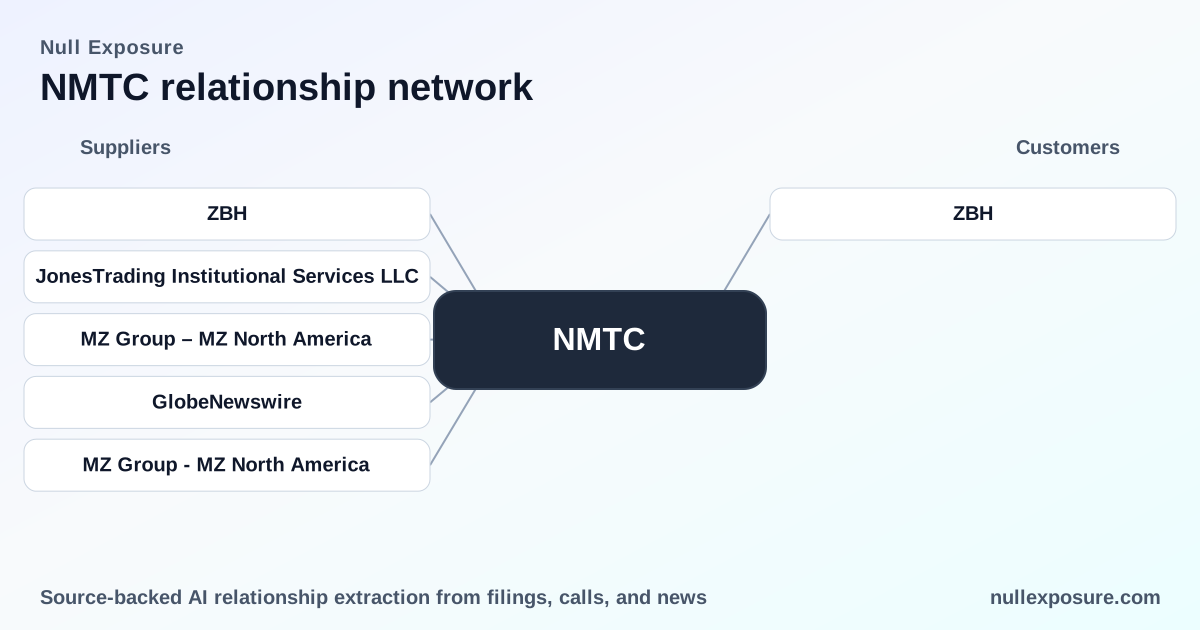
Zimmer Biomet — Zimmer Biomet is NeuroOne’s commercialization and distribution partner for the Evo SEEG system, and the companies have collaborated on development and distribution since the product’s FDA 510(k) clearance; Zimmer has also distributed additional clinical cases under the partnership (FY2022 and FY2026 reporting). According to a PR Newswire release tied to the 510(k) clearance, NeuroOne described the partnership as central to advancing commercialization (FY2022), and a mobihealthnews profile referenced ongoing case work through Zimmer Biomet in FY2026.
Sources: PR Newswire (FDA 510(k) announcement, FY2022); mobihealthnews (company profile, FY2026). -
JonesTrading Institutional Services LLC — JonesTrading is the broker‑dealer executing NeuroOne’s at‑the‑market equity program; the company filed an updated prospectus supplement for an up to $6.75 million ATM offering using JonesTrading as the placement agent in FY2025. This relationship is operationally important because the ATM program is a direct lever for short‑term liquidity and dilution control.
Source: SEC/press reporting summarized on Investing.com (SEC filing on Nasdaq extension and ATM details, FY2025). -
MZ Group – MZ North America — MZ Group serves as NeuroOne’s investor relations contact and communications partner, listed on multiple press releases and earnings notices in FY2025. Professional IR support influences investor outreach, message control, and the cadence of disclosure—important for market perception and retail/institutional access.
Sources: Yahoo Finance press notices and QuiverQuant/GlobeNewswire distributions (FY2025). -
GlobeNewswire (press distribution) — GlobeNewswire appears as the distribution channel for NeuroOne’s earnings and corporate press releases; press distribution amplifies filings and commercial milestones to the investor and journalist ecosystems. A QuiverQuant posting noted the press release distribution through GlobeNewswire in FY2025.
Source: QuiverQuant summary of a GlobeNewswire press release (FY2025).
Contracting posture and constraints — what the company‑level signals indicate
NeuroOne explicitly outsources the supply and manufacture of prototype components and plans to continue outsourced manufacturing for the foreseeable future; this is a company‑level constraint rather than a relationship‑specific clause. That outsourcing strategy conveys four operational characteristics:
- Contracting posture: The company maintains a vendor‑centric model that reduces fixed asset intensity and capital expenditure but increases dependence on external manufacturers for quality and throughput.
- Concentration risk: Outsourcing consolidates production risk into a small set of suppliers; a single supplier disruption could materially affect deliveries.
- Criticality: Suppliers hold critical roles for product availability given the proprietary nature of components and regulatory controls on device manufacturing.
- Maturity and scaling: Outsourcing signals early‑stage commercialization where scaling is achieved through contractual relationships rather than internal factory investment.
These constraints imply that supplier diligence—auditing quality systems, capacity, and contingency plans—should be a priority for acquirers and strategic partners.
Financial and commercialization implications for investors
NeuroOne’s model reduces capital intensity and accelerates time‑to‑market, but that tradeoff comes with elevated operational dependency and recurring capital needs. Key investor considerations:
- Liquidity pathway: The presence of an active ATM with JonesTrading provides a standardized, flexible mechanism for near‑term capital raises and is a direct lever over dilution and runway.
- Market access: The Zimmer Biomet partnership materially de‑risks commercial rollout by leveraging a major orthopedics and neuro devices distribution platform; investors should value the sales leverage this provides.
- Communications and perception: Outsourced IR and distribution channels (MZ Group, GlobeNewswire) control narrative and ensure consistent announcement cadence, which matters for small‑cap stocks with concentrated shareholder bases.
- Operational risk: Outsourced manufacturing is a primary supply‑chain risk. A single vendor disruption could interrupt commercial shipments and delay revenue recognition.
Given FY‑TTM revenue of ~$11.7M against ongoing operating losses and limited market capitalization, investors should treat partnerships as critical value drivers and suppliers as potential single‑point failures.
Practical next steps for investors and operators
- Perform supplier audits focusing on quality systems, capacity, and contingency plans for any contract manufacturers supporting NeuroOne.
- Monitor the ATM utilization rates published in future SEC filings to understand dilution and runway.
- Track Zimmer Biomet case counts and adoption metrics as primary commercial KPIs; partner‑led traction will be the clearest signal of scalable revenue.
For a consolidated view of supplier signals and to track changes in partner relationships, visit https://nullexposure.com/.
Closing recommendation
NeuroOne presents a capital‑efficient commercialization path anchored by a major distribution partner and supported by active capital markets access, but the company’s reliance on outsourced manufacturing and external sales channels concentrates execution risk. Active monitoring of supplier contracts, ATM usage, and Zimmer Biomet channel activity is essential for any investment thesis.
Review ongoing supplier intelligence and partner tracking at https://nullexposure.com/ to stay current on NMTC’s operational and commercial developments.