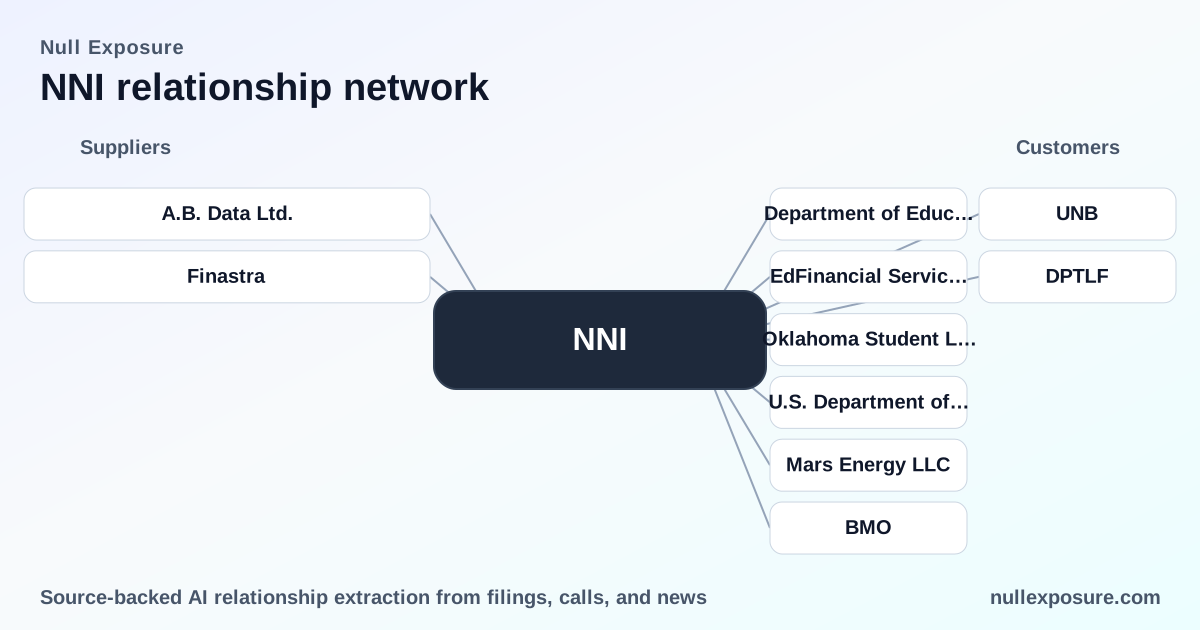
Nelnet (NNI) — supplier relationships, operational constraints, and what investors should price in
Nelnet operates as a diversified financial-services platform: the company earns servicing fees and interest income from student loan servicing and loan management, while generating ancillary revenue from communications, educational technology, and payment-processing services. With trailing revenue of roughly $1.67 billion, a reported profit margin north of 25%, and a market capitalization near $4.6 billion, Nelnet monetizes scale in loan administration and adjacent technology services while outsourcing several operational building blocks to third parties. For investors evaluating counterparty risk, the supplier footprint and documented third‑party dependencies drive operational and reputational risk that should be priced into valuation and covenant protections.
Explore supplier intelligence and operational risk indicators at https://nullexposure.com/.
How these supplier relationships fit into Nelnet’s operating model
Nelnet discloses that it relies on third parties for critical operational services, technology, software development, data center hosting facilities, cloud computing platforms, and software—language consistent with a centralized servicer that outsources infrastructure and specialized functions rather than vertically integrating every capability. That contracting posture creates a set of structural characteristics investors must weigh:
- Criticality: Third parties deliver non‑discretionary functions—hosting, cloud platforms, software—that are essential to servicing cash flows and regulatory compliance.
- Concentration risk: Outsourcing raises single‑vendor concentration exposure if a small set of providers underpin core platform uptime, security, or data handling.
- Contract maturity and negotiating power: Nelnet's size gives it leverage in procurement, but long‑dated legacy contracts or specialist providers (e.g., settlement administrators) can limit flexibility.
- Operational risk transmission: Vendor failures, data incidents, or regulatory lapses at suppliers translate directly to Nelnet’s servicing continuity and brand integrity.
The company‑level disclosure quoted above comes from Nelnet’s public filings and is an explicit statement of its supplier reliance. Investors should treat this as a material operating constraint when stress‑testing cash flows, estimating outage probabilities, or modeling regulatory remediation costs.
Supplier relationships on file — what the record shows
Below are every supplier relationship surfaced in the supplied results, with a concise plain‑English description and source reference.
A.B. Data Ltd.
Nelnet appointed A.B. Data Ltd. to serve as the settlement administrator for the Nelnet data security settlement, with a mailing address listed for settlement communications. This indicates Nelnet engaged an external claims/notice administrator to manage post‑incident remediation logistics. Source: settlement notice on ClaimDepot (Nelnet Data Security Settlement), first referenced March 10, 2026 — https://www.claimdepot.com/settlements/nelnet-data-settlement.
Finastra
Nelnet executed an acquisition agreement to purchase Finastra’s Canadian student loan servicing business, expanding its servicing footprint through an asset transfer from a financial‑software and services vendor. The transaction underscores a strategic move to internalize servicing scale while interacting commercially with a legacy technology/servicing supplier. Source: MarketScreener news flash reporting the Finastra deal (news item referencing 25‑Oct‑2023), cited March 10, 2026 — https://www.marketscreener.com/news/earnings-flash-nni-nelnet-inc-posts-q4-adjusted-eps-1-56-per-share-vs-factset-est-of-1-63-ce7e5cd9d18cf320.
What investors and operators should infer from the relationships
The A.B. Data engagement is transactional and tied to a settlement process, which signals a prior data security event that required external claims administration—this elevates near‑term remediation costs, communication risk, and regulatory engagement. The Finastra transaction reflects strategic consolidation of servicing capacity and implies integration risk as Nelnet absorbs an external servicing operation and any legacy technology or contractual obligations associated with it.
Both relationships align with the company filing language that Nelnet consistently outsources critical functions: one relationship is a vendor hired for a discrete legal/consumer mandate, the other is a commercial transfer of servicing assets from a supplier. These dynamics stress two separate governance requirements—claims handling and post‑merger integration.
Practical implications: risk factors to model and monitor
Investors should move beyond checklist thinking and treat supplier exposures as drivers of cash‑flow volatility, capital requirements for remediation, and execution risk on growth initiatives. Key, actionable items:
- Demand visibility into vendor concentration and service‑level agreements (SLAs) that govern uptime, security responsibilities, and indemnities.
- Stress‑test scenarios that include data‑incident remediation costs, regulatory fines, and settlement accruals tied to third‑party failures.
- Verify integration playbooks and post‑acquisition transition plans for transactions like the Finastra deal, with targeted KPIs for transfer timing, cost synergies, and client retention.
- Track audit evidence: SOC reports, penetration‑test summaries, and contractual termination clauses that limit lock‑in or single‑vendor dependency.
These items translate to measurable monitoring: recovery‑time objectives, percentage of revenue tied to outsourced platforms, and the size and tenor of indemnities provided or received.
Explore provider risk summaries and operational counterparty charts at https://nullexposure.com/ to keep due diligence current.
Governance and remediation posture investors should insist on
Given Nelnet’s disclosure about third‑party reliance and the specific relationships above, underwriters and credit committees should require:
- Mandatory escrow or source‑code access clauses for critical software providers.
- Clear escalation ladders with penalty provisions for SLA breaches.
- Insurance and cyber coverage that explicitly extends to vendor failures and settlement administration activities.
- Periodic independent testing and verification of post‑merger systems integration for acquisitions similar to the Finastra purchase.
These protections convert supplier reliance into governed, auditable exposures rather than open operational liabilities.
Bottom line — what to price into the investment thesis
Nelnet’s core business generates durable servicing revenue, but the operational leverage to third‑party vendors creates tail risk that is not captured by headline financials alone. The A.B. Data engagement signals legacy remediation and reputational cost; the Finastra deal signals growth through acquisition and the integration execution risk that accompanies it. For investors, the right premium for Nelnet should reflect its market position and profitability while discounting for supplier concentration, potential remediation costs, and integration execution risk.
For a deeper review of supplier exposures and third‑party governance implications, visit https://nullexposure.com/ and request the Nelnet supplier intelligence briefing.
Key takeaway: Nelnet’s profitability is robust, but vendor dependency is a material operational constraint—price the stock with explicit reserves for remediation and integration execution, and insist on contractual protections that convert vendor reliance into controlled exposure.