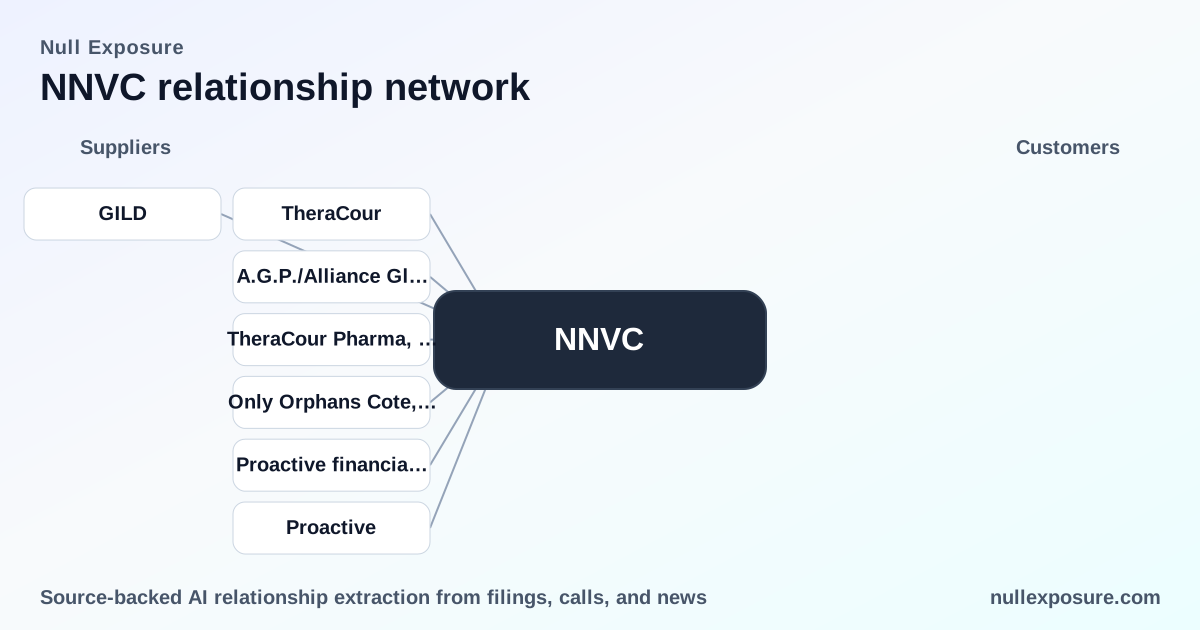
NanoViricides (NNVC): Supplier relationships that determine execution risk and upside
NanoViricides is a clinical‑stage nanobiopharmaceutical company that licenses core nanoviricide technology from TheraCour, outsources development and manufacturing rights, and funds operations through equity placements and periodic registered offerings. The company monetizes by advancing licensed antiviral drug candidates toward clinical milestones and, ultimately, commercialization or sub‑licensing; near‑term value capture depends on successful clinical progress and continued access to capital markets. For a deeper supplier-risk profile and actionable intelligence, visit https://nullexposure.com/.
How NNVC’s operating model concentrates execution around a few external partners
NanoViricides is not a vertically integrated drug developer. The company’s business model is explicitly built on licensing and outsourcing: it holds broad exclusive, sub‑licensable licenses for TheraCour technology while TheraCour retains development and manufacturing rights, and NNVC contracts regulatory and clinical services from specialist firms. According to NNVC’s FY2025 10‑K, TheraCour is the sole developer of licensed products and charges both development fees and direct costs; those fees totaled approximately $2.49 million in FY2025 and a similar amount in FY2024, with roughly $584,000 payable at June 30, 2025. This contractual posture creates high supplier concentration and operational criticality around TheraCour’s continued performance and capacity.
Company filings and public disclosures also show active, paid engagements with regulatory consultants and clinical managers: NNVC has a Master Services Agreement with Only Orphans Cote, LLC for orphan‑drug strategy and worked with KMPL for India clinical development, with payables and incurred costs consistent with mid‑to‑high six‑figure bands. These arrangements illustrate a hybrid model: IP and licensing on one side (long‑dated exclusive rights), and episodic, project‑based service spend on the other. NNVC’s funding posture reinforces this model — the company uses registered direct offerings, private placements and an “ATM” facility to bridge R&D milestones.
For background and ongoing coverage of supplier risk and financing events visit https://nullexposure.com/.
Supplier relationships you must evaluate before underwriting NNVC exposure
TheraCour / TheraCour Pharma, Inc.
TheraCour is the originator and ongoing developer/manufacturer of the nanoviricide technology: NNVC holds broad exclusive, sub‑licensable licenses for multiple viral indications while TheraCour retains exclusive development and manufacturing rights and bills NNVC for development fees; NNVC’s FY2025 10‑K records development fees of roughly $2.49 million for the year and outstanding payables to TheraCour of about $584,000 at June 30, 2025 (FY2025 10‑K). Numerous company press releases across 2025–2026 reiterate that NNVC’s nanoviricide candidates and platform are based on TheraCour’s intellectual property and that the firms maintain a Memorandum of Understanding for broad antiviral development (press releases, March 2026).
A.G.P. / Alliance Global Partners
A.G.P. acted as the sole placement agent for NNVC’s registered direct offering and concurrent private placement that closed in March 2026, facilitating a $6 million raise reported in public press notices; this places A.G.P. as a near‑term capital markets counterparty important to NNVC’s liquidity path (TimesRecordNews and other press releases, March 2026).
Only Orphans Cote, LLC (OOC)
Only Orphans Cote is NNVC’s retained regulatory consultant for orphan‑drug strategy; NNVC executed a Master Services Agreement with OOC and used the firm’s expertise to prepare Orphan Drug Designation applications for NV‑387, leveraging Dr. Timothy Cote’s former FDA Office of Orphan Products Development experience (company press release and AccessNewswire coverage, March 2026).
Proactive / Proactive financial news
NNVC has engaged Proactive (and affiliated publishing channels) for investor communications and paid promotion; Proactive discloses annual cash compensation arrangements for publishing services (up to roughly $25,000 per year cited in media reports), indicating a managed investor‑relations channel rather than an independent editorial partner (Proactive financial news reporting, March 2026).
Gilead (GILD)
Gilead appears as the originator of remdesivir, which NNVC references in the context of NV‑CoV‑2‑R (remdesivir encapsulated within NV‑387 polymeric micelles); NNVC’s disclosures note that remdesivir is developed by Gilead, establishing a de‑facto scientific link rather than an active commercial supply contract reported in filings (press reporting summarizing NNVC commentary, March 2026).
What the constraints tell investors about NNVC’s supplier risk and maturity
- Contracting posture: NNVC’s primary relationship with TheraCour is a license‑plus‑service arrangement where NNVC holds perpetual exclusive licenses while TheraCour retains development and manufacturing rights — this creates structural dependency: the company is effectively a licensee and commercialization sponsor rather than an independent manufacturer (FY2025 10‑K excerpts).
- Concentration and criticality: TheraCour represents the single largest external development counterparty; reported annual development fees (
$2.49M) and payables ($584k) in FY2025 show material ongoing spend and cash exposure to that supplier. This concentration translates into execution risk if TheraCour capacity or priorities change. - Spend profile and maturity: Recorded spend bands place TheraCour charges in the $1M–$10M annual range, while clinical services through KMPL and other consultants fall into the $100k–$1M band, consistent with a small clinical‑stage company outsourcing the balance of development activities (FY2025 filings).
- Relationship stage and activity: Multiple amendments, an MOU for all antivirals, and recent clinical starts in India (KMPL‑managed activity) indicate active, ongoing supplier relationships rather than dormant or one‑off contracts (FY2025 filings and 2025–2026 press releases).
- Funding dependency: NNVC’s reliance on registered offerings and placement agents such as A.G.P., plus an ATM facility, shows cash runway is linked to capital markets; supplier commitments (manufacturing, clinical milestones) will pressure near‑term liquidity if clinical timelines accelerate.
Investment implications and a short risk checklist
- Catalyst pathway: Value will accrue from successful clinical readouts and regulatory designations; converters include orphan‑drug approvals driven by OOC work and clinical execution by KMPL/TheraCour.
- Primary operational risk: TheraCour’s role is single‑point critical — delays or disputes on development or manufacturing could materially delay programs.
- Liquidity risk: NNVC funds development through periodic capital raises; placement agent relationships and the ATM program are operationally important to sustain supplier payments and trial activity.
- Communications risk: Use of paid publishing channels like Proactive affects investor visibility but not clinical execution.
For a practical supplier‑risk monitoring framework and to track subsequent filings and press releases about NNVC’s counterparty performance, start here: https://nullexposure.com/.
Conclusion — what to watch next
Focus on three near‑term data points: (1) payments and aging to TheraCour reported in the next quarterly filing, (2) clinical milestone progress and regulatory updates tied to NV‑387 and NV‑387‑remdesivir combinations, and (3) follow‑on financing activity via placement agents or the ATM. These will determine whether NNVC converts its outsourced development model into commercial optionality or remains dependent on recurring market financing. For vendor tracking, filings aggregation, and supplier‑risk alerts on NNVC, subscribe via https://nullexposure.com/.