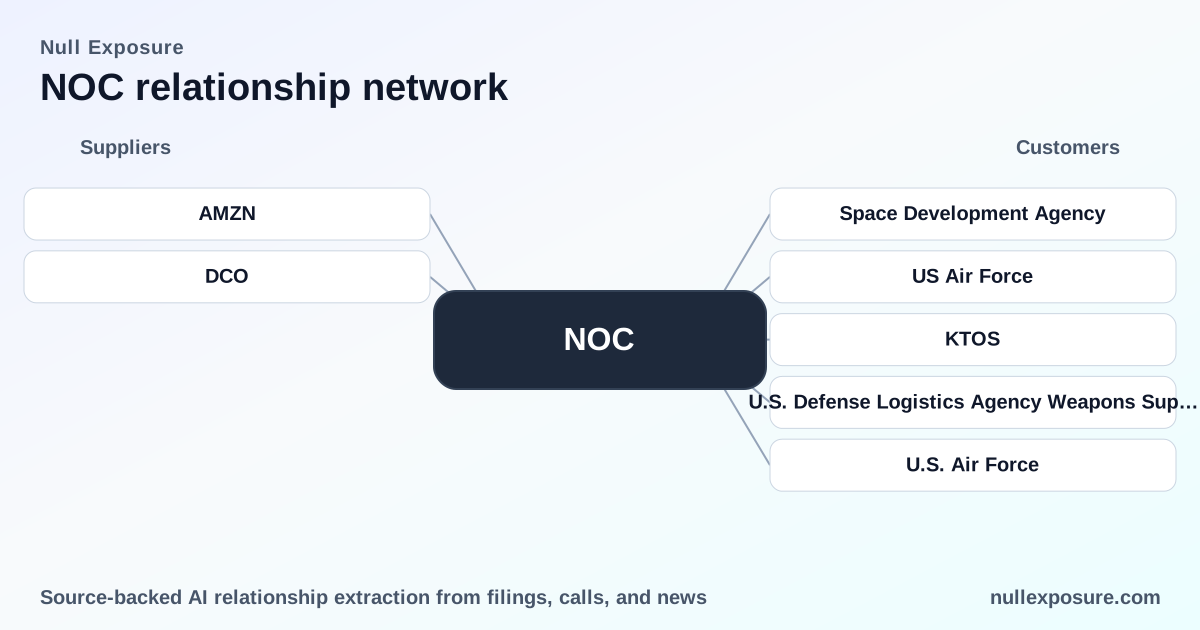
Northrop Grumman (NOC): supplier relationships, contracting posture, and what investors should price in
Northrop Grumman operates as a large defense prime that designs, manufactures and integrates aerospace and defense systems and components, monetizing through long‑duration U.S. government contracts, prime subcontract awards, and recurring systems-production revenue. The company centralizes program risk while acting as a major buyer to a broad supply base; its commercial exposure includes selective high-volume programs such as Amazon’s Project LEO. For investors evaluating counterparty and supplier risk, the combination of large purchase obligations and program-level supplier dependencies defines both upside from execution and downside from supply disruption. Learn more at https://nullexposure.com/.
What the direct relationships reveal about revenue drivers
Northrop’s supplier and customer relationships illustrate two common structural dynamics for defense primes: (1) reliance on specialized suppliers for mission-critical subcomponents that can drive near-term revenue volatility, and (2) the role of Northrop as a large purchaser with multibillion-dollar forward commitments that concentrate counterparty importance.
Amazon — production of Gen 63 motors for Project LEO
Northrop increased production of Gen 63 motors for Amazon’s Project LEO, and higher sales were driven by that increased motor output and elevated volume on certain restricted programs. Source: Northrop Grumman 2025 Q4 earnings call (referenced March 7, 2026).
Ducommun — a small/medium tier supplier exposed to prime program timing
Ducommun’s commentary highlights exposure to program timing and production issues at major primes including Northrop Grumman, indicating Ducommun views Northrop as a meaningful customer whose schedule and budget decisions affect Ducommun’s revenue. Source: SimplyWall St summary of Ducommun FY2026 commentary (March 10, 2026).
How the company-level constraints shape the operating model
The textual constraints drawn from Northrop’s disclosures give a crisp view of contracting posture, scale of supplier commitments, supplier criticality, and governance maturity:
- Contracting posture: large buyer with long-term obligations. Northrop discloses $23.9 billion of purchase obligations as of December 31, 2025, approximately half short-term, signaling sustained, committed spending to suppliers and subcontractors under U.S. government contracts. That scale of forward commitments makes supplier performance central to near-term revenue realization.
- Spend concentration and criticality. The magnitude of purchase obligations implies high concentration of supplier importance: individual program components (for example, motors for LEO) can materially affect revenue when production steps up or down.
- Service relationships and control maturity. Deloitte & Touche LLP issued an attestation report (January 26, 2026) on Northrop’s internal control over financial reporting and audited the consolidated financial statements for 2025, indicating standard Big Four governance and audit rigor appropriate for a company of this size.
- Geographic posture. Evidence in filings points to North American (U.S.) reporting and control activities, consistent with U.S.-centric contract exposure and regulatory oversight.
Together these constraints portray a mature, centralized prime whose supplier network is mission-critical and supported by formal governance, but whose financials are sensitive to program timing and supplier execution.
What investors should weigh: concentration, execution risk, and margin resilience
Northrop’s fundamentals remain robust — large market capitalization, healthy operating margins, and high institutional ownership — but relationship-level signals point to specific operational risks and potential levers for upside:
- Execution and schedule sensitivity. Programs that ramp production (for example, Gen 63 motors for Project LEO) create identifiable near-term revenue tailwinds; conversely, supplier production issues create binary downside for quarterly performance. The Amazon relationship shows how a single OEM program can move the top line.
- Purchasing leverage, but not immunity. With $23.9 billion of purchase obligations, Northrop has material leverage to negotiate and plan, yet the company’s revenue is still exposed to subcontractor capacity and program timing; suppliers such as Ducommun explicitly call out dependency on prime schedules.
- Governance and audit standards reduce financial-reporting risk. A Deloitte attestation and audit for the 2025 year-end support confidence in reported obligations and control over supplier commitments.
- Program concentration tradeoff. High-margin systems business and recurring defense contracts support margins, but concentration on key programs requires active monitoring of supplier health and contract tails.
Place active monitoring on supplier production metrics and program award cadence. Earnings calls that discuss specific supplier volumes (motors, avionics, specialty castings) will be the most direct early-warning indicators of execution changes.
Learn how to map these dynamics into counterparty risk assessments at https://nullexposure.com/.
Practical next steps for investors and operators
- For investors: track quarterly commentary that quantifies supplier volume changes and purchase-obligation evolution; focus on programs flagged as “restricted” or ramping production. Holders should expect volatility around program milestones.
- For operators and procurement teams: prioritize alternative sourcing or dual-sourcing plans for high‑criticality components and maintain contractual remedies in supplier agreements consistent with the scale of purchase obligations.
- For credit and counterparty analysts: incorporate the $23.9 billion of purchase obligations and documented audit attestation into liquidity and vendor-concentration stress scenarios.
Explore tailored supplier-relationship intelligence and monitoring at https://nullexposure.com/.
Bottom line
Northrop Grumman’s supplier profile combines the defensive stability of a mature aerospace prime with acute execution sensitivity tied to a handful of mission-critical components and programs. The company’s $23.9 billion of purchase obligations and documented supplier dependencies make supplier performance a primary driver of short-term revenue variability, while Deloitte’s audit attestation supports confidence in the underlying disclosures. Investors should balance program upside (e.g., ramping Project LEO volume) with the non‑linear risks that come from single‑source components and prime‑level schedule shifts.