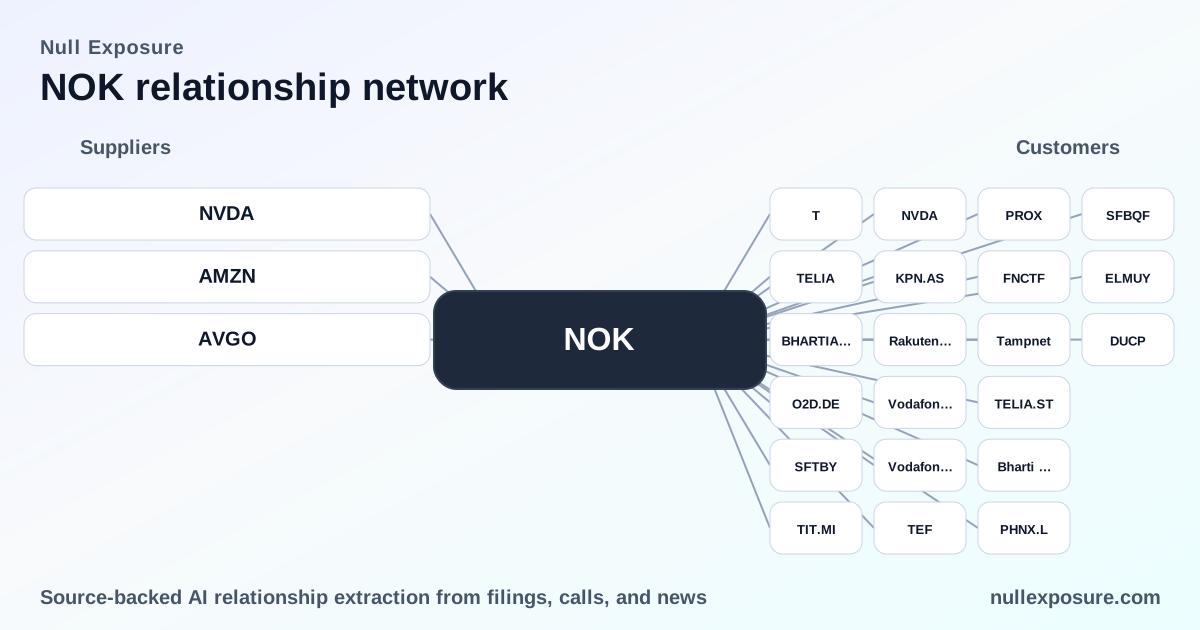
Nokia (NOK) — supplier relationships that reshape the network stack
Thesis: Nokia monetizes by selling a blended mix of network hardware, software licenses and managed services to global telecom operators, and now accelerates revenue growth by embedding third‑party AI and silicon partners into its 5G/6G stack. Its commercial model is contract‑driven — large multi‑year operator deals, software subscriptions and professional services — with gross margins supported by software and specialized switching platforms and with growth levers tied to strategic supplier integrations.
Discover more supplier intelligence at https://nullexposure.com/.
Why strategic suppliers are now revenue drivers, not accessories
Nokia’s shift from pure hardware toward software‑defined networking and agentic AI means supplier partnerships directly influence product roadmap, time‑to‑market and customer lock‑in. The company sells equipment and software bundles to carriers; when Nokia certifies a CPU, switch silicon or cloud platform, that endorsement shortens procurement cycles for operators and creates cross‑sell opportunities for managed services.
No supplier constraints were provided in the available signals; as a company‑level indicator, there are no reported contractual restrictions or supplier-specific embargoes in this set of records. From an operating model perspective, Nokia exhibits the following characteristics: it executes long‑duration commercial contracting with telecom operators; supplier concentration is material because a handful of hyperscalers and chipset vendors integrate into its stack; supplier criticality is high because network resiliency and performance depend on validated silicon and cloud platforms; and the product maturity curve is mid‑to‑late stage — Nokia leverages established hardware while layering newer software and AI services to expand recurring revenue.
The headline supplier relationships investors should price in
Below I summarize every supplier relationship captured in the recent monitoring results and link to the original coverage.
NVIDIA — AI chips and AI‑RAN integration
Nokia will adapt its 5G and future 6G software to run on NVIDIA chips and will integrate NVIDIA‑powered AI‑RAN products and CUDA tooling into its RAN software, positioning AI acceleration at the edge of operator networks. According to CNBC reporting in October 2025, Nokia committed to adapting its software to run on NVIDIA silicon, and a March 2026 news piece noted the partnership’s focus on NVIDIA‑powered AI‑RAN products. (CNBC, Oct 28, 2025; Finviz news, Mar 10, 2026).
Amazon Web Services (AWS) — cloud AI meets network slicing
Nokia partnered with AWS to combine Nokia’s network technology and AWS’s AI platform to deliver agentic AI capabilities that enable telecom operators to dynamically manage network resources and advanced network slicing in real time. This collaboration was described in a March 2026 report highlighting the integration of Nokia’s technology with AWS’s AI services to automate network resource allocation. (Finviz news, Mar 10, 2026).
Broadcom — switch silicon powering new platforms
Nokia launched hardware built around Broadcom’s TH6 silicon, specifically citing the 7220 IXR‑H6 switching platform, and highlighted an Agentic AI solution for event‑driven automation that reduces downtime. Nokia referenced Broadcom’s TH6 in its Q4 2025 earnings discussion and it was also covered in an earnings transcript summary noting new product introductions. (Nokia Q4 2025 earnings call, Mar 2026; InsiderMonkey transcript summary).
What these relationships mean for revenue, margins and risk
These supplier integrations change how to model Nokia’s revenue mix and operational risk. Three structural implications matter for investors:
- Revenue mix shift to recurring software/AI services. Tighter integration with NVIDIA and AWS enables subscription and managed service offers that carry higher gross margins than commodity radio or switching hardware.
- Margin leverage tied to silicon and cloud economics. Partnerships with Broadcom and NVIDIA influence unit economics: validated silicon can reduce BOM costs and improve performance, but supplier pricing and availability directly affect hardware margin profiles.
- Concentration and criticality create binary operational risks. Relying on a small set of strategic suppliers improves time‑to‑market but increases negotiation leverage for those suppliers and raises single‑point‑failure exposure for certifications and firmware/silicon bugs.
Key risk items to watch:
- Supplier pricing and allocation for AI GPUs and switching silicon.
- Long‑tail integration and certification timelines for carrier deployments.
- Carrier procurement cadence and willingness to adopt agentic AI features.
How operators and procurement teams will react
For operators, the case to buy shifts from hardware specs to validated end‑to‑end solutions. Operators evaluate Nokia not only on radios and switches, but on how well Nokia operationalizes NVIDIA GPUs, Broadcom silicon, and AWS cloud services into deterministic SLAs. That elevates Nokia’s services organization and professional engineering as a competitive moat but also raises delivery risk if any supplier interfaces change.
Explore supplier impact assessments and procurement playbooks at https://nullexposure.com/.
What investors should track next quarter
Focus on three measurable indicators that reflect supplier‑driven momentum:
- Revenue split between hardware, software and services (sequential improvement in software/services signals successful monetization).
- New customer logos or tier‑1 operator pilots referencing NVIDIA/AWS‑enabled features.
- Commentary on supply availability and unit economics linked to Broadcom TH6 and NVIDIA GPUs.
Bottom line: supplier partnerships are now central to Nokia’s valuation
Nokia’s supplier relationships are transforming how the company captures value: these partnerships are not peripheral; they are core drivers of product differentiation, recurring revenue and margin expansion. Investors should reweight Nokia’s risk profile to reflect higher supplier concentration but clearer pathways to software monetization. For a deeper supplier map and ongoing monitoring, visit https://nullexposure.com/.
Key takeaway: Nokia’s commercial future depends on continuing to translate validated integrations with NVIDIA, AWS and Broadcom into carrier contracts, service attach rates and predictable software revenue.