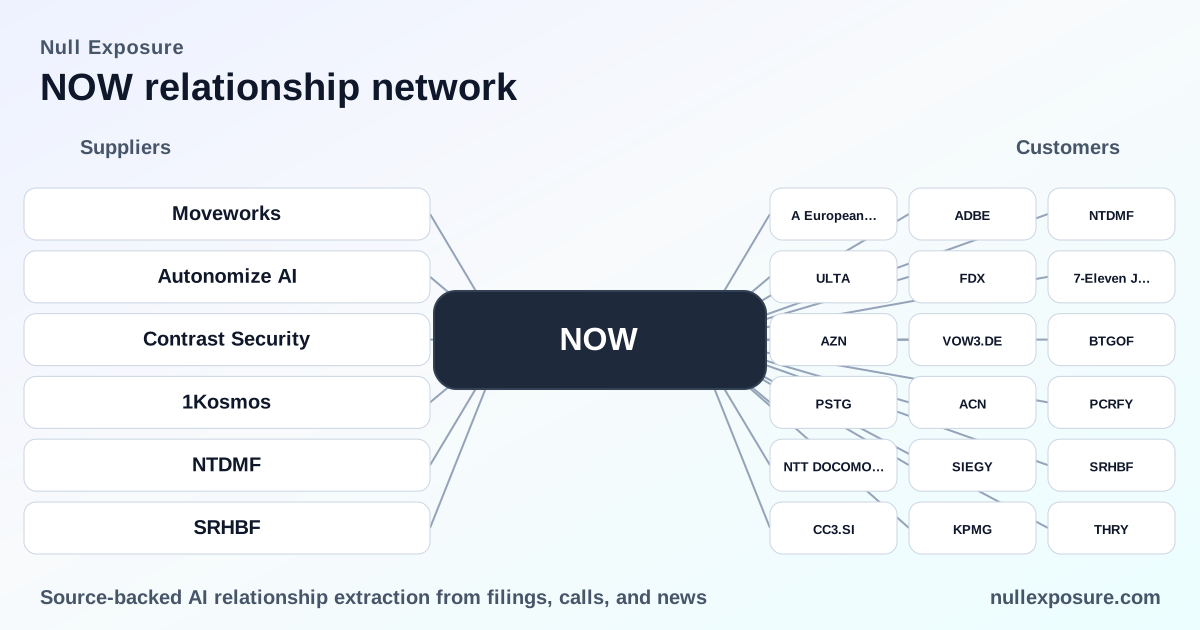
ServiceNow Supplier Map: What investors should know before underwriting exposure
ServiceNow monetizes by selling a cloud-native workflow platform to large enterprises and governments through subscription SaaS contracts, professional services, and a partner ecosystem; revenue accrues from multi-year contracts and expanding module adoption across IT, HR, security and newly announced AI-driven workforce products. Operationally, ServiceNow combines its private cloud with public cloud infrastructure and a broad partner services network, creating recurring revenue with embedded supplier commitments that support global delivery. For a quick tour of supplier intelligence and portfolio implications, visit https://nullexposure.com/.
Why supplier relationships matter for a SaaS growth story
ServiceNow’s valuation premium rests on sustained subscription growth, margin expansion and cross-sell into adjacent enterprise workflows. Suppliers shape each of those levers: infrastructure partners drive margin volatility and capacity constraints; niche AI and security suppliers accelerate product time-to-market; telecom partners unlock new vertical deployments. Supplier structure therefore translates directly into capital intensity, contract duration and execution risk.
Key company-level operating constraints that shape supplier risk
- Global infrastructure footprint. ServiceNow operates data centers across North America, South America, Europe, Asia and Australia — a global posture that increases operational complexity but supports multinational contracts (evidence from ServiceNow’s data center disclosures through FY2025).
- Service provider orientation. The company delivers SaaS via its private cloud and public cloud service providers, and it also deploys professional services via internal teams plus contracted third parties; fees to these third parties are recognized as cost of revenues (company statements, FY2025).
- Meaningful contracted spend. Non‑cancellable purchase commitments total $7.9 billion as of Dec 31, 2025 — a large five‑year cash commitment that signals long-term supplier relationships and capital planning requirements.
- Working capital program exposures. Outstanding payment obligations to suppliers in the supply chain finance program were $87 million as of Dec 31, 2025, indicating ongoing use of supplier financing tools.
Collectively these constraints indicate an enterprise with high maturity in supplier relationships, significant multi-year contractual commitments, and a distributed delivery model that depends on third-party infrastructure and specialist partners.
Supplier landscape: partnerships and acquisitions that matter
Below I summarize every supplier/partner relationship surfaced in public coverage. Each short line links the relationship to visible product or go‑to‑market activity.
Moveworks — autonomous conversational AI integrated into EmployeeWorks
ServiceNow completed the acquisition of Moveworks and quickly launched EmployeeWorks, combining Moveworks’ conversational AI and enterprise search with ServiceNow’s Employee Center to convert natural language requests into governed end‑to‑end workflows for employees. According to WashingtonExec and later press coverage in March 2026, this integration is central to ServiceNow’s push into autonomous workforce experiences (WashingtonExec, March 2026; InsiderMonkey, March 2026).
Autonomize AI — payer workflow and industry-specific AI partnership
ServiceNow is integrating Autonomize AI capabilities into offerings targeting regulated and payer workflows, extending the company’s AI Control Tower narrative into specialized verticals. SimplyWallSt covered this partnership as part of ServiceNow’s FY2026 AI expansion around government and regulated industries (SimplyWallSt, March 2026).
Contrast Security — application security tie‑ins for AI Control Tower
ServiceNow is building application security integrations with Contrast Security as part of an ecosystem approach to its AI Control Tower, leveraging third‑party security tooling rather than building every layer in‑house (SimplyWallSt, March 2026).
1Kosmos — identity security integrations embedded into workflows
1Kosmos has integrated identity verification into ServiceNow workflows via the ServiceNow Store to secure help desk recovery and sensitive change requests, supporting secure operations without disrupting user experience (GlobeNewswire, March 2026).
NTT DOCOMO — telecom roaming collaboration to broaden global footprint
ServiceNow has a newer telecom roaming collaboration with NTT DOCOMO that expands the company’s reach into telco use cases and international roaming capabilities, a move noted alongside other telecom partnerships in FY2026 coverage (SimplyWallSt, March 2026).
StarHub — regional telecom partner for roaming and channel expansion
StarHub is part of the same telecom collaboration narrative with NTT DOCOMO and ServiceNow, enabling localized channel and roaming deployments in key Asia Pacific markets (SimplyWallSt, March 2026).
What these relationships imply for investors
- Product acceleration via acquisitions and specialist partners. The Moveworks acquisition plus integrations with Autonomize AI and Contrast Security accelerate ServiceNow’s AI roadmap without requiring full in‑house development. That reduces time-to-market risk but increases integration and dependency risk with acquired and partner codebases.
- Security and identity are treated as strategic integration points. Partnerships with Contrast Security and 1Kosmos show management’s preference to assemble best‑of‑breed security and identity capabilities into its workflow fabric rather than re‑implementing. This approach improves go‑to‑market speed but concentrates risk across integrated vendors.
- Global delivery requires telecom and infrastructure partners. Collaborations with NTT DOCOMO and StarHub reflect a push into telco verticals and internationalized services; combined with a global data center footprint, this implies higher fixed costs and contractual commitments but a stronger competitive moat for multinational customers.
- Financial implications of supplier commitments are material. The disclosed $7.9 billion of non‑cancellable purchase commitments and the $87 million of SCF obligations are not cosmetic — they reflect a capital planning profile that investors must reconcile against cash flows and margin targets.
For a deeper supplier risk assessment and to map your exposure to these partners, explore practical intelligence at https://nullexposure.com/.
Investment takeaways and risk checklist
- Bull case driver: Integration of Moveworks and targeted AI partners accelerates cross‑sell across ServiceNow’s large installed base, supporting sustained subscription expansion.
- Key risk: High contractual supplier spend and global infrastructure complexity create execution and margin pressure if adoption lags or if supply interruptions occur.
- Operational signal: Preference for assembling partner ecosystems (security, identity, AI, telecom) indicates a capital-light product expansion strategy with meaningful integration risk.
If you underwrite enterprise software exposure, track these supplier linkages closely — they are the channels through which ServiceNow converts R&D and M&A activity into recurring revenue. For an actionable supplier exposure report and continuous monitoring, visit https://nullexposure.com/.
Final posture for investors
ServiceNow’s supplier relationships reflect a deliberate strategy: scale quickly via acquisitions and best‑in‑class integrations, operate globally with mixed private/public cloud infrastructure, and commit materially to multi‑year supplier contracts. That combination underwrites growth but also concentrates operational and contractual risk; investors should price in both the upside from accelerated AI rollouts and the downside from supplier‑driven execution gaps. For tools to quantify those supplier exposures in your portfolio, start here: https://nullexposure.com/.