Neptune Insurance Holdings (NP): underwriting capacity and the bank syndicate that funded the debut
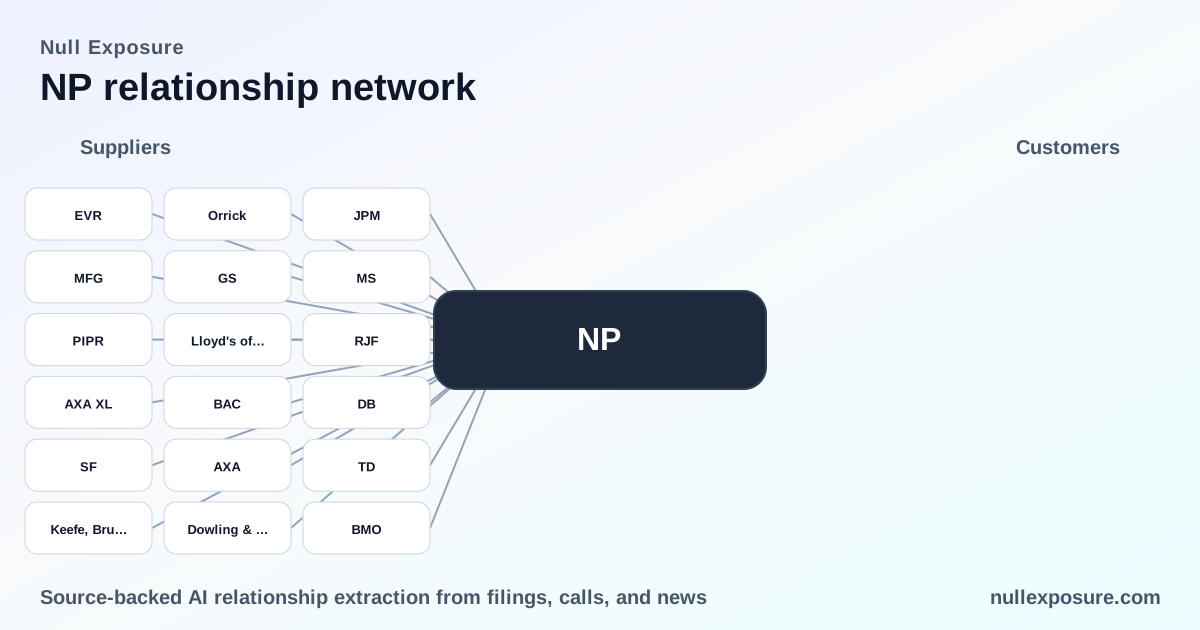
Neptune Insurance Holdings operates a digitally-native private flood insurer, selling homeowner flood policies and monetizing through premium income, underwriting margins and reinsurance-backed capacity. The company converted private capital into a public equity base via an FY2025 IPO that pooled underwriting capacity from Lloyd’s and strategic partners (AXA XL), while distributing equity through a broad syndicate led by Morgan Stanley and supported by a cluster of global investment banks. For investors and operators, the core thesis is straightforward: Neptune’s value is driven by premium scale and access to capital and reinsurance capacity rather than fixed physical assets. Learn more about supplier and partner mapping at https://nullexposure.com/.
What the market structure looks like for a modern private-flood insurer
Neptune’s business model is capital‑intensive in a non-capex way: revenue comes from premiums, but profitability depends on claims experience, reinsurance arrangements, and the cost and availability of capital. The FY2025 IPO converted capacity and growth optionality into public market funding, which in turn reduces balance-sheet concentration risk but increases scrutiny from institutional shareholders (institutions currently hold ~90% of float). Financials show meaningful margins on current revenue — Revenue TTM $159.6M, Gross Profit $93.6M and Operating Margin ~31.6% — but EPS is negative on a diluted basis (-$0.26), indicating continued investment in growth and capital adequacy. Market valuation implies expectations for material future scale: Market Cap ~$3.04B, Price-to-Sales ~19x and EV/EBITDA ~43x.
If you’re tracking counterparty risk or supplier concentration for underwriting capacity or distribution, start with the underwriting and capital partners and then layer in the bank syndicate that delivered public capital. For a full supplier map, visit https://nullexposure.com/.
Key operational signals and constraints investors should internalize
- Contracting posture: Neptune operates with third-party underwriters and reinsurance partners rather than owning large amounts of catastrophe risk itself, so its contractual relationships for capacity are mission-critical.
- Concentration: Underwriting and capital are provided by a small set of reinsurers and underwriting syndicates (Lloyd’s, AXA XL historically), while capital distribution relies on a broad but clearly defined investment bank syndicate from the IPO.
- Criticality: Reinsurance and underwriting partners are existential for product availability and regulatory capital efficiency; the bank syndicate is material for liquidity and investor diversity.
- Maturity: The company is an early public entrant — established in private markets and listed in FY2025/FY2026 — so governance, disclosure cadence and investor relations will determine how quickly market multiples normalize.
Counterparties and partners to watch
Below I cover every relationship surfaced in public reporting and press coverage, with succinct, source-linked descriptions.
- Morgan Stanley — Morgan Stanley acted as the lead left bookrunner for Neptune’s offering, taking primary responsibility for syndicate placement and pricing in the IPO process. According to ReinsuranceNews and an Orrick notice (Oct 2025 / Mar 2026), Morgan Stanley led the bookrunning effort.
- J.P. Morgan — J.P. Morgan is listed as an active bookrunner in the offering, partnering with BofA to support distribution and execution according to PR Newswire and ReinsuranceNews (Mar 2026).
- BofA Securities — BofA served as an active bookrunner alongside J.P. Morgan, participating in the IPO execution and stabilization activities per the PR Newswire release (Mar 2026).
- BMO Capital Markets — BMO appears as a joint bookrunner and syndicate member in filings and press materials, part of the broad group that helped place shares into the market (Orrick / ReinsuranceNews, Oct 2025 / Mar 2026).
- Goldman Sachs & Co. LLC — Goldman Sachs is named among the joint bookrunners that supported the IPO syndicate, contributing distribution capability and investor relationships (ReinsuranceNews / Orrick, Oct 2025 / Mar 2026).
- Evercore ISI — Evercore ISI participated as a joint bookrunner, helping to broaden the syndicate and institutional reach during the offering (Orrick / PR Newswire, Oct 2025 / Mar 2026).
- Deutsche Bank Securities — Deutsche Bank functioned as part of the joint bookrunner group, supplying distribution and advisory support for the offering (Orrick / ReinsuranceNews, Oct 2025 / Mar 2026).
- Keefe, Bruyette & Woods (a Stifel company) — KBW is listed among joint bookrunners; the firm’s inclusion signals targeted outreach to financial services and regional institutional accounts (Orrick / PR Newswire, Oct 2025 / Mar 2026).
- Mizuho — Mizuho joined the joint bookrunning group, broadening the syndicate’s international and institutional footprint for the IPO (Orrick / ReinsuranceNews, Oct 2025 / Mar 2026).
- Piper Sandler — Piper Sandler is named as a joint bookrunner, supporting distribution to middle‑market institutional investors (Orrick / PR Newswire, Oct 2025 / Mar 2026).
- Raymond James — Raymond James appears as a joint bookrunner, adding independent and regional dealer reach to the syndicate (ReinsuranceNews / Orrick, Oct 2025 / Mar 2026).
- TD Securities — TD Securities was included among joint bookrunners, indicating cross-border dealer involvement in the placement (ReinsuranceNews / PR Newswire, Mar 2026).
- Dowling & Partners Securities LLC — Dowling acted as co‑manager for the offering, typically a role focused on specialist distribution to retail and regional accounts (Orrick / PR Newswire, Oct 2025 / Mar 2026).
- Orrick — Orrick served as legal advisor to Neptune for the IPO, handling transactional and disclosure work for the sale of over 18 million Class A shares by selling stockholders per the firm’s press release (Orrick, Oct 2025).
- Lloyd’s of London — Lloyd’s backed Neptune Flood policies historically, providing A.M. Best‑rated capacity (A/A+) that underwrites policy obligations and supports consumer confidence, as reported in a PR Newswire seed financing notice (2018 disclosure cited in later summaries).
- AXA XL — AXA XL entered a strategic underwriting partnership with Neptune Flood to expand private flood capacity for homeowners, providing underwriting expertise and incremental capacity (industry press coverage, 2019).
What this means for investors and operators
- Underwriting capacity is the single largest operational risk and value driver: Neptune’s product availability and loss-bearing capability depend on Lloyd’s and strategic reinsurers such as AXA XL; that relationship profile reduces capital strain but creates counterparty dependency.
- Capital markets distribution is diversified but bank-led: Morgan Stanley as lead left with J.P. Morgan, BofA and a broad syndicate indicates strong institutional appetite and puts pressure on disciplined execution of growth targets given the valuation multiple (Price-to-Sales ~19x).
- Governance and disclosure will determine multiple compression or expansion: as an early public company with substantial institutional ownership, Neptune’s future reads through claims performance, retention trends and reinsurance pricing.
If you want the supplier map embedded into investment workflows, explore our platform at https://nullexposure.com/ for sourcing, verification and continuous monitoring.
Final actionable takeaways
- Track underwriting partners and reinsurance renewals ahead of catastrophe seasons — these are primary levers of margin and product continuity.
- Monitor syndicate behavior and lock‑ups — the IPO syndicate and selling stockholders influence float dynamics and secondary supply.
- Maintain a counterparty watchlist: Lloyd’s, AXA XL and the lead banks (Morgan Stanley, J.P. Morgan, BofA) are the names that will move the needle on liquidity and capacity.
For deeper supplier intelligence, mapping and alerts on counterparties, see https://nullexposure.com/.