NeuroPace (NPCE) — supplier concentration presents an operational lever and a risk
NeuroPace operates as a U.S.-based medical device manufacturer and sells implantable therapeutic systems and related clinical services to hospitals and clinics, monetizing primarily through product sales and after‑sale consumables and support. The company’s operating model is tightly coupled to a small set of component manufacturers, which creates a direct link between supplier performance and NeuroPace’s revenue delivery and margin profile. Investors evaluating NPCE should treat supplier relationships as a first‑order operational risk that translates into revenue volatility and procurement negotiating power.
For a concise vendor risk view and supplier mapping, visit the NullExposure homepage: https://nullexposure.com/
Single‑source suppliers are central to the operating model
NeuroPace discloses that it depends on a limited number of single‑source suppliers and vendors for manufacture of key product elements. That disclosure is not peripheral: the 2024 Form 10‑K explicitly identifies printed circuit assemblies and batteries as components sourced from single suppliers. Supplier concentration is material to the business — the company warns supply shortages and price fluctuations can harm its financial results. This is a structural characteristic of medical device supply chains where qualifying second sources is time and resource intensive.
- Contracting posture: NeuroPace operates with single‑source procurement for critical assemblies, indicating limited short‑term bargaining leverage and a higher reliance on supplier stability.
- Concentration and criticality: A small number of suppliers provide components that are integral to product function; interruptions would have immediate production and revenue consequences.
- Maturity and resilience: The disclosure implies established commercial arrangements with named manufacturers rather than ad‑hoc suppliers, but it also signals the absence of readily available alternative sources for those components.
A full reading of NeuroPace’s FY2024 Form 10‑K frames these constraints in the company’s risk section and supplier descriptions.
What the filings name — the two suppliers cited
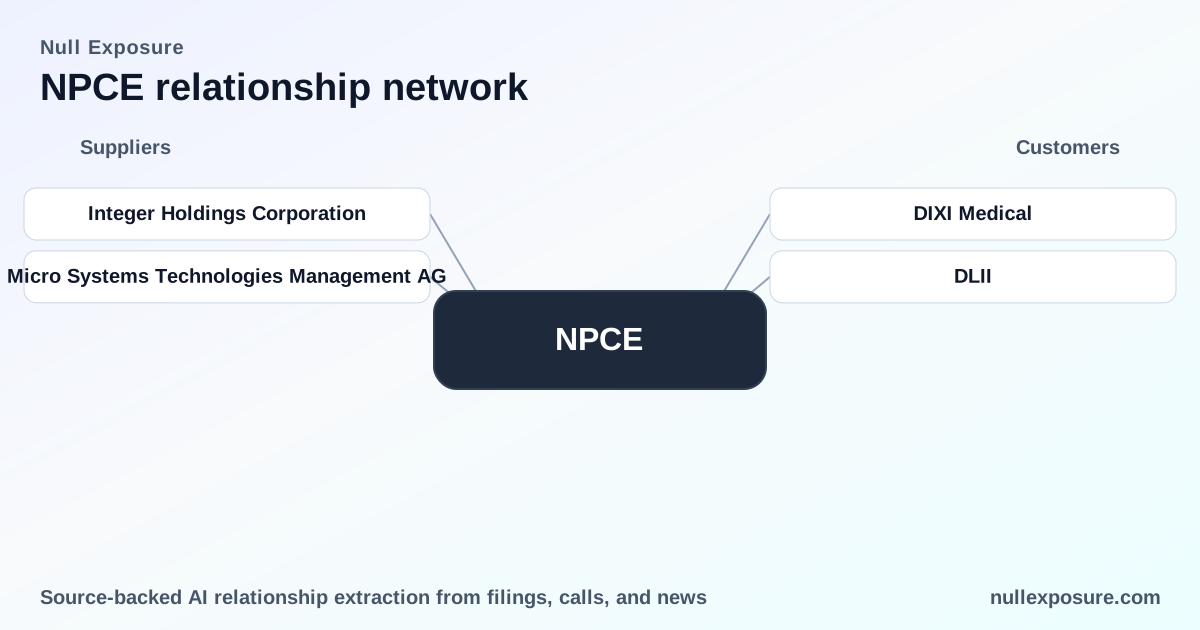
Integer Holdings Corporation (formerly Greatbatch Ltd)
NeuroPace’s FY2024 10‑K names Integer Holdings Corporation (formerly Greatbatch Ltd) as a single‑source supplier for several key components, including batteries used in NeuroPace products. According to the filing, Integer is a manufacturer of components that NeuroPace sources on a sole‑supplier basis, making the company operationally critical. (Source: NeuroPace Form 10‑K, FY2024)
Micro Systems Technologies Management AG
The same FY2024 10‑K lists Micro Systems Technologies Management AG as a single‑source supplier for key components such as printed circuit assemblies. The filing identifies Micro Systems alongside Integer as dedicated manufacturers whose components are essential to NeuroPace’s product build. (Source: NeuroPace Form 10‑K, FY2024)
Both entries are called out in the supplier section of the FY2024 10‑K and in the company’s risk disclosures; these are not incidental vendor mentions but explicit single‑source acknowledgements.
What that concentration means for investors and operators
Operational risk is concentrated and measurable. When a device manufacturer discloses single‑source relationships for fundamental components, investors should price in the probability and impact of supply interruption: lost device placements, deferred service revenue, and increased component costs. NeuroPace’s 2025 operating metrics (revenue of roughly $100M TTM and negative EPS) leave less room to absorb abrupt cost inflation or large order delays.
Supply dependency also affects strategic optionality. Qualifying alternate suppliers for implantable‑grade batteries and printed circuit assemblies is costly and time‑consuming given regulatory and validation requirements; that elevates the supplier’s effective switching costs and strengthens their negotiating position. For operators, this translates into prioritizing inventory buffers, vendor scorecards, and contractual protections.
For direct reference, NeuroPace’s public filing clarifies these stakes in its FY2024 risk narrative.
Explore supplier risk dashboards and deeper supplier mappings at https://nullexposure.com/
Practical implications and suggested investor actions
- Monitor procurement KPIs and lead times: track changes in lead time for batteries and PCAs, and treat sustained elongation as a near‑term revenue risk signal.
- Review supplier financial health: Integer Holdings is a public company; monitor its credit and capacity indicators; for Micro Systems, seek third‑party signals of manufacturing capacity and geographic risk.
- Demand contract transparency: For larger or strategic investors, request visibility into supplier agreements and inventory policy to assess how NeuroPace is hedging single‑source exposure.
- Stress test scenarios: Build revenue sensitivity analyses that assume partial production loss for defined periods and quantify capex or margin responses.
These actions align capital allocation with operational vulnerabilities and give operators levers to reduce disruption exposure.
Constraints and how they fit into the corporate picture
NeuroPace’s filings produce two clear constraint signals:
- At the company level, NeuroPace depends on a limited number of single‑source suppliers, a material risk the company identifies in its risk disclosures; this is a structural constraint on procurement flexibility and revenue resilience.
- The filing explicitly names Micro Systems Technologies Management AG and Integer Holdings (Greatbatch Ltd) as single‑source manufacturers of key components (printed circuit assemblies and batteries), making those relationships both critical and concentrated.
Treat these constraints as business model characteristics: they inform contracting posture, supplier negotiation dynamics, and the time horizon for remediation (dual‑sourcing and qualification). Investors should not view supplier concentration as a short‑term oddity but as a persistent operating lever that affects margin volatility and execution risk.
Final read: risk balanced with opportunity
NeuroPace’s supplier disclosures highlight an operational reality common in medical devices: high dependency on specialized vendors creates both fragility and predictability. When suppliers are reliable and financially sound, NeuroPace benefits from consistent supply of certified components; when disruptions occur, recovery timelines are long and costly. For investors focused on execution risk, supplier concentration is among the top three signals to monitor alongside clinical adoption and reimbursement dynamics.
For a deeper supplier risk report and ongoing monitoring, visit the NullExposure homepage: https://nullexposure.com/
Actionable takeaway: assign explicit scenario weights in your model for supplier disruption events and demand disclosure of mitigation steps from management; supplier concentration is not a peripheral footnote — it is an operational lever that moves cash flows.