NPK International (NPKI): Supplier relationships and what they mean for investors
NPK International operates as a provider of products, rentals, and field services to the oil & gas E&P sector and monetizes through equipment sales, long‑term rentals, and service contracts tied to drilling activity. Revenue sensitivity tracks rig count and E&P capex, while margins benefit from rental annuities and aftermarket parts, which make supplier continuity and legal/financial partner stability important to operating execution and strategic transactions.
If you evaluate supplier counterparty risk or strategic partner exposure for energy services names, start with the company profile and relationship map at https://nullexposure.com/ — it’s a straightforward way to move from high‑level thesis to actionable diligence.
What the uncovered relationships actually are (and why they matter)
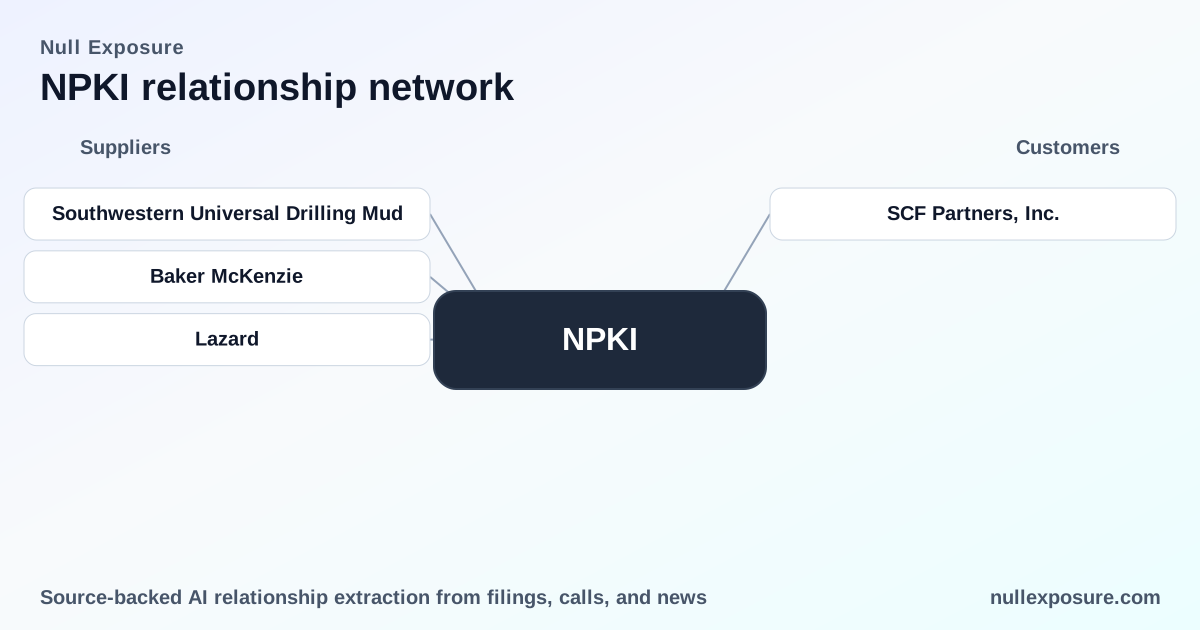
Below are every supplier- or advisor‑related relationship surfaced in the available records for NPKI. Each entry is a concise, plain-English summary with the primary source noted.
Southwestern Universal Drilling Mud
Southwestern Universal Drilling Mud was an independent mud services operator that sold its business to Newpark Resources in 1998 and subsequently operated under contract to Newpark; the reference highlights historical contracting and acquisition activity within Newpark’s supplier ecosystem that can inform legacy contractual practices in the sector. Source: Dignity Memorial obituary noting the 1998 sale and subsequent contract relationship (document referenced March 2026).
Baker McKenzie
Baker McKenzie served as legal advisor on the 2024 sale of Newpark’s Fluids Systems segment, demonstrating the use of top‑tier external law firms to support divestitures and complex supplier/segment transactions in this market. Source: MarketScreener coverage of the SCF Partners acquisition of Newpark’s Fluids Systems (FY2024).
Lazard
Lazard acted as Newpark’s exclusive financial advisor in the same FY2024 transaction, indicating engagement of large investment banks for valuation, process management, and deal execution in fluids‑and‑services divestitures. Source: MarketScreener coverage of the SCF Partners acquisition of Newpark’s Fluids Systems (FY2024).
How these relationships translate into operational signals
These three relationships collectively signal patterns that investors should treat as part of NPKI’s broader operating environment, not as direct contracts unless explicitly stated.
- Contracting posture and market practices: The Southwestern Universal note illustrates that drilling services and mud providers have historically transitioned from owner/operator models to contractor models under larger services platforms. That history reflects standard industry behavior where independent operators are absorbed and then retained under contract by larger suppliers.
- Strategic M&A and advisory reliance: Engagements of Lazard and Baker McKenzie on a FY2024 sale of a peer segment indicate that parties in this sector leverage major legal and financial advisors for portfolio reshaping and spin/sale processes. That increases the probability of rigorous sell‑side processes when assets are marketed and raises the bar on price discovery and buyer due diligence.
- Concentration and criticality: None of the disclosed items identify NPKI as a single‑sourced dependent buyer or seller. The available evidence does not show supplier concentration that would create a single point of failure for operations.
A deeper, company‑level constraint is also relevant: NPKI reports that resins, chemicals, and other raw materials used to manufacture recyclable composite mats are widely available, not dependent on any single supplier, and adequate for current needs, which signals low supply concentration for those inputs and reduces near‑term procurement risk (company disclosure excerpt).
If you want a consolidated view of these partner signals and where they place NPKI relative to peers, review the supplier mapping and diligence tools at https://nullexposure.com/ — they make cross‑company comparisons efficient.
What investors should read into this — operational and financial implications
These relationship signals imply the following for owners and analysts:
- Low supplier concentration for certain materials reduces the probability of abrupt production stops for composite mat components, supporting stable gross margins for that product line.
- Use of top‑tier advisors in sector M&A means any future asset sales or carve‑outs by NPKI or its peers will follow sophisticated processes that typically compress time‑to‑close but increase competitive bidding — a positive for valuations.
- Legacy contracting behaviors (independent operator → sale → contract with acquirer) are common and suggest that workforce and vendor integration risks are manageable if acquisitions occur; however, integration execution remains an operational discipline that drives post‑transaction performance.
Consider these signals together with the company’s financials: Market capitalization is roughly $1.16bn with TTM revenue of $277m, operating margin around 16.7%, and EV/EBITDA about 16.1, which positions NPKI as a mid‑sized services vendor trading at premium multiples relative to cyclicality. Those valuation metrics mean operational stability and supplier continuity are material to upside.
Risk checklist for supplier and advisor exposure
- Legal and transaction risk: Engagement of major law firms implies robust deal protections when assets move; investors should expect contractual complexity on warranties and indemnities that can influence post‑close liability profiles.
- Input availability versus pricing: Even with a claim of wide availability for key materials, commodity price swings and logistics can still press margins; monitor raw material cost trajectories and freight dynamics.
- Concentration elsewhere: The disclosed relationships do not show single‑supplier dependence, but investors should verify vendor roll‑for‑roll existences in field services where specialized equipment or chemicals can create pockets of dependency.
If you want a structured supplier risk scorecard tied to NPKI’s public disclosures and transaction history, use the tools at https://nullexposure.com/ for a quick, investor‑grade briefing.
Final read: where this matters for strategy and valuation
For investors and operators, the takeaways are straightforward: NPKI operates in a sector where contractor models, frequent asset reshaping, and professional advisory engagement are the norm, and the company’s disclosure on raw material availability is a net positive for short‑to‑medium term execution. Given the company’s valuation and margins, sustained operational stability and predictable supplier relationships are necessary to justify multiple expansion.
For targeted diligence, combine the relationship notes above with counterparty confirmations and contract term reviews to move from signal to certainty. For a concise supplier‑and‑advisor briefing tailored to investor due diligence, visit https://nullexposure.com/ and access the NPKI supplier dossier.